 US – English
 UK – English
 Canada – English
 Australia – English
 Danmark – Dansk
 DACH - Deutsch
 France – Français
 España – Español
 Sverige – Svenska
 Italia – Italiano
 Nederland – Nederlands
 Portugal – Português
 Suomi – Suomi
 Norge – Norsk
 日本 – 日本語
 Romanian – Română












Financial liabilities are obligations that require one party to pay money, deliver assets, or provide services to another party at a future date. In accounting, they represent amounts a business or individual owes to creditors, lenders, or suppliers.
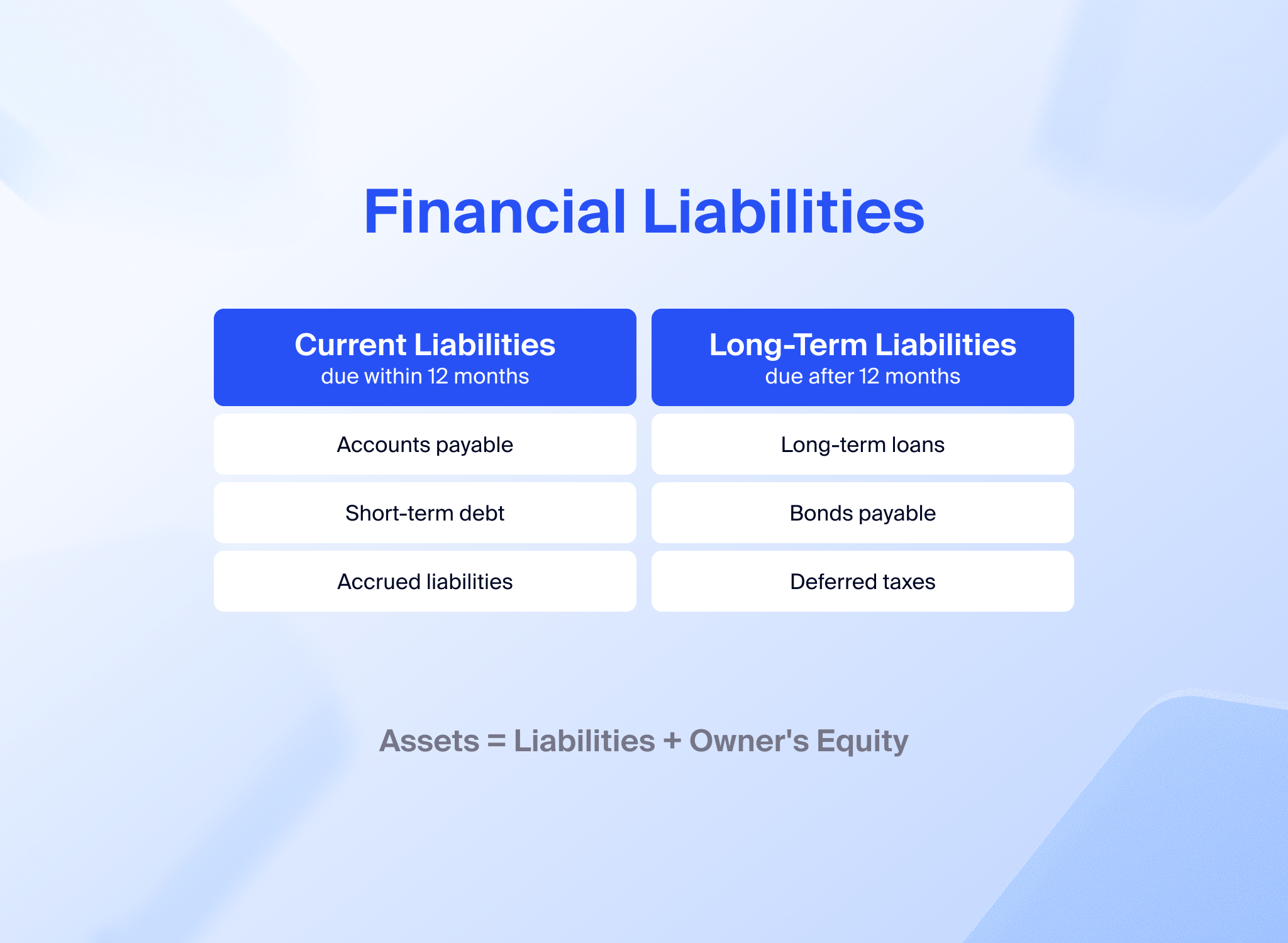
Under Generally Accepted Accounting Principles (GAAP), financial liabilities are recorded on the balance sheet and classified as either current or noncurrent, depending on when payment is due.
The most common types of financial liabilities include:
- Accounts payable, which are amounts owed to suppliers for goods or services received on credit
- Loans and borrowings, such as bank loans taken out to fund operations or expansion
- Deferred revenue, which is payment received before the corresponding goods or services have been delivered
- Bonds payable, which are long-term debt instruments issued to raise capital
- Accrued liabilities, such as wages or taxes that have been incurred but not yet paid
- Financial derivatives, including options and forwards that create an obligation based on an underlying asset or index
Financial liabilities vs. assets
Assets and liabilities both appear on the balance sheet, but they are not the same. Assets are resources the business owns, such as cash, equipment, or receivables. Liabilities are amounts the business owes. The relationship between them follows the accounting equation:
Assets = Liabilities + Owner’s Equity
Financial liabilities vs. expenses
A liability is an obligation not yet paid. An expense is a cost already settled. Expenses appear on the income statement and reduce net income. Liabilities appear on the balance sheet and remain recorded until the obligation is paid.
Frequently asked questions
Are financial liabilities always bad for a business?
Not necessarily. Most businesses carry some level of financial liability as a normal part of operations. Borrowing to purchase inventory or expand capacity can support growth. The concern arises when liabilities grow faster than revenue or when the business lacks sufficient current assets to meet short-term obligations.
What is the difference between current and noncurrent liabilities?
Current liabilities are due within the next 12 months, such as accounts payable or short-term loans. Noncurrent liabilities have longer repayment timelines, such as long-term mortgages or bonds payable. Both categories are reported separately on the balance sheet.
How do lenders use financial liability information?
Lenders and investors review a company’s liabilities alongside its assets and revenue to assess financial health. A common measure is the current ratio, which compares current assets to current liabilities. A ratio of at least 1:1 indicates the business can cover its short-term