 US – English
 UK – English
 Canada – English
 Australia – English
 Danmark – Dansk
 DACH - Deutsch
 France – Français
 España – Español
 Sverige – Svenska
 Italia – Italiano
 Nederland – Nederlands
 Portugal – Português
 Suomi – Suomi
 Norge – Norsk
 日本 – 日本語
 Romanian – Română












When should you fire your accountant? (And how to do it right)
Run your entire firm on one platform

Key takeaways:
- Firing your accountant is a normal, routine business decision. You don’t owe them an explanation or a dramatic conversation.
- Recurring errors, missed deadlines, poor communication, and a fee that doesn’t match the value you’re getting are all valid reasons to switch.
- Dishonesty or unethical conduct is different. That calls for leaving right away, not a conversation first.
- Line up your next accountant before you give notice. It’s one of the most consistent pieces of advice across the profession.
- Even if your outgoing accountant is slow to hand over records, a new accountant can often pull prior-year data straight from the IRS’s own wage and income transcripts.
- When you’re ready to look for your next accountant, TaxDome’s Accountant and Advisor Finder lets you browse vetted professionals by specialty and location.
If you’ve started dreading calls with your accountant, or you’re quietly searching for someone new, you’re not alone. Switching accountants is one of the more common moves small business owners make, and waiting too long to do it carries its own risk.
A pattern of missed deadlines, mediocre advice, or unreturned messages can quietly cost you through penalties, missed deductions, and decisions made on incomplete information.
In this guide, we’ll walk through when it makes sense to fire your accountant, how to tell if the relationship is actually salvageable, and the exact steps to take so the switch goes smoothly instead of leaving you stranded mid-filing.
Table of сontents
- Is it normal to fire your accountant?
- What are the top reasons a company fires its accountant?
- Signs it’s time to fire your accountant
- Before you fire them: is the problem fixable?
- How to fire your accountant: step by step
- Sample termination letter
- What to do if your accountant makes it difficult
- Finding the right replacement
- FAQs
- To sum up
Table of сontents
- Is it normal to fire your accountant?
- What are the top reasons a company fires its accountant?
- Signs it’s time to fire your accountant
- Before you fire them: is the problem fixable?
- How to fire your accountant: step by step
- Sample termination letter
- What to do if your accountant makes it difficult
- Finding the right replacement
- FAQs
- To sum up
Is it normal to fire your accountant?
Yes. Switching accountants is a routine business decision, not a personal conflict. You’re free to end the relationship whenever it stops working for you, and you don’t need to justify the decision to your accountant.
It helps to think of it the same way you’d think about ending any vendor relationship that isn’t delivering. You wouldn’t feel obligated to keep a software subscription that no longer fit your needs, and the same logic applies here.
Accountants themselves expect this to happen periodically. Most firms have an offboarding process precisely because clients leave, whether that’s due to fit, cost, growth, or simply changing needs.
What are the top reasons a company fires its accountant?
We ask this question in the TaxDome Niche Accounting Business Report, and the answers are telling.
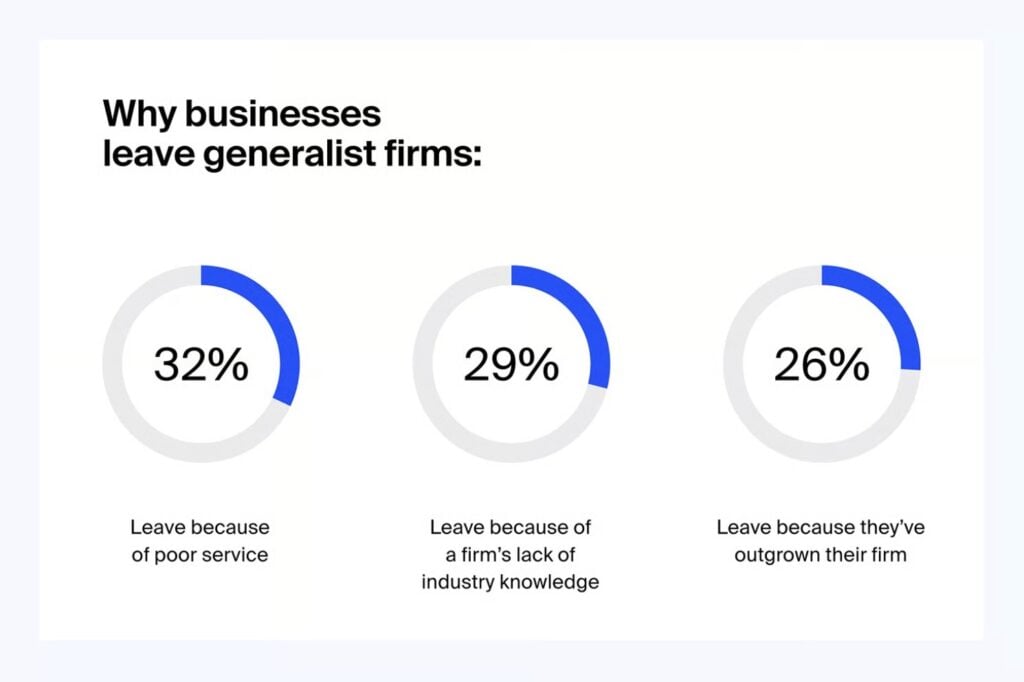
- 32% leave because of poor service
- 29% leave because of a firm’s lack of industry knowledge
- 26% leave because they’ve outgrown their firm
While poor service tops the reasons for switching accounting firms, it’s not the only reason a business decides it’s time to make a change. In fact, 50% of businesses that leave generalists move to accounting firms with proven expertise in their field. Sooner or later, a growing company needs more than its current accountant can provide, and this is a perfectly legitimate reason to end the relationship.
Signs it’s time to fire your accountant
A single frustrating month doesn’t necessarily mean it’s time to go. But if you’re seeing a pattern across any of these categories, that’s worth taking seriously.
Competence and accuracy issues
- Recurring errors in tax filings or financial statements
- Missed deadlines, especially when they cause penalties or interest
- Advice that turns out to be outdated, generic, or wrong when checked against a second opinion
- You’re learning about deductions or strategies from other sources that your accountant should have raised first
Communication and responsiveness issues
- Calls or emails go unanswered for days
- You have to chase them repeatedly for basic documents or answers
- No proactive communication. You only hear from them when they need something, never with ideas or check-ins
- They can’t explain things in terms you understand, or make you feel talked down to
Value and fit issues
- You don’t have a clear sense of what you’re getting for what you’re paying, and every invoice makes you a little anxious
- They don’t understand your industry or business size
- The relationship has outgrown a one-person shop with no backup coverage if your accountant is sick, on leave, or retires. That’s a real continuity risk worth naming explicitly
If cost is a recurring source of friction, it’s worth understanding what a fair benchmark looks like before you decide whether you’re overpaying. Our guide to what an accountant actually costs breaks down typical fee ranges by service type and business size.
Trust and ethics issues
This category is different from the others. It’s non-negotiable.
- Dishonesty, misrepresented credentials, or unethical or illegal conduct
Any of these warrant immediate action rather than working through the relationship. That’s a distinct standard from the “give feedback first” approach below, which applies to everything else on this list.
Dishonest or fraudulent behavior from a financial professional isn’t hypothetical. Our roundup of real accounting fraud examples shows how these situations tend to unfold, and why they’re worth taking seriously the moment you spot one.
Before you fire them: is the problem fixable?
Not every frustration means it’s time to go. For most non-ethics issues, whether that’s one bad mistake, a rough busy season, or a communication gap, it’s worth raising the issue directly before ending the relationship. A single error doesn’t necessarily indicate a pattern.
Ask yourself a few questions first:
- Is this a pattern, or a one-time mistake?
- Have you been communicating proactively yourself? This is a two-way relationship.
- Have you given direct, specific feedback and seen no change?
If the honest answer is “this has happened before” or “I’ve already raised it and nothing changed,” that’s your signal to move forward.
How to fire your accountant: step by step
Once you’ve decided to make the switch, the order you do things in matters more than the wording you use.
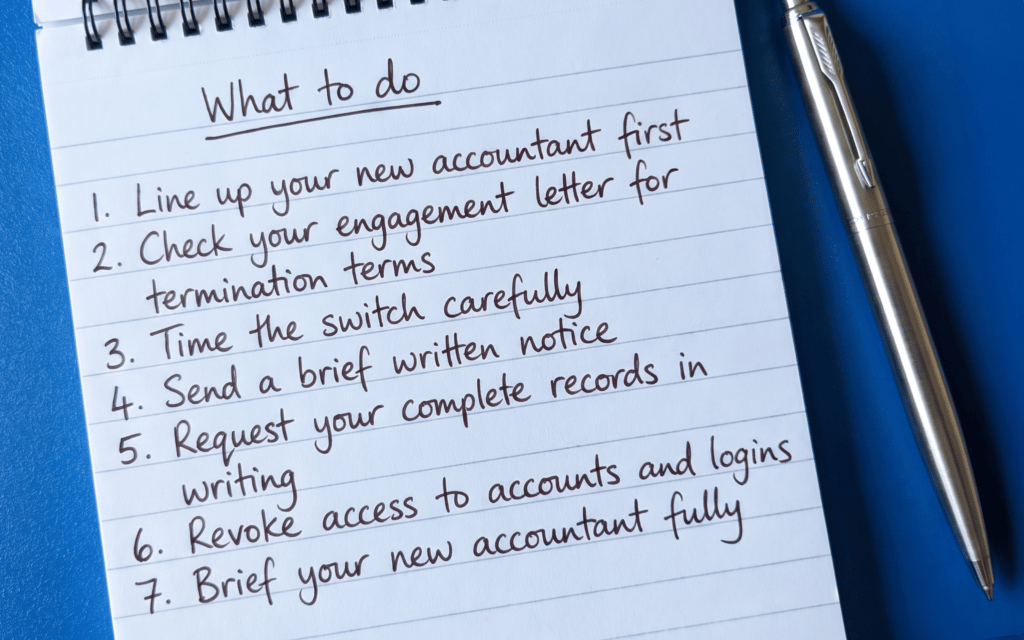
- Line up your replacement first. Never end the relationship before you have a new accountant ready to receive your records and pick up where things left off. This is one of the most consistent pieces of advice across expert sources, and it’s the non-negotiable first step.
- Check your engagement letter or contract. Look for termination terms, notice periods, or final-invoice obligations.
- Time it carefully. Avoid switching mid-audit or right before a major filing deadline if you can help it. If a switch happens mid-year, map out what’s pending, like quarterly estimated payments or in-progress filings, so nothing falls through the cracks.
- Send a brief, professional written notice. You don’t owe a lengthy explanation. A short, clear email or letter stating the effective date and requesting your records is sufficient and professional.
- Request your complete records in writing, including prior-year returns, financial statements, and workpapers. The duty to hand these over isn’t just professional courtesy. It’s governed by professional standards, state board of accountancy rules, and federal regulations, so if records are withheld unreasonably, checking with the relevant state board of accountancy is a real option.
- Revoke access to financial accounts, software logins, and any systems your outgoing accountant had access to, as soon as the relationship ends.
- Brief your new accountant fully so they can flag any issues left behind and reconstruct missing data if needed. If records are incomplete, new accountants can often pull prior-year income data straight from the IRS’s own transcripts.
On the records point specifically: the obligation to return client records is governed by professional standards, state board of accountancy regulations, and federal law, not just professional courtesy, so an accountant who drags their feet is actually out of step with their own field’s expectations.
And on the transcript point: the IRS’s own wage and income transcript pulls data straight from the W-2s, 1099s, and 1098s that were filed on your behalf, which is often enough for a new accountant to reconstruct what’s missing.
Sample termination letter
A short, adaptable template can save you the stress of figuring out what to say in the moment.
Hi [Name], I’m writing to let you know that I’ll be transitioning to a new accountant effective [date].
Please consider this formal notice of termination of our engagement.
I’d appreciate receiving copies of my complete financial records, prior-year returns, and supporting workpapers at your earliest convenience.
Thank you for your assistance over the past [time period].
What to do if your accountant makes it difficult
Most accountants hand over records without friction. If yours doesn’t, you still have options.
- Know your rights. Most states require timely return of client records.
- Escalate to the state board of accountancy if records are withheld unreasonably.
- Remember that new accountants can often reconstruct prior-year data from IRS transcripts if needed. Missing records aren’t the dealbreaker they might feel like in the moment.
Finding the right replacement
The accountant you hire next matters just as much as how you leave the last one. A few things to keep in mind:
- Don’t repeat the same hiring mistake. Look for someone with experience at your business size and industry, not just whoever is convenient or already does your personal taxes. That mismatch is a commonly cited root cause of bad-fit accountant relationships.
- Avoid a single-person shop with no backup coverage if continuity matters to you, unless it’s a deliberate trade-off you’re comfortable with.
- Ask new candidates how they’d handle the same situation that pushed you to switch.
It also helps to know exactly what you’re hiring for. Our guide to CPA vs. accountant breaks down the practical differences, including which one can represent you in front of the IRS.
FAQs
When should you fire your accountant?
When there’s a pattern, not a one-off, of missed deadlines, recurring errors, poor communication, or a fee that no longer matches the value you’re getting. Any sign of dishonesty or unethical conduct warrants leaving immediately, without a conversation first.
How do you fire your accountant?
Line up a new accountant first, check your engagement letter for termination terms, then send a brief written notice requesting your complete records. You don’t need to explain your reasons in detail.
Can you fire your accountant at any time?
Yes. As the client, you can end the relationship whenever you choose, without giving advance notice or a justification, though checking your engagement letter first can help you avoid any contractual surprises.
What do you say when firing your accountant?
A short, professional written notice is enough. State the effective date, request your records, and thank them for their work. You don’t owe a lengthy explanation.
Will my accountant give me my records back?
In most cases, yes. Returning client records is governed by professional standards and state board of accountancy rules, not just courtesy. If an accountant withholds records unreasonably, you can escalate to your state’s board of accountancy.
Is it bad to switch accountants mid-year?
It’s not ideal, but it’s manageable. Avoid switching mid-audit or right before a major deadline if you can help it, and make sure your new accountant knows exactly what’s pending, like estimated payments or in-progress filings.
Where can I find a new accountant?
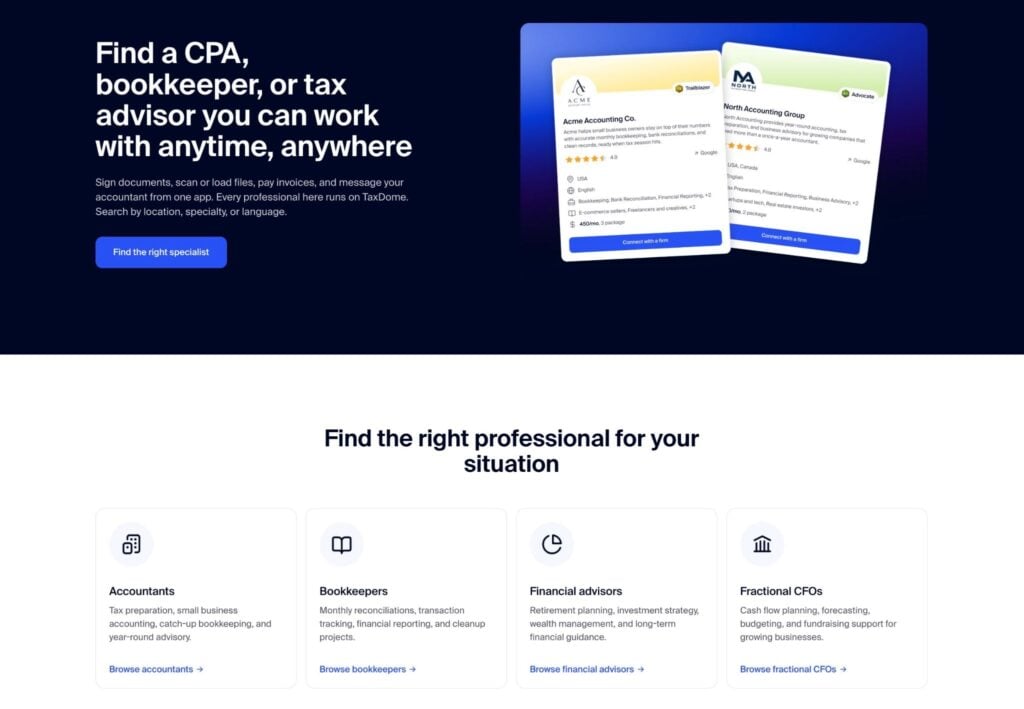
TaxDome’s Accountant and Advisor Finder lets you browse vetted accountants, bookkeepers, and CPAs by specialty and location, so you can line up your replacement before you give notice to your current one.
To sum up
A consistent pattern of problems, not a single bad moment, is the real signal that it’s time to move on. Missed deadlines, poor communication, or a fee that doesn’t match the value are all worth raising directly first, unless dishonesty or unethical conduct is involved, in which case the decision is immediate.
Done in the right order, switching accountants is a low-risk move. Line up your replacement first, put your notice in writing, and get your records secured before you revoke access.
If you’re ready to start that search, TaxDome’s Accountant and Advisor Finder connects you with vetted professionals rated 4.7 out of 5 across more than 700 reviews, so you can find someone who fits your business before you need them.

Jeff writes for TaxDome with experience in accounting, finance, and invoicing industries. He focuses on educating users about accounting trends and maximizing productivity through practical guidance on TaxDome’s features.
Get your free guide

Thank you!
The guide copy has been sent to your email. Please check your inbox!
Recommended articles

Top AI tools for accountants in 2026: key features and use cases compared

Why accountants are quitting: inside the forces reshaping the profession

How to start a virtual bookkeeping business from scratch