 US – English
 UK – English
 Canada – English
 Australia – English
 Danmark – Dansk
 DACH - Deutsch
 France – Français
 España – Español
 Sverige – Svenska
 Italia – Italiano
 Nederland – Nederlands
 Portugal – Português
 Suomi – Suomi
 Norge – Norsk
 日本 – 日本語
 Romanian – Română











When does a small business need a fractional CFO? Cost, duties, and how to hire one
Run your entire firm on one platform

Key takeaways:
- Most small businesses don’t need a CFO until specific triggers hit: unpredictable cash flow, unclear margins, or a lender asking for forecasts you can’t produce.
- A fractional CFO typically costs $3,000 to $10,000 a month, a fraction of a full-time CFO’s base salary, which starts around $195,500 (Robert Half, 2026 Salary Guide; monthly retainer range per NerdWallet).
- Businesses under roughly $1 million in revenue usually aren’t ready for a CFO yet, a threshold echoed across multiple fractional CFO providers though not confirmed by one independent study (see the cost section below for that caveat). Clean bookkeeping plus a good CPA covers most of what they need at that stage.
- The right fractional CFO fits your revenue stage and industry. A vetted directory like the TaxDome Accountant and Advisor Finder makes that search easier than starting from a cold search.
Most small businesses will never need a $250,000-a-year full-time CFO. But plenty of them outgrow what a bookkeeper or a part-time accountant can offer long before they’re anywhere close to that kind of hire.
That gap, between accurate books and a confident financial strategy, is where a fractional CFO fits in.
In our work with thousands of accounting firms and the business owners who hire them, we see this exact gap show up again and again. A business has solid revenue and organized records, but no one is translating that data into decisions about pricing, hiring, or cash. A fractional CFO fills that gap part-time, at a fraction of the cost of a full-time executive.
This guide covers what a fractional CFO actually does, the signs your business has outgrown its current setup, what the role costs, and how to hire the right one.
Table of сontents
- What is a fractional CFO?
- What does a CFO do in a small business? Role and responsibilities
- Signs your small business needs a fractional CFO
- Fractional CFO vs. full-time CFO vs. part-time CFO
- How much does a fractional CFO cost?
- CFO firm vs. independent fractional CFO
- What to look for when hiring a fractional CFO: requirements and vetting
- How to find and hire the right fractional CFO for your business
- FAQs
- The bottom line
Table of сontents
- What is a fractional CFO?
- What does a CFO do in a small business? Role and responsibilities
- Signs your small business needs a fractional CFO
- Fractional CFO vs. full-time CFO vs. part-time CFO
- How much does a fractional CFO cost?
- CFO firm vs. independent fractional CFO
- What to look for when hiring a fractional CFO: requirements and vetting
- How to find and hire the right fractional CFO for your business
- FAQs
- The bottom line
What is a fractional CFO?
A fractional CFO is a senior finance executive who works part-time or on contract, typically splitting their time across a handful of businesses rather than working full-time for just one.
The most common point of confusion is telling a fractional CFO apart from a bookkeeper or a controller. A bookkeeper records transactions as they happen. A controller manages the accounting function day to day and makes sure the books close accurately and on time.
A fractional CFO uses those numbers to look forward instead of back: building forecasts, modeling decisions, and guiding strategy. For a closer look at how that role compares to in-house finance staff, see our breakdown of CFO vs. controller roles.
| Role | Time orientation | Core focus | Typical cost |
| Bookkeeper | Past | Recording transactions, reconciling accounts | Lowest, hourly or flat monthly fee |
| Controller | Past to present | Overseeing the books, ensuring accurate, timely closes | Moderate, typically salaried or retainer |
| Fractional CFO | Future | Forecasting, strategy, fundraising and lender readiness | Moderate, hourly or monthly retainer (see below) |
| Full-time CFO | Future | All of the above, plus full-time company leadership | Highest: $195,500–$321,750+ base salary |
The full-time CFO comparison above is based on Robert Half’s 2026 Salary Guide, and covers base pay only, before bonus, equity, or benefits.
If you haven’t hired a bookkeeper yet, start with our guide to hiring the ideal bookkeeper for your small business before considering a CFO-level hire.
What does a CFO do in a small business? Role and responsibilities
The role of a CFO in a small business centers on where the money is going next, not just where it’s been. A fractional CFO’s day-to-day work typically covers:
- Cash flow forecasting and management
- Financial planning and budgeting, including rolling forecasts
- Pricing and margin analysis by product, job, service line, or customer
- Profitability analysis and KPI or dashboard reporting
- Fundraising, loan, and lender readiness, including clean financials and forecasts for banks or investors
- Hiring and headcount modeling, weighing the cost of a new hire against the revenue needed to break even
- Scenario planning and strategic decision support for expansion, hiring, investment, or holding cash
- M&A or exit preparation, when relevant to the business’s stage
What a fractional CFO does not do is day-to-day bookkeeping or accounts payable and receivable data entry. That’s a bookkeeper or controller function, and it’s the single distinction that resolves most of the confusion business owners have about which role they actually need.
For a deeper dive into how this role fits alongside outsourced accounting more broadly, see our guide to accounting advisory services.
Signs your small business needs a fractional CFO
A few recurring situations tend to push business owners toward hiring a fractional CFO:
- You’re profitable on paper but consistently surprised by cash shortfalls.
- You don’t know your real margins by product, job, or client.
- You’re making hiring or expansion decisions without modeling the financial impact.
- A bank, investor, or buyer has asked for forecasts or reports you can’t produce.
- Your bookkeeping is accurate, but nobody is using it to make decisions.
- You’ve outgrown your accountant’s quarterly check-ins.
- You’re preparing to raise capital, take out a loan, or sell the business.
Any one of these can be reason enough. Several showing up at once usually means the business has already outgrown what a bookkeeper or accountant alone can offer.
There’s an important exception, though: businesses under roughly $1 million in revenue, or those without clean books yet, usually aren’t ready for a CFO. Clean bookkeeping plus a good CPA covers most of what they need at that stage. If that describes your business, our guide on when to hire an accountant is the better starting point.
Fractional CFO vs. full-time CFO vs. part-time CFO
Searchers use “part time CFO,” “fractional CFO,” and “small company CFO” somewhat interchangeably, but the terms describe slightly different setups:
- Fractional: ongoing but limited hours per month, often across multiple clients, usually through a firm or an independent contractor.
- Part-time or in-house: dedicated to one company, just on reduced hours, rather than split across several clients.
- Full-time: dedicated to a single company, with a base salary that starts around $195,500 and can reach $321,750 or more for the most experienced candidates, plus benefits and equity.
That full-time figure comes from Robert Half’s 2026 Salary Guide. For a closer look at how that scales by company size, see our guide to CFO salaries.
How much does a fractional CFO cost?
The direct answer: independent data puts most fractional CFO retainers between $3,000 and $10,000 a month, though the exact number depends heavily on your revenue stage and how much support you need.
Fractional CFO pricing generally breaks down by business stage:
| Business stage | Typical monthly cost | Notes |
| Under $1M revenue | $1,500–$3,000/month | Often not needed yet; light support only |
| $1M–$5M revenue | $2,500–$5,000/month | Typically 8–15 hours/month |
| $5M–$15M revenue | $7,000–$12,000/month | More hours, deeper scope |
| Hourly alternative | $150–$450/hour | Varies by experience and specialization |
Independent reporting from NerdWallet, which doesn’t sell fractional CFO services itself, puts monthly retainers at $3,000 to $10,000, hourly billing at $150 to $500, and project-based work at $10,000 to $50,000 or more.
Within that range, cost typically scales with revenue. The table above reflects tiers commonly reported across fractional CFO providers, though no single independent study breaks the market down with this level of granularity, so treat the exact boundaries as directional rather than precisely verified.
A separate, job-posting-based benchmark from Go Fractional puts the average fractional CFO hourly rate at $189, generally consistent with NerdWallet’s range.
A few things drive price up or down: the scope of work, the CFO’s seniority and background, industry complexity, a multi-entity or multi-state structure, and whether your books are already clean. Messy books mean more cleanup time, which means a higher cost.
Compare that to a full-time CFO, whose base salary alone starts around $195,500 and can reach $321,750 before bonus, equity, and benefits, and the value case for going fractional becomes clear.
CFO firm vs. independent fractional CFO
Once you’ve decided to hire a fractional CFO, you’re really choosing between 2 types of small business CFO services: a CFO firm or an independent contractor.
A firm offers bench depth, backup coverage if your CFO is unavailable, and often bundles in bookkeeping or controller support alongside the CFO work.
An independent fractional CFO may offer a lower cost and a more direct relationship, but with less redundancy if they’re out or overloaded with other clients.
What to look for when hiring a fractional CFO: requirements and vetting
A handful of criteria separate a fractional CFO who becomes a genuine strategic partner from one who never quite gets there:
- Relevant industry experience: a generalist CFO can miss risks that are specific to your industry.
- A track record with businesses at your revenue stage. What works at $2 million doesn’t always work at $8 million.
- Clear scope and deliverables in the engagement, not just “hours available.”
- A communication cadence and set of tools you’re comfortable with for receiving reports and forecasts.
- References from clients of a similar size to yours.
Industry fit matters more than it might seem. In surveying more than 350 business decision-makers for our own Niche Business Accounting Report, we found that companies earning over $1 million a year are twice as likely to hire a niche specialist over a generalist, and report being willing to pay up to 25% more for that fit. The same logic applies directly to a fractional CFO search: someone who already understands your industry’s margins and cash cycles will get up to speed faster and catch problems a generalist would miss.
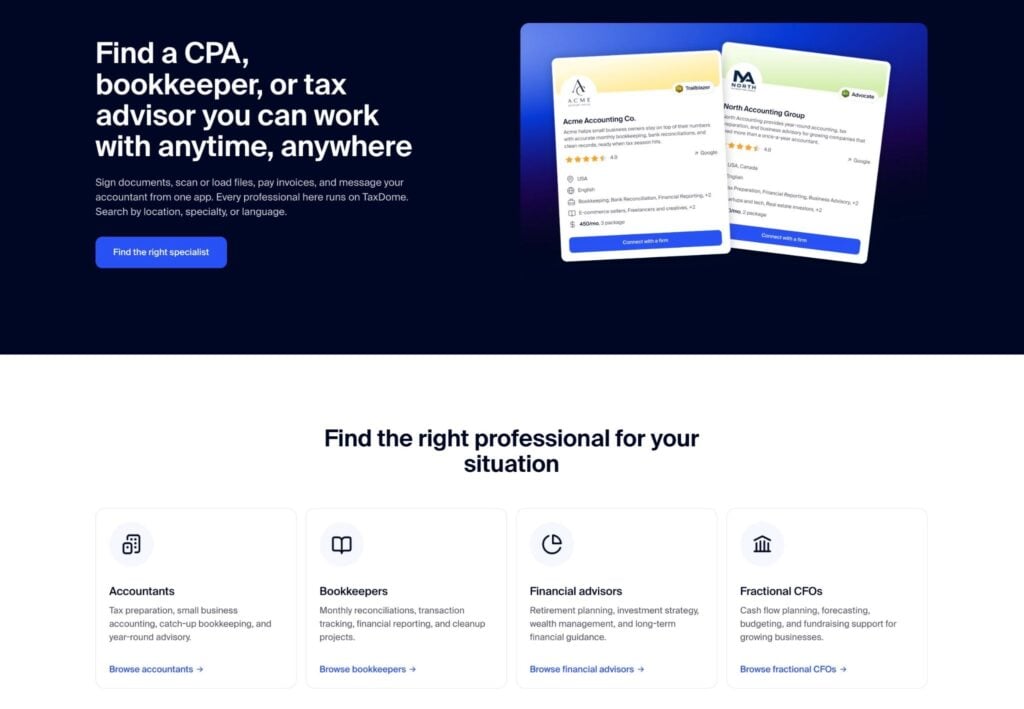
This is also a natural, low-pressure point to start browsing options rather than cold-searching. The TaxDome Accountant and Advisor Finder lets you compare vetted fractional CFOs, along with bookkeepers and accountants, who operate through a shared, secure client platform.
How to find and hire the right fractional CFO for your business
- Define your need first. Whether you’re comparing CFO services for small business or vetting individual candidates, get specific about whether you need forecasting, fundraising prep, or margin clarity before you start talking to anyone.
- Decide retainer vs. hourly vs. project pricing, based on how ongoing your need actually is.
- Get scope and pricing in writing before the engagement starts.
FAQs
What does a CFO do in a small business?
A small business CFO forecasts cash flow, builds budgets and rolling forecasts, analyzes pricing and margins, and prepares financials for lenders or investors. They don’t handle day-to-day bookkeeping or AP/AR data entry.
How much does a fractional CFO cost?
Most small business engagements fall between $2,500 and $12,000 a month depending on revenue stage. Independent reporting from NerdWallet puts the core monthly retainer range at $3,000 to $10,000, or $150 to $500 an hour if billed hourly.
What’s the difference between a bookkeeper, controller, and CFO?
A bookkeeper records transactions. A controller oversees the books and ensures accurate closes. A CFO uses that data to forecast, strategize, and guide decisions. Most growing businesses eventually need more than one of these roles working together.
What size business needs a fractional CFO?
Businesses generally start considering a fractional CFO once they clear roughly $1 million in revenue and have clean books. Below that, a good CPA and solid bookkeeping usually cover the need.
Is a fractional CFO worth it for a small business?
For businesses that have outgrown basic bookkeeping, yes. A fractional CFO costs a fraction of a full-time hire’s $195,500+ base salary while still providing the forecasting and strategic guidance a growing business needs to make bigger decisions with confidence.
The bottom line
Most small businesses don’t need a CFO until specific financial complexity hits: unpredictable cash, unclear margins, or a lender asking for numbers you can’t produce. When that moment arrives, a fractional CFO is the right-sized answer, delivering senior financial judgment without the cost of a full-time executive.
TaxDome’s own client directory carries an average rating of 4.7 out of 5 stars across more than 6,200 reviews on Capterra, G2, and GetApp, and it’s the kind of vetted, secure platform worth starting your search on.

Jeff writes for TaxDome with experience in accounting, finance, and invoicing industries. He focuses on educating users about accounting trends and maximizing productivity through practical guidance on TaxDome’s features.
Get your free guide

Thank you!
The guide copy has been sent to your email. Please check your inbox!
Recommended articles

Top AI tools for accountants in 2026: key features and use cases compared

Why accountants are quitting: inside the forces reshaping the profession
How to start a virtual bookkeeping business from scratch