 US – English
 UK – English
 Canada – English
 Australia – English
 Danmark – Dansk
 DACH - Deutsch
 France – Français
 España – Español
 Sverige – Svenska
 Italia – Italiano
 Nederland – Nederlands
 Portugal – Português
 Suomi – Suomi
 Norge – Norsk
 日本 – 日本語
 Romanian – Română












When to Hire an Accountant: Clear Signs It Is Time to Outsource Your Finances
Run your entire firm on one platform
Key takeaways:
- Startup setup: consult an accountant early to choose the right tax structure, such as an LLC or S corporation.
- Opportunity cost: if DIY accounting is eating hours you could spend on revenue-generating work, it’s time to outsource.
- Growth triggers: hiring employees, selling into multiple states, and raising capital all call for professional oversight.
- Finding the right fit: use a modern accountant directory to find tech-forward, organized firms instead of guessing from a search engine.
Every business owner, freelancer, and entrepreneur eventually asks the same question: do keep doing the books alone, or hire an accountant? Deciding when to hire an accountant usually comes down to a simple trade-off: the time that DIY accounting takes away from you vs the cost of hiring a professional.
Ultimately, hiring an accountant is an investment in growth that any successful business makes sooner or later. In fact, TaxDome’s 2025 Niche Business Accounting Report found that 85% of business owners agree that saving money through tax strategies justifies paying higher accounting fees. Below are seven clear signs it’s time to stop doing your own books and bring in an accounting expert.
Table of сontents
- You’re starting a business or changing entity structures
- DIY bookkeeping is costing you valuable time
- Your revenue is growing rapidly and becoming complex
- You’re hiring employees or expanding payroll
- You’re preparing to apply for a bank loan or raise capital
- You received an IRS notice or are facing an audit
- Accountant vs. bookkeeper: which do you need right now?
- FAQs
Table of сontents
- You’re starting a business or changing entity structures
- DIY bookkeeping is costing you valuable time
- Your revenue is growing rapidly and becoming complex
- You’re hiring employees or expanding payroll
- You’re preparing to apply for a bank loan or raise capital
- You received an IRS notice or are facing an audit
- Accountant vs. bookkeeper: which do you need right now?
- FAQs
1. You’re starting a business or changing entity structures
Getting professional advice before you launch, or before you move from a sole proprietorship to an LLC or S corporation, is one of the highest-leverage moments in a company’s life. Hiring a professional accountant at this stage affects how much self-employment tax you pay, how you’re allowed to take money out of the business, and how clean your books look to a lender or investor.
An accountant sets up your chart of accounts correctly from day one, which prevents the kind of structural tax mistakes that are expensive and slow to unwind once they’re baked into a few years of filings.
If an S corporation election makes sense for your situation, your accountant can also walk you through electing S corporation status with the IRS, including the timing rules that determine which tax year the election applies to.
2. DIY bookkeeping is costing you valuable time
Every hour spent reconciling bank feeds, chasing down receipts, or wrestling with tax software is an hour not spent selling, building, or serving customers. That trade-off is the core of the opportunity cost case for bringing in an accountant, and it adds up faster than most owners expect.
The National Small Business Association’s 2025 Small Business Taxation Survey found that most small business owners spend 20+ hours a year on federal tax compliance alone, even when a tax professional handles the filing.
Add routine bookkeeping, payroll, and monthly reconciliations on top of that, and the time cost of staying DIY starts to rival, or exceed, what a bookkeeper or accountant would actually charge. See TaxDome’s guide on how much an accountant costs for a full breakdown of typical fees by service type.
And, if you want to find the perfect bookkeeper to handle this workload for you, the TaxDome Accountant and Bookkeeper Finder is here to help. Find reputable bookkeepers with the skills you need, in the price range that works for you.
3. Your revenue is growing rapidly and becoming complex
A simple spreadsheet works fine when a business has a handful of transactions a month, but rapid growth breaks that setup fast.
Multi-state sales tax is the clearest example. Once a business crosses a state’s economic nexus threshold, it must register, collect, and remit tax in a state it may never have set foot in. Add physical inventory, foreign currency transactions, or a new product line, and the accounting complexity compounds quickly.
An accountant can set up the systems, from inventory costing methods to multi-state tax registrations, that a spreadsheet was never built to handle, before a small filing gap turns into back taxes and penalties.
| Trigger | What it means |
| Multi-state sales | Crossing a state’s economic nexus threshold triggers new tax registration and filing duties |
| Physical inventory | Requires a consistent costing method (FIFO, LIFO, or average cost) for accurate financials |
| Foreign currency | Transactions need consistent exchange-rate treatment for revenue and expense reporting |
| New product lines | Each line may need separate cost tracking to show true profitability |
4. You’re hiring employees or expanding payroll
Adding employees moves a business into one of the most tightly regulated corners of small business finance. Payroll taxes, workers’ compensation, and benefit deductions all have to be calculated and filed correctly and on time, and the cost of getting it wrong compounds quickly.
The highest-risk decision is usually worker classification. Treating someone as a 1099 contractor when the IRS would consider them a W-2 employee, or vice versa, can trigger back taxes, penalties, and interest. The financial hit can dwarf what a payroll-savvy accountant would have charged to set things up correctly in the first place.
An accountant can review each new hire against the IRS’s classification tests, register the business for the right state and federal payroll accounts, and route the recurring compliance calendar so nothing gets missed.
See TaxDome’s guide on the average cost of payroll services for what outsourced payroll typically runs by business size.
5. You’re preparing to apply for a bank loan or raise capital
Banks, angel investors, and venture capitalists don’t work from rough estimates or a spreadsheet a business owner put together over a weekend. They expect GAAP-compliant financial statements, a clean balance sheet, and financial projections that hold up under scrutiny. They’ll ask pointed questions if the numbers don’t reconcile with the business’s tax returns and expect reasoned answers.
A qualified accountant prepares or reviews those statements to the standard lenders and investors actually expect. They’re trained to catch the inconsistencies a business owner might miss, and can speak to the numbers directly during due diligence.
Walking into a financing conversation with professionally prepared financials signals that the business is organized and lower risk to fund, which can be the difference between a fast approval and a drawn-out back-and-forth over documentation.
6. You received an IRS notice or are facing an audit
An IRS notice can range from a routine request for documentation to the start of a full audit, and it’s rarely obvious at first glance which one a business is dealing with. The IRS has said it won’t raise audit rates for small businesses and taxpayers earning under $400,000, and rates for that group remain at historically low levels.
However, any and all notices that arrive require fast, correct responses.
Handling it alone carries real financial risk: missing a deadline, sending the wrong documentation, or making an unsupported claim can turn a routine inquiry into a larger dispute. A CPA or enrolled agent can respond to the notice directly and represent the business in front of the IRS if it escalates to an audit. They can also negotiate a penalty abatement on your behalf if a mistake did happen. This representation right is exactly what separates a CPA or EA from an unlicensed preparer or software.
7. Accountant vs. bookkeeper: which do you need right now?
The terms get used interchangeably, but the roles solve different problems. A bookkeeper handles the day-to-day: recording transactions, reconciling bank feeds, and keeping the books current. An accountant works a level up, analyzing that data for tax strategy, financial statements, and the kind of forward-looking advice covered in the sections above.
If the immediate pain point is data entry and reconciliation, TaxDome’s guide on how to hire the ideal bookkeeper for your small business walks through exactly what to look for. If you’re looking for tax strategy, entity structure, or financial analysis, whether for a business or as a personal accountant handling an individual’s own return, you want an accountant or CPA. Many growing businesses eventually need both, working together rather than in isolation.
| Bookkeeper | Accountant / CPA | |
| Handles | Daily transactions, bank reconciliation, categorizing expenses | Tax strategy, financial statements, entity structure, IRS representation |
| Best for | Keeping books current and accurate | Interpreting the numbers and planning around them |
| Typical credential | Bookkeeping certificate or on-the-job training | CPA, EA, or accounting degree |
FAQs
When to hire an accountant: is there one clear moment?
Not really one single moment, it’s usually a combination of signals: starting or restructuring a business, spending too many hours a month on your own books, growing revenue that outpaces a spreadsheet, adding employees, seeking financing, or receiving an IRS notice. Any one of these on its own can be reason enough to bring in a professional.
When should I get an accountant if I’m self-employed rather than running a company with employees?
The same signals apply, just at a smaller scale. If you’re spending hours each month on invoicing, categorizing expenses, or estimated tax payments, or if your income sources have gotten more complex, such as multiple clients, investment income, or a side business, a personal accountant can usually save you more in taxes and time than they cost.
What does it typically cost to bring in an accountant?
It depends heavily on the scope of work and whether you need a bookkeeper, an accountant, or a CPA. See TaxDome’s guide on accountant costs for a full breakdown by service type and business size.
Is a CPA the same as an accountant?
No. All CPAs are accountants, but not all accountants are CPAs. A CPA has passed the CPA exam and met state licensing requirements, which is what allows them to represent a business before the IRS during an audit and issue certain types of financial statement assurance. A non-CPA accountant can still handle bookkeeping, tax preparation, and financial analysis, just without those two specific credentialed functions.
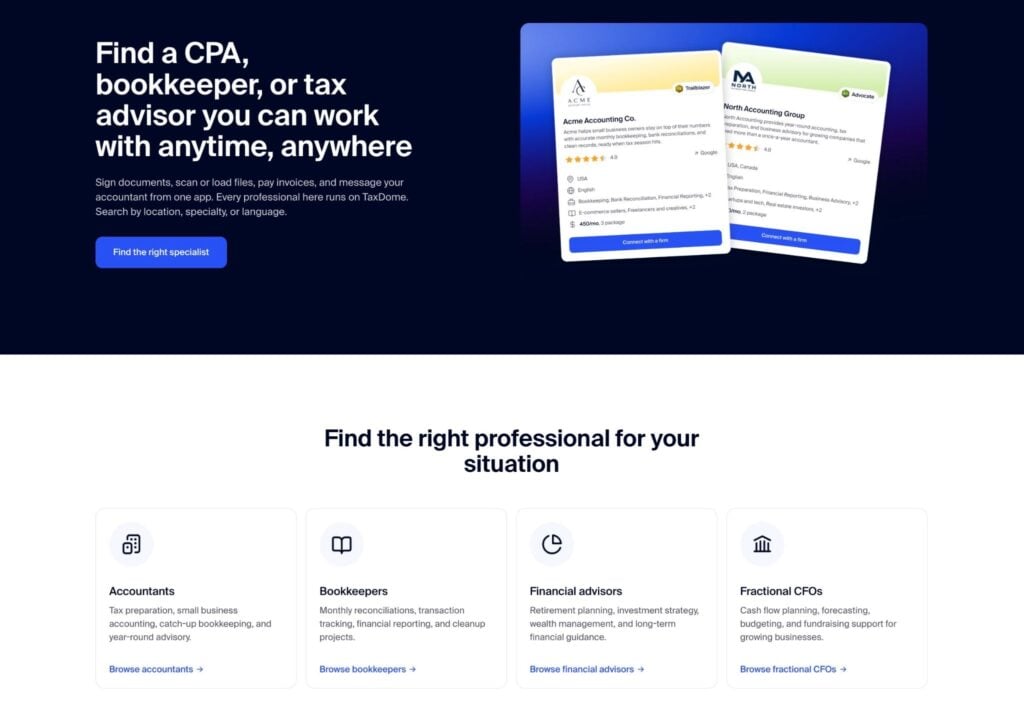
Find an organized accountant through the TaxDome Firm Directory
Once you recognize one or more of these signs, the next step is finding the right accounting partner, not just any name from a search engine. TaxDome’s Firm Directory lets you browse and filter trusted accounting, bookkeeping, and tax firms by location, specialty, and language. It’s worth prioritizing firms that have invested in modern, client-facing technology: a UK industry survey found that 89% of accounting firms invested in automation and digital tools over the past year, and the ones that pair that technology with responsive service are usually the easiest to work with.

Jeff writes for TaxDome with experience in accounting, finance, and invoicing industries. He focuses on educating users about accounting trends and maximizing productivity through practical guidance on TaxDome’s features.
Get your free guide

Thank you!
The guide copy has been sent to your email. Please check your inbox!
Recommended articles

Top AI tools for accountants in 2026: key features and use cases compared

Why accountants are quitting: inside the forces reshaping the profession

How to start a virtual bookkeeping business from scratch