 US – English
 UK – English
 Canada – English
 Australia – English
 Danmark – Dansk
 DACH - Deutsch
 France – Français
 España – Español
 Sverige – Svenska
 Italia – Italiano
 Nederland – Nederlands
 Portugal – Português
 Suomi – Suomi
 Norge – Norsk
 日本 – 日本語
 Romanian – Română












How much does an accountant cost in 2026? A complete guide to accountant fees and charges
Run your entire firm on one platform
Key takeaways:
- The average accountant charges $150-$300 per hour in 2026
- Bookkeepers typically charge between $40-$100 per hour
- Small businesses spend $1,500-$5,000 annually on accounting services, depending on their needs
- Accountant fees vary depending on their experience, demand, and services offered
- Entry-level accountants are often cheaper, but may not provide advanced tax or advisory services
- Fees can also vary depending on your location, business niche,
- Accountants may bill hourly, monthly, or on a per-project basis
- The new TaxDome Accountant and Advisor Finder is the quickest way to find an accountant that meets your needs and budget
Everyone needs an accountant at some point in their lives. Whether you’re an individual taxpayer or a business owner, wading into the murky waters of bookkeeping, financial reporting, and tax preparation without professional support can be overwhelming — and sometimes risky.
When you start looking for an accountant, the first question you’ll often have in mind is: “how much is this going to cost me?” Unfortunately, the short answer is: it depends. And, getting a more complete answer involves a lot of research, often with conflicting information.
So, we’ve done the legwork and pulled together the research to give you an accurate picture of what an accountant costs in 2026. We also break down pricing by service and business type, and introduce a new tool to help you find your ideal accountant in minutes.
Table of сontents
- How much does an accountant cost in 2026? Key figures at a glance
- Accountant, bookkeeper, advisor, or CFO: what do you need and what’s it going to cost?
- What services do accountants offer?
- Factors influencing accountant fees
- Technology adoption
- Accountant fee structures
- Accountant costs for different types of businesses
- Comparing costs: in-house vs. outsourced accounting
- Why is it so difficult to find the right accountant?
- Find your next accountant with the new TaxDome Accountant and Advisor Finder
- Frequently asked questions
- To sum up
Table of сontents
- How much does an accountant cost in 2026? Key figures at a glance
- Accountant, bookkeeper, advisor, or CFO: what do you need and what’s it going to cost?
- What services do accountants offer?
- Factors influencing accountant fees
- Technology adoption
- Accountant fee structures
- Accountant costs for different types of businesses
- Comparing costs: in-house vs. outsourced accounting
- Why is it so difficult to find the right accountant?
- Find your next accountant with the new TaxDome Accountant and Advisor Finder
- Frequently asked questions
- To sum up
How much does an accountant cost in 2026? Key figures at a glance
Accountant costs in 2026 depend primarily on who you hire and what you ask them to do. As a starting point, here are the typical hourly rates by role:
| Role | Typical hourly rate |
| Bookkeeper | $40 – $100 |
| Junior accountant | $50 – $150 |
| CPA (mid-level) | $150 – $300 |
| Senior CPA or specialist | $300 – $500+ |
| Tax preparer | $75 – $200 |
Sources: Talo accountant cost guide,QuickBooks accountant cost guide
For ongoing support, most small businesses spend between $1,500 and $6,500 per year on accounting services, while larger companies with complex needs can spend tens of thousands or more.
Accountant, bookkeeper, advisor, or CFO: what do you need and what’s it going to cost?
Bookkeepers
Bookkeepers handle the day-to-day recording of financial transactions: categorizing expenses, reconciling bank accounts, tracking invoices and payments, and often processing payroll.
Typical fees: between $40 to $100 per hour, or $300 to $2,500+ per month on retainer, depending on transaction volume
Accountants
Accountants work at a higher analytical level, preparing financial statements, managing compliance, and advising on financial decisions. For routine business needs, a qualified non-CPA accountant often offers the best balance of expertise and price.
Typical fees: $50 to $150 per hour at the junior level, rising with experience
CPAs
Certified Public Accountants are licensed professionals who can do everything an accountant can, plus conduct external audits and represent clients before the IRS. The license carries a premium: per the NATP 2025 Fee Study, a base Form 1040 averages $280 from a CPA versus about $185 from a non-credentialed preparer.
Typical fees: $150 to $300 per hour for a mid-level CPA, with senior specialists charging $300 to $500+
Financial advisors
Financial advisors are a different profession altogether, focused on your personal wealth rather than your business finances: retirement planning, investment strategy, and long-term financial guidance. If your question is about growing and protecting personal assets rather than managing business books or taxes, an advisor is what you need.
Typical fees: around 1% of assets under management per year for ongoing management, $200 to $400 per hour for one-off advice, or roughly $3,000 for a comprehensive financial plan
Fractional CFOs
Fractional CFOs provide senior finance leadership on a part-time basis: cash flow planning, forecasting, budgeting, and fundraising support. They suit growing businesses that need strategic financial expertise without the cost of a full-time executive.
Typical fees: $3,000 to $7,500 per month, depending on business size and scope
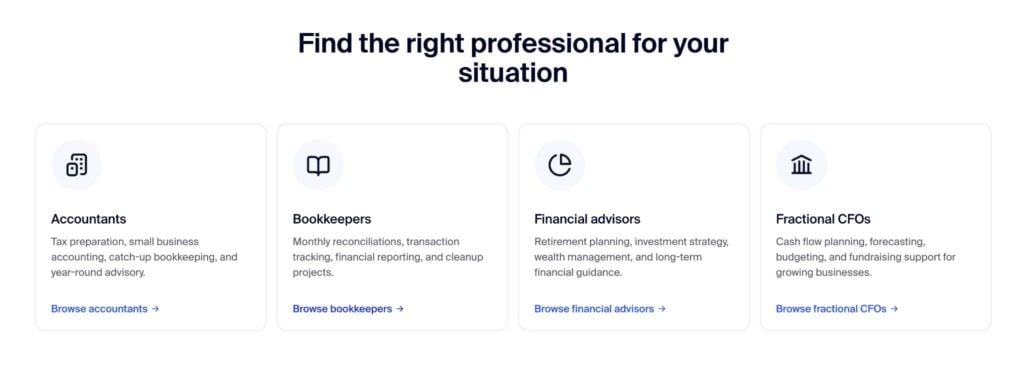
Finding an accountant that can deliver what you need is easier said than done, until you try the new TaxDome Accountant and Advisor Finder. Our directory helps you find accountants, bookkeepers, financial advisors, and fractional CFOs in minutes.
Simply use the filters to set your requirements and draw up a shortlist of accountants that match your profile.
What services do accountants offer?
Accountants offer a broad range of services designed to help individuals and businesses manage their finances more effectively. In this section, we’ll highlight some of the main ones.
Tax services
The cost of preparing income tax returns depends on the complexity of the job. Individual tax returns tend to cost less, but you’ll pay more if you are self-employed and have multiple income sources and itemized deductions. You’ll also pay more for state tax filing. Corporate tax returns tend to cost more, and prices vary depending on the complexity and type of business structure.
With all that in mind, here are the average flat-fee price ranges for income tax return preparation:
- Individual tax preparation: $250 to $900
- Corporate tax preparation: $500 to $2,500+
Sources: NSA fee data via Wallet Hacks, NATP 2025 Fee Study
For tax planning and advisory, accountants tend to charge per hour. You can expect to pay anywhere from $150 to $500 per hour, with CPAs charging more than regular accountants. For representation in front of the IRS, you can expect to pay in the region of $250 to $500.
Bookkeeping
Bookkeeping costs tend to be cheaper overall than more complex accounting services. This is because modern accounting software automates most of the manual processes involved. Prices can vary based on factors such as the volume and complexity of transactions and the size of your business.
Accountants either charge hourly rates or monthly retainers for bookkeeping services. Here are some examples of what you’re likely to pay:
- Hourly rates: $40 to $100 per hour
- Monthly retainer: $300 to $2,500+
Payroll management
The cost of payroll management increases the more employees you have. So small businesses will pay significantly less than large ones. Accountants use payroll management software to ensure people get paid accurately and on time. This enables them to lower overall costs compared to more hands-on accounting services.
Payroll costs are typically calculated using a combination of a flat monthly rate and an additional per-employee fee. Here’s what you can expect to pay:
- Monthly rate: $40 to $100+
- Additional per-employee fee: $2 to $15
Example: you have a team of 50 staff and pay a monthly rate of $100, with an additional per-employee fee of $5. Your monthly bookkeeping cost will be $350.
For a deeper dive into payroll fees and average costs, check out our in-depth article: The average cost of payroll services in 2026: a comprehensive guide.
Business accounting services
Business accounting services cover a broad range of accounting tasks. In some cases, you may need an accountant to cover all of your day-to-day accounting needs. In other cases, you may need someone for a specific task. This makes it difficult to calculate an average cost.
Typically, accountants will charge anywhere from $150 to $500 per hour for business accounting services. Below, we’ll give some rough estimates for how much different business accounting services might cost:
- Preparing financial statements: $1,000 to $5,000 per year
- Monthly accounting services: $500 to $3,500+ per month
- Budgeting and forecasting: $200-$500 per hour
Consulting and advisory services
Consulting and advisory services are generally charged on an hourly basis. This is because they tend to be either one-off or sporadic short-term sessions. In some cases, however, organizations might require ongoing advisory services or longer-term advice around specific corporate projects. Here’s how much you can expect to pay:
Consulting projects: $2,000 to $15,000+ depending on the size and complexity of the project
Hourly rates: $200 to $500
Fractional CFO services
A growing number of businesses engage fractional CFOs for strategic finance support: cash flow management, forecasting, budgeting, and fundraising preparation. This gives you executive-level financial oversight without the cost of a full-time hire. Here’s what you can expect to pay:
- Monthly retainer: $3,000 to $7,500
Audit services
Audit costs vary wildly depending on the size and specifics of your business. Large enterprises pay huge amounts of money to be audited: S&P 500 companies pay a median of $7.96 million per audit, with the average pushed above $12 million by the very largest organizations. If you’re running a small business, however, you’ll pay considerably less.
Here are some rough per-project amounts for audit services based on business size:
- Small and medium-sized businesses: $10,000 to $100,000
- Large organizations: $100,000 to more than $10 million
Specialized services
Accountants charge more for specialized services than routine ones. This is because they require specific skills and experience that not all accountants have. Here’s what you can expect to pay for certain specialized accounting services:
- Forensic accounting: $200 to $600 per hour
- International tax planning: $250 to $500 per hour
- Estate planning: $1,000 to $5,000+ depending on complexity
Factors influencing accountant fees
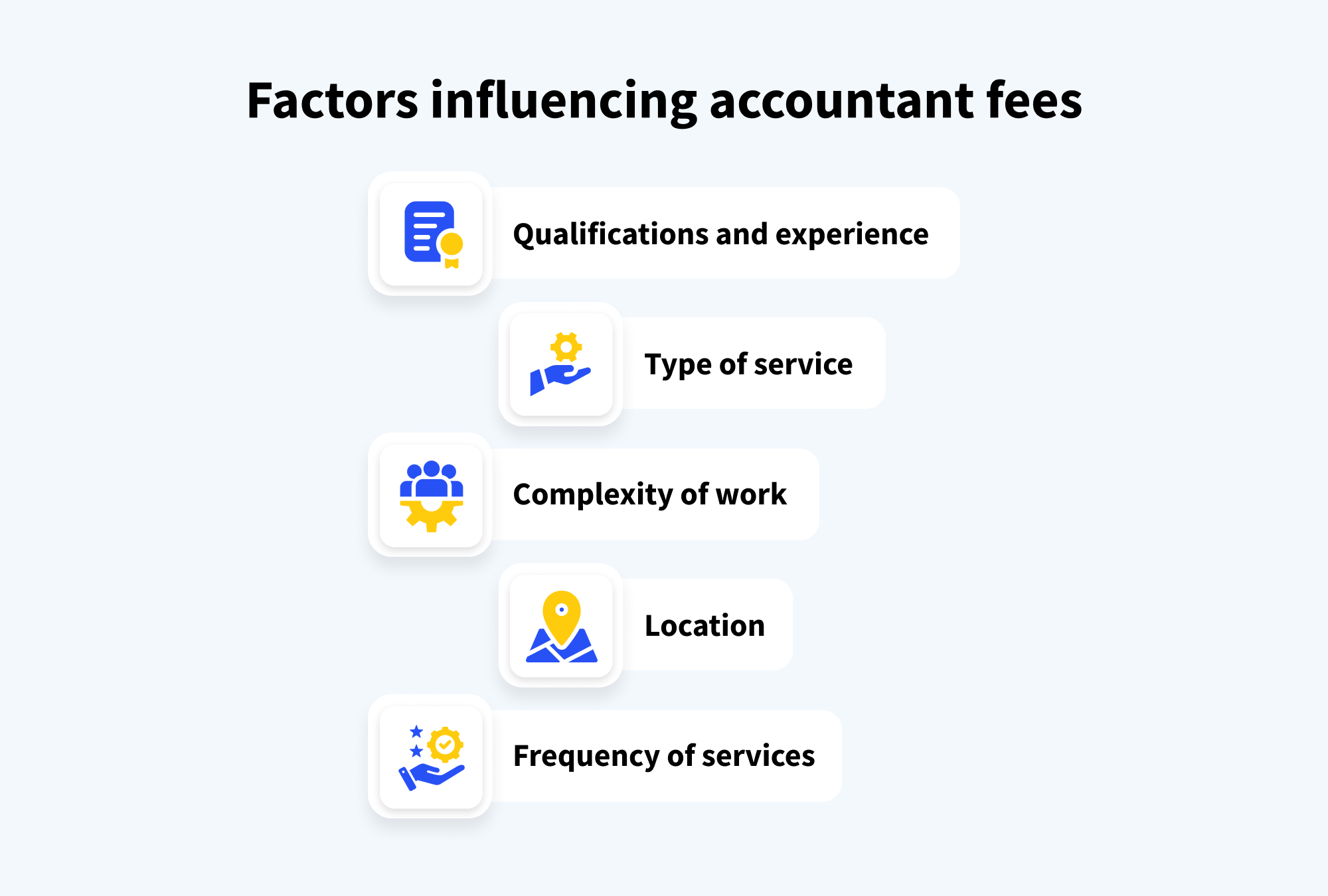
There are all sorts of factors that can impact how much an accountant charges, and why some charge more than others. Understanding these factors can help you make the most cost-effective decision when choosing which accountant to work with.
Qualifications and experience
One of the biggest factors influencing price is an accountant’s qualifications and experience. A regular accountant with basic qualifications and a year or two of experience will be relatively inexpensive to work with. On the other end of the scale, a CPA with decades of experience in highly specialized accounting areas will cost significantly more.
The right choice for you will depend on your specific needs and budget. For basic services such as bookkeeping or tax preparation, a regular accountant often represents a more cost-effective choice. For more complex or high-value services, such as external audits or representation in front of the Internal Revenue Service (IRS), working with a CPA is essential.
Type of service
The type of service you need will also have a major impact on the overall cost. Routine services such as tax preparation or bookkeeping tend to be relatively inexpensive. Services that require deeper knowledge and expertise, such as audit or advisory services, tend to be more expensive. Then there are highly specialized services such as forensic accounting, which come at a premium.
Complexity of work
Accounting fees within a service type can vary depending on the complexity of the job. For example, a simple individual tax return will cost significantly less than a complex corporate tax return. The more complex your case is, the more expertise and time it will take — and the more you’ll pay.
Location
Geographic location plays a major role in determining accounting fees. Accountants in major cities or affluent areas charge more in line with the higher cost of living. Those in rural areas or regions where service costs are generally lower will charge less. Thanks to cloud software and remote work, however, it’s no longer necessary to engage an accountant in your local area — especially if your needs are relatively simple.
Frequency of services
The frequency of services also dictates how much you’ll pay. Over the course of a year, one-time or infrequent services such as tax preparation will cost less than ongoing services such as bookkeeping or payroll. That said, if you’re a regular client with a longstanding relationship with the accountant, you may be able to negotiate discounted rates for ongoing services.
Technology adoption
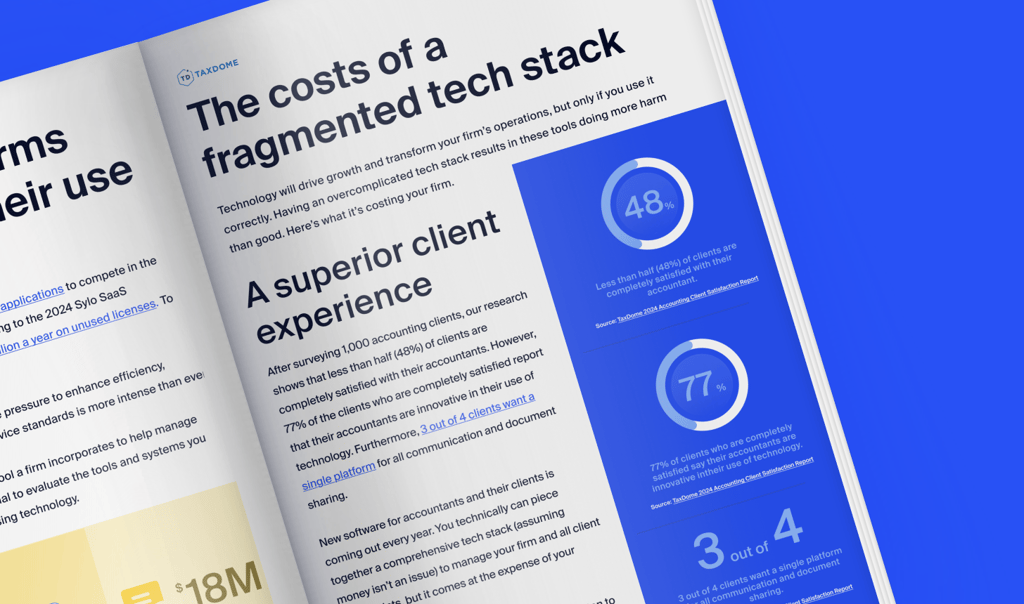
When 97% of accounting firms say they use technology inefficiently, who do you think is absorbing those costs? We’re not only talking about software fees, either. You’re also absorbing the hit of inefficient processes on their profit margins, while receiving slower turnarounds as a result.
It’s no surprise that only 48% of clients tell us they’re fully satisfied with their current accountant. What’s more telling is that 77% of those who are fully satisfied cite their accountants’ innovative use of technology as a reason.
A firm that successfully implements technology passes the time and efficiency savings on to you, as their client. A firm that doesn’t has to pass those expenses on to your bill.
Accountant fee structures
Accountants use a variety of fee structures when charging for their services. Understanding how these structures work can help you make the right choices when it comes to working with an accountant:
- Project-based fees: a flat fee for a one-time job with a clearly definable scope, such as a tax return, an audit, or a new system setup
- Hourly rates: you pay for the time the accountant spends on billable work
- Monthly retainers: a fixed monthly fee secures ongoing support for recurring work such as bookkeeping, payroll, and financial reporting
You can compare these fee structures, their pros and cons, and how they are best used in the table below:
| Fee structure | Average costs | Pros | Cons | Used for |
| Hourly rates | $40 to $800 | Flexible pricing based on work done | Costs can be unpredictable | Consulting, advisory, tax planning |
| Monthly rates | $300 to $10,000+ | Predictable costs, easy to budget, reliable support | May not cover extra services, set prices may not reflect work done | Bookkeeping, payroll, financial reporting |
| Project-based | $300 to $10,000+ | Clear and upfront pricing, defined start and end | Scope creep may lead to additional charges | Tax preparation, audits, system setups |
Accountant costs for different types of businesses
The cost of accounting services can vary significantly depending on the size and complexity of your business. In this section, we’ll look at how much different types of businesses can expect to pay and why.
Freelancers and solopreneurs
Freelancers and solopreneurs tend to have simple accounting needs compared to businesses. In addition to help with income tax returns, they may need basic bookkeeping support. In most cases, freelancers will be able to handle these tasks themselves using accounting automation software, but here are some average prices nonetheless.
- Income tax preparation: $200 to $1,000 yearly
- Bookkeeping: $50 to $250 per month
Small businesses
In addition to having few employees, small businesses tend to have simple financial structures. This makes their accounting needs relatively straightforward. In most cases, small businesses won’t require more complex services such as audits.
- Income tax preparation: $500 to $1,000 yearly
- Bookkeeping: $250 to $750 monthly
- Payroll management: $250 to $750 monthly
Medium-sized and large businesses
The larger the business, the more complex the accounting needs. For this reason, medium-sized and large companies can expect to have higher accounting bills and require a wider range of services. While most medium-sized and large businesses have internal accounting teams, here are some ballpark figures for what it would cost to outsource these tasks to an external accountant:
- Income tax preparation: $2,000 to $5,000+ yearly
- Bookkeeping: $1,000 to $5,000+ monthly
- Payroll management: $750 to $5,000+ monthly
- Audit services: $10,000 to $100,000+ yearly
- Consulting and advisory services: $250 to $500 per hour
Enterprises
Enterprises are large corporations that operate across multiple jurisdictions and regions. They have large workforces reaching into the thousands and highly complex financial and legal structures, including multiple entities and subsidiaries. As a result, they can expect to pay significantly more for accounting services.
Enterprises tend to have extensive in-house accounting and finance departments. That said, if they were to engage an external accounting firm, here are some rough costs:
- Income tax preparation: $10,000 to $50,000+
- Bookkeeping: $10,000 to $50,000+
- Payroll management: $10,000 to $50,000+
- Audit services: $1 million to $10 million+
- Consulting and advisory services: $500 to $800 per hour
Comparing costs: in-house vs. outsourced accounting
When it comes to meeting accounting needs, businesses typically have two options: hire an in-house accountant or work with an external accountant. Before making a decision, it’s important to understand the advantages and disadvantages of both options.
In-house accounting
The majority of businesses choose to keep accounting in-house. In the US, almost two-thirds (63%) of small businesses have in-house accountants. Generally speaking, the larger a business is, the more likely it is to have an in-house accounting team.
Pros:
- Direct control over accounting staff and operations
- Fast internal communication and coordination
- Dedicated accountants learn the intricacies of your financial systems and controls
- Easier to maintain confidentiality and data security
Cons:
- High salary and benefits costs
- Overheads such as equipment, software licenses, and office space
- Ongoing training and development costs
- Harder to scale up and down with demand
Cost considerations:
Accountant salaries and recruitment costs are increasing as the talent shortage and other economic factors increase pressure on the industry:
- Accountant salaries: $50,000 to $100,000 per year (median $84,578, BLS)
- CPA salaries: $95,000 to $165,000, depending on seniority and specialization (Robert Half)
- CFO salaries: $195,500 to $321,750 (median $269,750, Robert Half)
- Benefits and overheads: an additional 40% of salary costs (BLS))
- Software and tools: $500 to $2,000+ per year
- Hardware and office equipment: $1,000 to $5,000+
- Year 1 cost of in-house hiring: averages $159,100–$280,000+ (45%-55% of which is salary, Mavi)
Outsourced accounting
Only a third of small businesses choose to outsource their accounting, and even fewer large companies do so. Nevertheless, there are huge benefits to outsourcing — especially for smaller businesses that prioritize flexible, cost-effective services. In recent years, outsourcing has grown in popularity, with 96% of CFOs relying on at least one third-party finance and accounting provider in 2026.
Pros:
- Flexibility: you only pay for what you need
- Scale services up and down during times of high or low demand
- Expert accounting support without committing to long-term costs
- No recruitment campaigns to run
- No employee engagement, training, or benefits to manage
Cons:
- Less control over day-to-day operations
- Potential communication issues
- An additional risk vector for data security and regulatory compliance
- External accountants work with multiple clients at any given time
- They’ll never know the nuances of your business like an internal accountant would
Cost considerations:
The exact costs depend on the service types, business size, and the complexity of the work. Below are some ballpark figures based on different business sizes:
- Freelancers: $100 to $1,000+ per year
- SMEs: $5,000 to $100,000 per year
- Larger businesses: $100,000 to $1 million+ per year
- Enterprises: $1 million to $10 million+ per year
As you can see, there’s no single best approach when it comes to accounting. The most effective strategy will depend on the size of your business, your budget, and other factors. You can see a comparison of the pros and cons of both approaches in the table below factors. You can see a comparison of the pros and cons of both approaches in the table below.
| Pros | Cons | Best for | |
| In-house | • Direct control • Faster communication • Dedicated staff • Improved compliance and security | • Higher fixed costs and overheads • Limited scalability • Hands-on management and training required | Larger businesses with steady cash flow that want full control. |
| Outsourced | • Scalable services • Flexible costs • No hiring or direct management • Reduced overheads | • Less control • Potential communication issues • Security and compliance risks | Smaller businesses that prioritize flexible, scalable, and cost-effective services. |
In many cases, however, larger businesses combine both approaches. They have a team of in-house accountants and finance experts to manage day-to-day operations, but they may dip into the external market when they need specific expertise for time-limited projects, such as an independent audit or forensic accounting.
Why is it so difficult to find the right accountant?
Finding an accountant happens in three phases: researching your options, selecting the right candidate, and the working reality that follows. Each phase has its own friction, and knowing where things go wrong is the first step to avoiding it.
1. Research: too many options, too little to go on
Most clients find their accountants through their professional network or by searching online. Either way, the first thing you probably do to learn more about an accountant is look at their website. The problem is, you quickly realize that most of these websites look very similar and largely say the same thing.
You have too many options to choose from, yet too little information to make a choice.
2. Selection: hard to verify, harder to compare
Once you have a shortlist of potential accountants to choose from, the selection process doesn’t get any easier. You have to submit queries or request a quote with each accountant to start a drawn-out process of getting accurate pricing information, and the comparisons are never clear-cut. One accountant is more expensive, but promises you’re getting more for your money. Another one initially sounds cheaper, until you notice all of the extra fees and charges.
3. The working reality: the part you can’t preview
You never truly know what it’s like to work with an accountant until you do. All of the research, and all of the promises made during inquiries count for nothing if the reality of working with your new accountant falls short of expectations.
Now, don’t tell anyone, but there’s an insider secret that will give you a clear picture of what it’s like to work with an accountant. Ask them to describe their onboarding process in detail, and the tools they expect you to use for the following:
- Communication
- Account access
- File sharing
- Signing documents
- Approving work
- Paying invoices
If the onboarding process they describe sounds complex and they give you a list of apps you’ll need to use, consider this a red flag. On the other hand, if the onboarding process sounds straightforward and you only need to use one app to do all of the above, put this accountant at the top of your shortlist.
Why does this work? Because the onboarding process, and everything it involves, gives you the most accurate picture of what working with this firm will look like, from month three to year three.
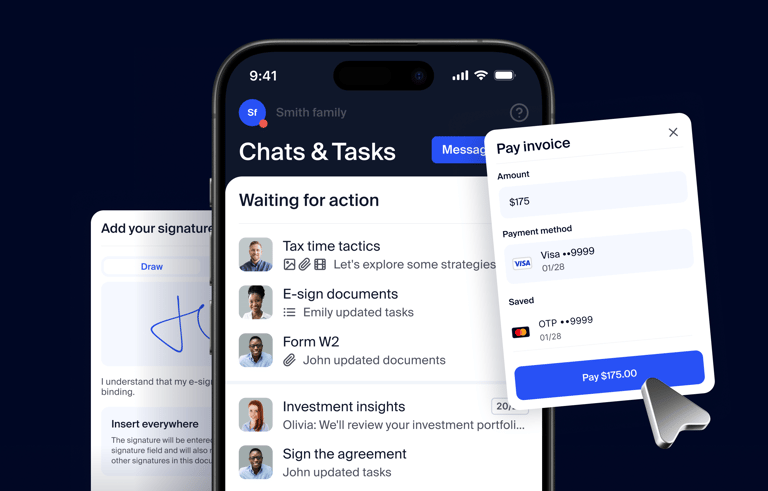
This is why we built our client app, so that accountants using TaxDome can give the same first-class experience to every client, from onboarding through to delivery. This is the mobile accounting experience rated 4.9/5 by 38,000+ clients.

Earlier this year, the TaxDome client app was also named a 2026 Webby Award Honoree in Fintech, Financial Services & Banking. This is the only app of its kind to rank among the biggest names in finance, including Apple Pay, HSBC, and TurboTax.
Find your next accountant with the new TaxDome Accountant and Advisor Finder
We know how difficult it is to choose the right accountant for your needs, but also the value in finding the perfect fit. And pricing isn’t the only factor you have to consider. To find the right accountant, you need to weigh up their areas of expertise, the services they offer, the clients they serve, and other considerations.
This information isn’t always easy to find online, and comparing multiple accountants becomes a major research project in itself.
To resolve this, we’ve launched the TaxDome Accountant and Advisor Finder, a directory of accountants and financial advisors to help you find the perfect accountant today.
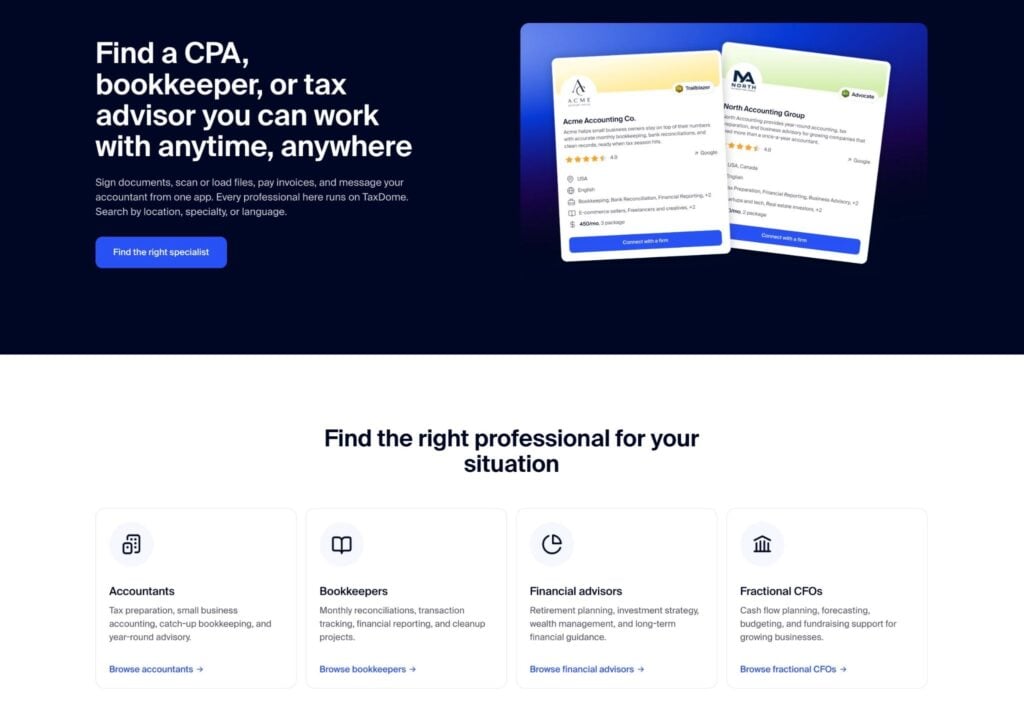
Forget about search engines and comparing dozens or hundreds of websites. Get all of the details you need to choose your next accountant, without the endless cycle of searches, websites, and compiling information yourself.
Find accountants who match your needs in seconds
The directory includes filters for States, Languages, Services, Specialties, and Industries. So, instead of manually searching for accountants that match your requirements, you can simply filter out the ones that don’t.
Now, you’ve got a genuine shortlist of accountants in seconds, not hours.

The accountant profiles in our directory pull review scores from Google Reviews and link to their Google Maps location, so you can verify with a single click. The profiles also show you the city and state they operate in, the languages supported, and a breakdown of services, specialties, and industries.
You can set your requirements using the filter settings and instantly compare accountant profiles, side by side.
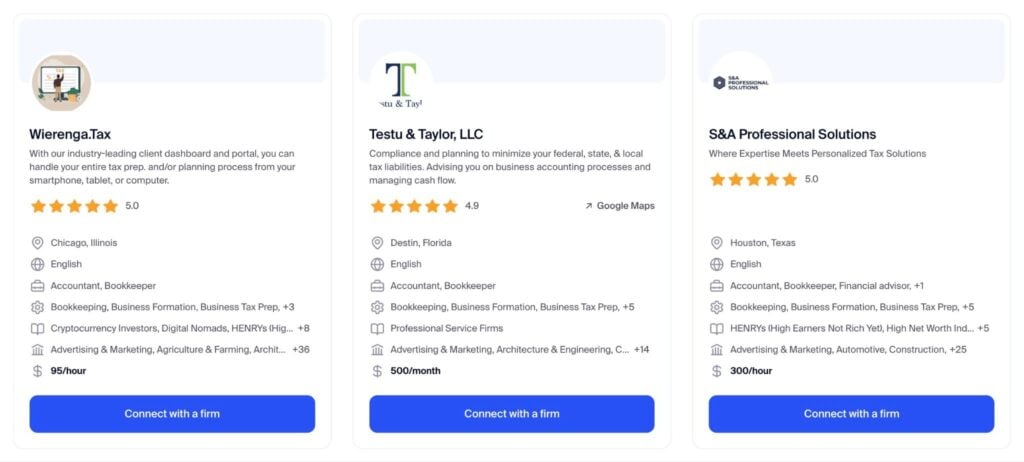
You’ll also see many accountants in our directory disclose pricing details or their starting fees, to give you an idea of which profiles match your budget. This pricing information is provided to us by the accountants listed on our directory themselves — no guesswork or third-party sources.
Connect with potential firms from one directory
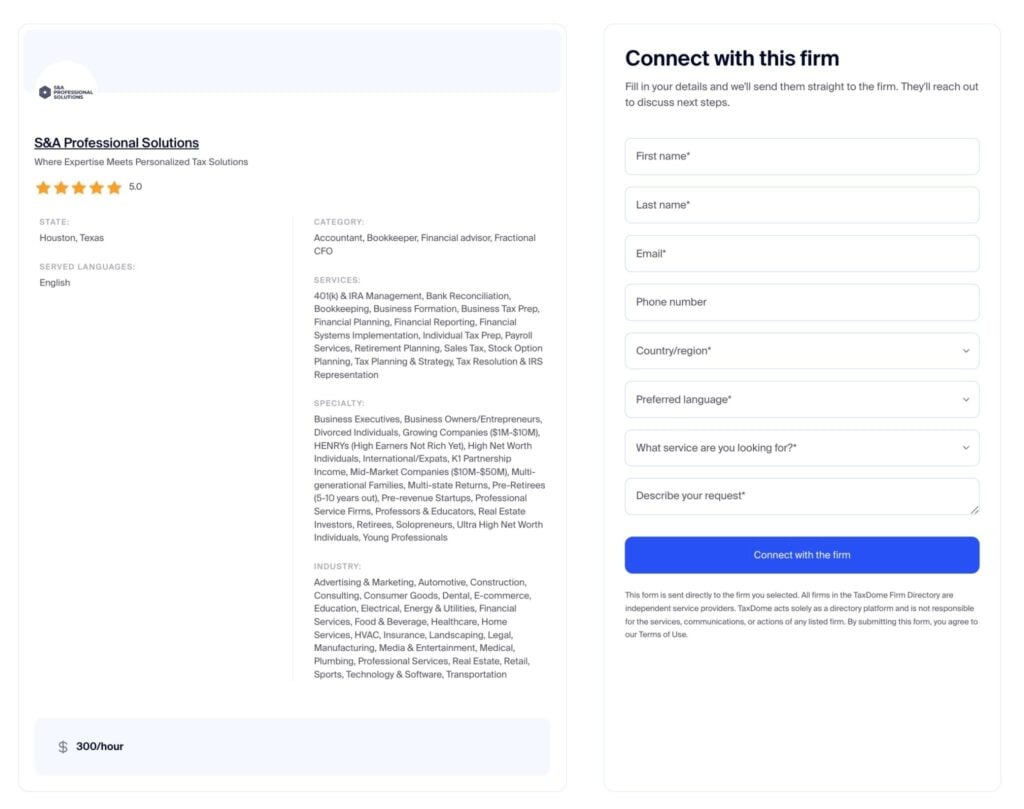
When you find an accountant who looks like a good fit, you can connect with them directly through the directory. You can reach out to multiple firms that match your requirements from one place, without having to visit each website individually.
Get five-star client experiences from accountants using TaxDome
The accountants in our directory all use TaxDome as their practice management software. This means they’re positioned to give you the same client app rated 4.9/5 by 38,000+ accounting clients around the world. This is one platform for all interactions with your accountant: communication, file sharing, document signing, payments, and everything else.
You don’t even need a scanner to send physical documents to your accountant. With our client app, you simply use your phone to take a picture of the document and it automatically converts it into a digital file for instant sharing.

We built this app to help accountants using TaxDome deliver the best client experiences in the industry. This has become our key selling point to TaxDome customers, which says a lot about how much the accountants using our platform care about client outcomes.
Frequently asked questions
How much does an accountant cost per month?
Monthly accounting costs vary by business size and scope. Basic bookkeeping retainers start around $300 per month, while fuller packages covering bookkeeping, payroll, and reporting typically run $500 to $2,500 per month for small businesses. Larger companies with complex needs can pay $3,500 or more.
Is it worth paying for an accountant?
For most businesses, yes, particularly where the cost of mistakes is high. A qualified accountant reduces your tax liability, keeps you compliant with deadlines, and frees your time for running the business. The return is clearest in tax planning, audit preparation, and financial reporting, where errors carry real penalties.
How much does a CPA cost vs a regular accountant?
CPAs charge roughly 15–20% more than non-credentialed accountants on average, with the gap widening at senior levels. Expect $150 to $300 per hour for a mid-level CPA versus $50 to $150 for a junior accountant. The premium reflects their license to conduct external audits, represent clients before the IRS, and provide advanced tax strategy.
How much does an accountant cost for a small business?
Most small businesses spend between $1,500 and $6,500 per year on accounting services. Basic bookkeeping and annual tax preparation sit at the lower end of that range, while adding payroll management and ongoing advisory support pushes annual costs toward the top of it and beyond.
Can I negotiate accountant fees?
Yes, in many cases. Accountants are often open to bundling services at a discount, and combining bookkeeping, tax prep, and payroll into a single retainer typically costs less than separate engagements. Long-term clients and those with organized, up-to-date records also tend to get better rates.
How much does tax preparation cost?
Individual tax preparation averages around $273 for a standard Form 1040 and $382 with itemized deductions, based on inflation-adjusted NSA fee data. The NATP 2025 Fee Study puts the average CPA-prepared base return at $280. Business returns range from roughly $300 to $800 for a sole proprietorship up to $2,500 or more for corporations.
To sum up
Accurate and compliant accounting is essential for any business. While it’s possible to take on some simple accounting tasks yourself, the larger and more complex your business is, the more you’ll need a professional accountant. But expertise comes at a cost.
In this article, we’ve outlined roughly how much you can expect to pay for different accounting services. We’ve looked at the different pricing structures accountants use. We’ve also covered the pros and cons of in-house accounting versus outsourced accounting.
Using an industry-specific directory can save you precious time if you’re in the market for an accounting professional. With the TaxDome Accountant and Advisor Finder, you can quickly connect with accounting and tax pros from across the globe — and ensure the best possible client experience. Try the TaxDome Accountant and Advisor Finder for yourself to find the ideal accountant for your business.

Aaron produces practical content for TaxDome, drawing on 11 years in SaaS copywriting and marketing. He helps accounting and tax professionals get the most from TaxDome and other tools, making complex topics clear and actionable.
Get your free guide

Thank you!
The guide copy has been sent to your email. Please check your inbox!
Recommended articles

What is accounting workflow management? The complete guide with real-world examples

ChatGPT for accountants: 12 strategies to automate your workflows

12 best free online accounting courses with certifications for 2026