 US – English
 UK – English
 Canada – English
 Australia – English
 Danmark – Dansk
 DACH - Deutsch
 France – Français
 España – Español
 Sverige – Svenska
 Italia – Italiano
 Nederland – Nederlands
 Portugal – Português
 Suomi – Suomi
 Norge – Norsk
 日本 – 日本語
 Romanian – Română












65+ key accounting statistics and insights for 2026
Run your entire firm on one platform
Summary:
- Most accounting firms reported growth in 2025 and expect to again in 2026
- Demand for strategic advisory services is growing
- The top firms are using automation to free up resources for advisory
- Big-spending clients are moving to firms that specialize in their niche
- Clients want technology that improves accounting services and keeps their data secure
The accounting industry is in a state of transformation. Disruption is everywhere, but so is opportunity. Firms are juggling new technologies, changing client expectations, and a critical talent shortage.
Accountants remain optimistic, but success will look very different in 2026. To see how firms are responding, we’ve analyzed the most telling accounting statistics and insights from the past year.
Table of сontents
- Accounting industry statistics
- 8 in 10 accounting software vendors say AI automates over half of manual tasks
- Key priorities and opportunities for accounting firms
- Biggest challenges for accounting firms in 2026
- Technology in accounting and finance
- Client expectations and priorities
- The state of accounting in 2026
Table of сontents
- Accounting industry statistics
- 8 in 10 accounting software vendors say AI automates over half of manual tasks
- Key priorities and opportunities for accounting firms
- Biggest challenges for accounting firms in 2026
- Technology in accounting and finance
- Client expectations and priorities
- The state of accounting in 2026
Accounting industry statistics
Key accounting statistics:
- The global accounting services market reached $660.38 billion in 2025
- The US accounting services industry is worth $145.5 billion
- Globally, 83% of accounting firms increased revenue in 2025
- In the US, 74% of accounting firms reported higher revenue
8 in 10 accounting software vendors say AI automates over half of manual tasks
In Capterra’s 2026 survey of 10 accounting software providers, 8 out of 10 report that AI now automates more than 50% of previously manual accounting tasks. Bank reconciliation and accounts payable invoice processing deliver the biggest time savings: high-volume work with predictable formats and consistent decision logic.
Global accounting services market to reach $804.4 billion by 2029
The global accounting services market reached $660.38 billion in 2025, up from $637.26 billion in 2024 at a compound annual growth rate (CAGR) of 3.6%.
By 2029, the global market is forecast to reach $804.4 billion, at a CAGR of 5.1%.
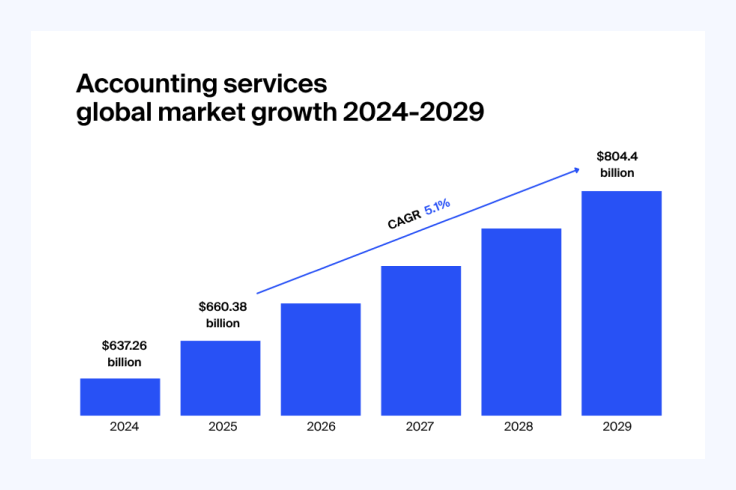
North America is the largest regional market in the world with exponential growth since 2013 driving the US accounting services industry to $145.5 billion in 2025.
83% of accounting firms increased revenue in 2025
Globally, 83% of accounting firms increased profit in 2025, up from 72% in 2024. It was a good year for profit growth, too, with 79% of firms reporting improved profitability in 2025, up from 74% the previous year.
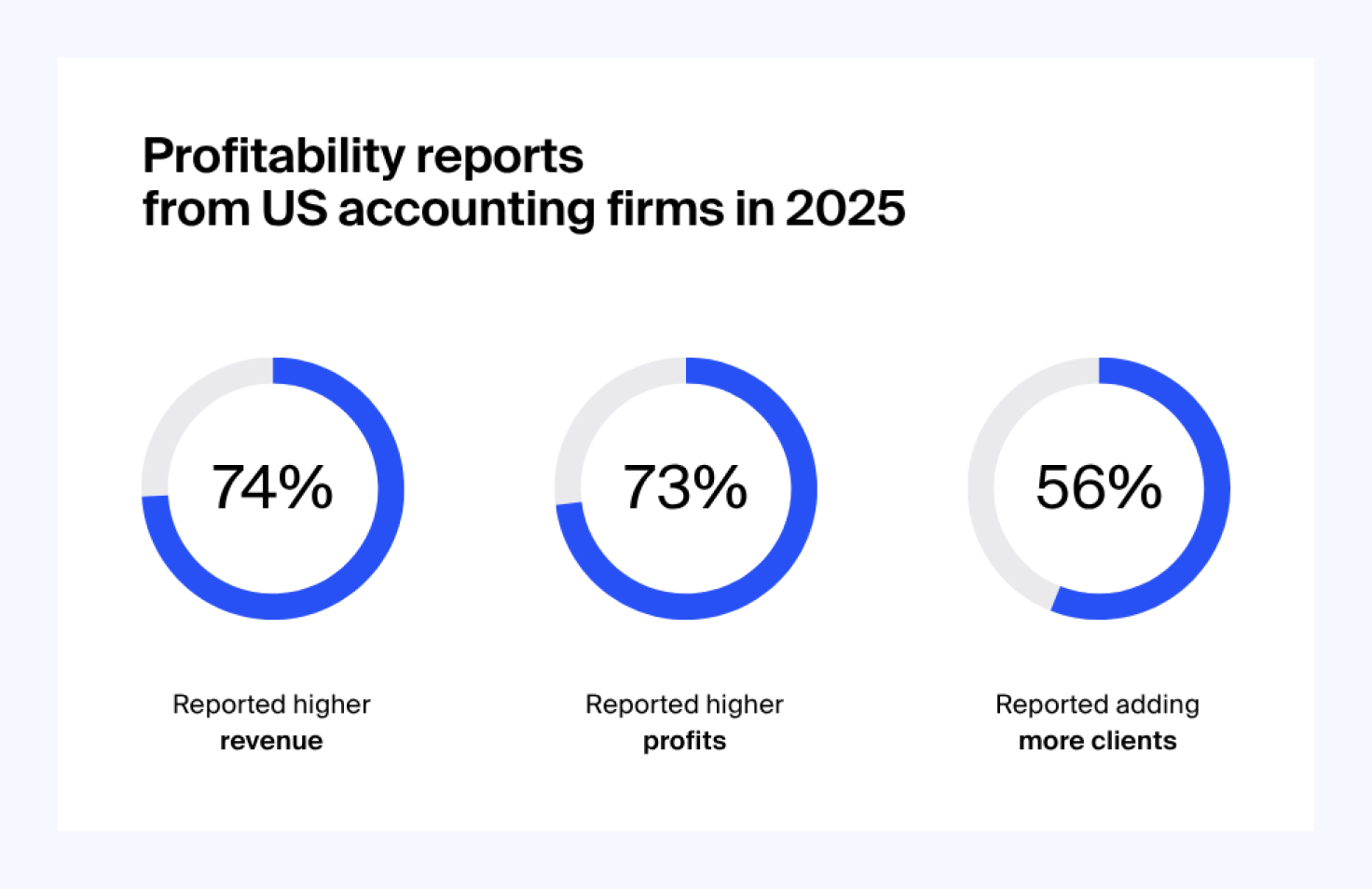
In the US, accounting firms posted similarly impressive results for 2025:
- 74% reported higher revenue
- 73% reported higher profits
- 56% reported adding more clients
Despite industry challenges, accounting firms remain confident about revenue growth. Heading into 2025, 88% of accounting firms in the US predicted revenue growth for the third year running.
Key priorities and opportunities for accounting firms
Key accounting statistics:
- Growth is the top goal (38%) for accounting firms in 2026
- Firms know that improving client services (35%) and internal efficiency (33%) are key to growth
- 58% of clients find their firm through referrals
- 93% of firms now offer advisory services
- Clients are willing to pay 25% more for a firm that specializes in their niche
Growth is the top goal for accounting firms in 2026
Increasing revenue and growth is the top goal for accounting firms in 2026, according to insights from Wolters Kluwer. However, firms realize the importance of improving client experiences and optimizing efficiency in achieving this goal.
Top goals for accounting firms in 2026
| Increase revenue/growth | 38% |
| Improve client service and engagement | 35% |
| Optimize operational efficiency | 33% |
| Maintain current performance and activity | 32% |
| Expand client base in current or new markets | 30% |
It’s promising that accounting firms see the value in maximizing returns from existing clients and resources, especially with the technology available to them today.
According to the 2025-26 AAM Marketing Budget Benchmark Study, the fastest-growing accounting firms average a 38.5% growth rate.
- Low growth — 5.2%
- Average growth — 11.5%
- High growth — 38.5%
The study also finds that high-growth firms spend 2x more on marketing and 57% more of their marketing budget on regional and local marketing activities. They also spend 21% more of their budget on conferences and events than low-growth firms.
These stats show how important traditional marketing channels are for accounting firms, even in the digital age.
58% of accounting clients find their firm through referrals
In our 2025 Niche Business Accounting Report, we asked clients how they discovered and chose their current firm.
92% of business clients rank referrals as important when choosing an accountant.
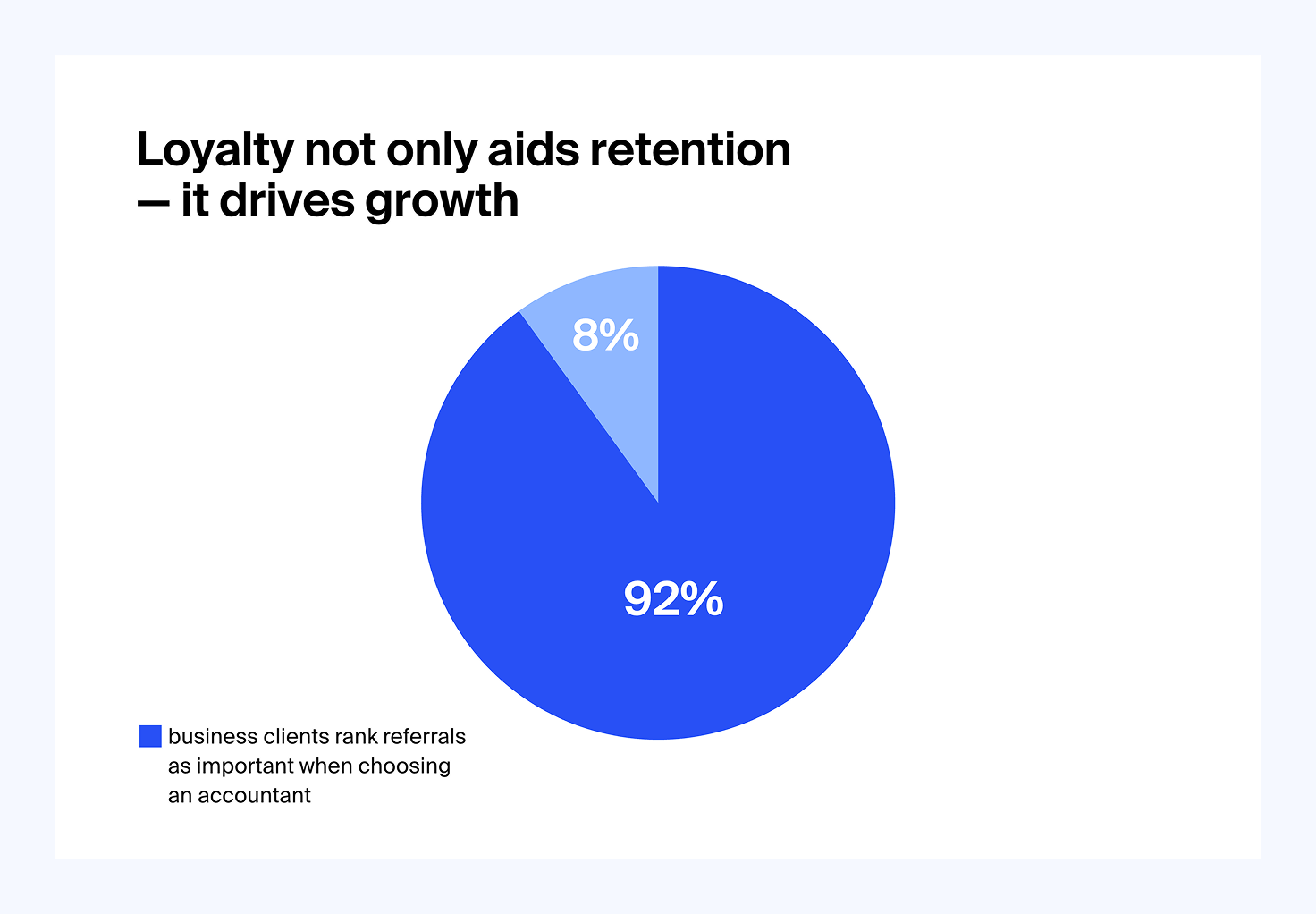
This isn’t hollow talk, either; it’s reflected in how businesses discover practices. 58% of businesses found their current accountant through a peer referral, while only 3% chose an accountant via advertising.
How did you find your current accountant/firm?
| Referral (from business or person) | 58% |
| Online search (Google, Yelp, etc.) | 17% |
| Social media | 10% |
| Webinar or event | 6% |
| Cold outreach from accountant | 4% |
| Responded to an advertisement | 3% |
| Other | 2% |
Digital channels are crucial for accounting firms — a combined 34% for search, social media, outreach and advertising — but referrals still rule in this industry. Accounting firms have to balance innovation with tradition as they adapt to changing times.
This reiterates the importance of client satisfaction — both for retaining and driving new business.
How are firms adapting accounting services in 2026?
According to Wolters Kluwer, 93% of accounting firms now offer advisory services and nearly half plan to expand their offerings in the next year. So, you can expect to see advisory services climb the list of top services in future reports:
- Individual and personal tax — 98%
- Business and corporate tax — 97%
- Client accounting services — 97%
- Financial statement services — 95%
- Advisory & consulting services — 93%
- Client payroll & processing — 88%
- Audit & assurance — 80%
Xero’s 2025 State of the Industry Report finds that client advisory is already the joint-top service provided by accountants and firms.
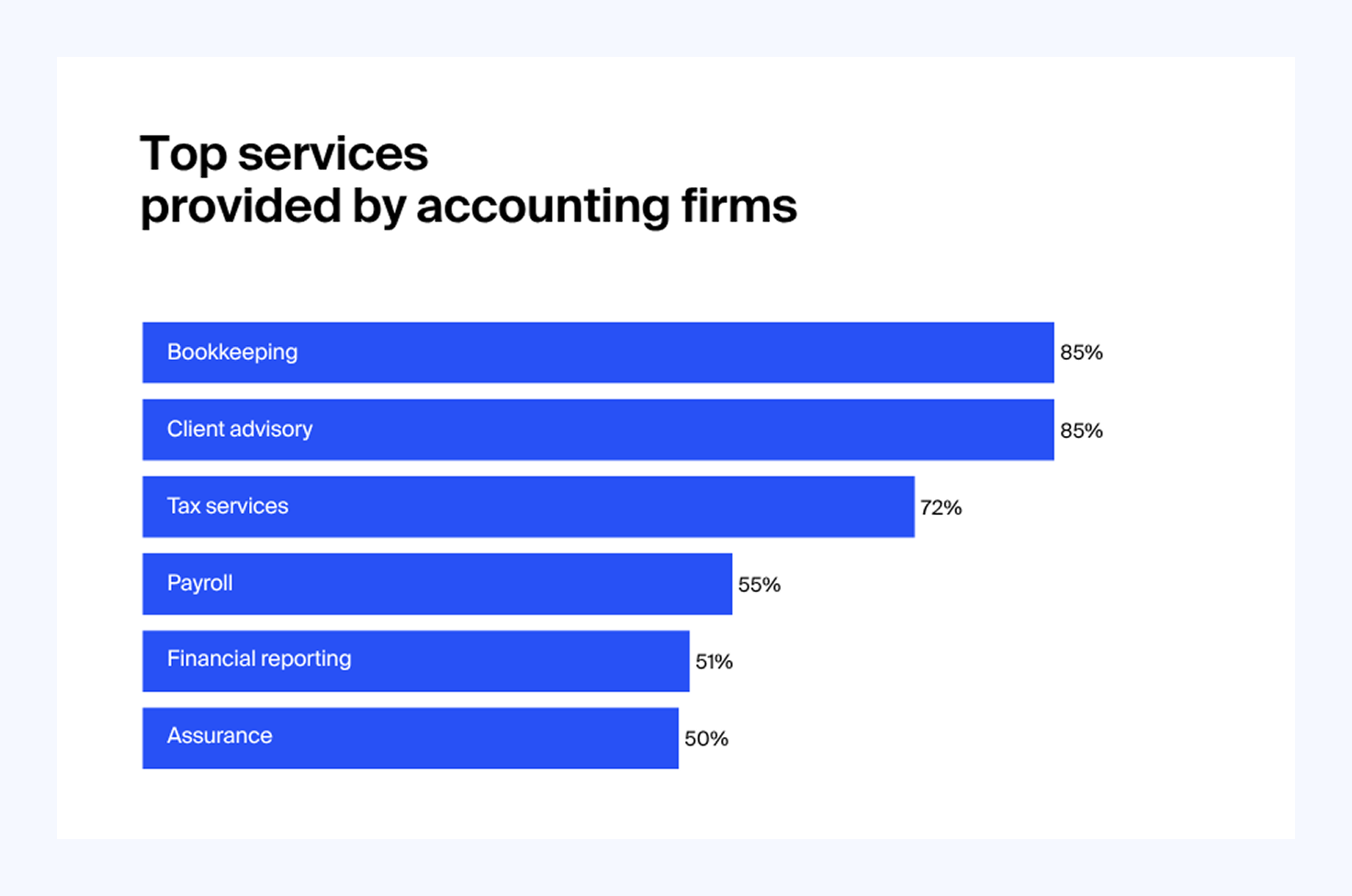
In the same survey, accountants reveal their top incentives for increasing client advisory services:
- To meet growing client expectations — 40%
- To strengthen client relationships — 40%
- To offer higher-value services to clients — 39%
- It is part of our growth strategy — 38%
- To increase profitability and grow practice revenue — 37%
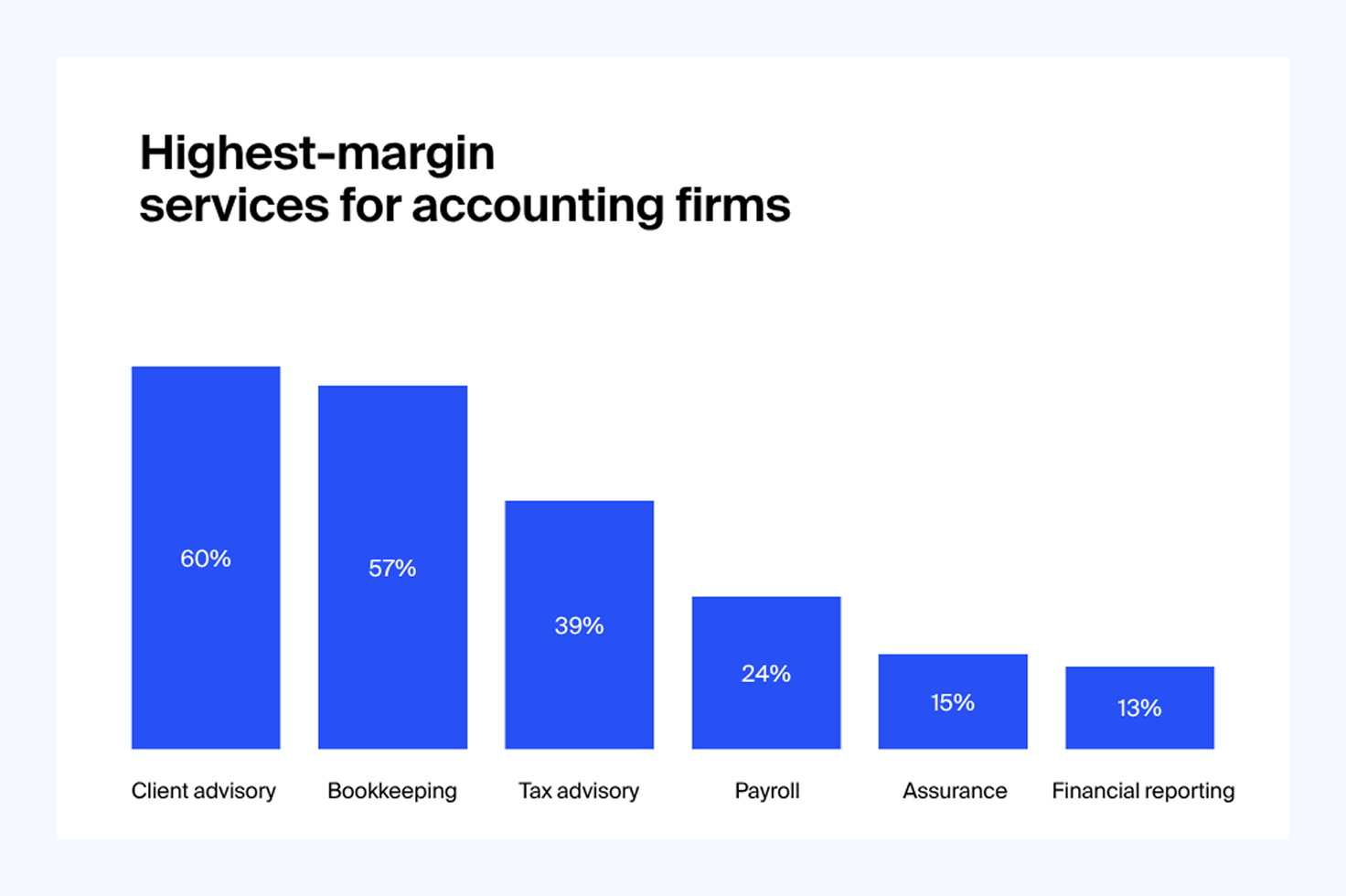
Profitability isn’t the only motivating factor here, but 60% of accounting firms that provide client advisory services say it delivers the highest profit margin.
Specialist firms win the top-spending clients
In our 2025 Niche Business Accounting Report, we asked accounting clients what really drives their loyalty to firms — and what they’re willing to pay a premium for. The stats are telling: clients are willing to pay 25% more for a firm that specializes in their field.
Crucially, the demand for niche accounting firms increases as businesses grow. Companies making over $1M are 2x as likely to hire a niche accountant as smaller businesses. And once businesses go niche, they stay niche — only 2% of clients return to a generalist after hiring a firm that specializes in their field.
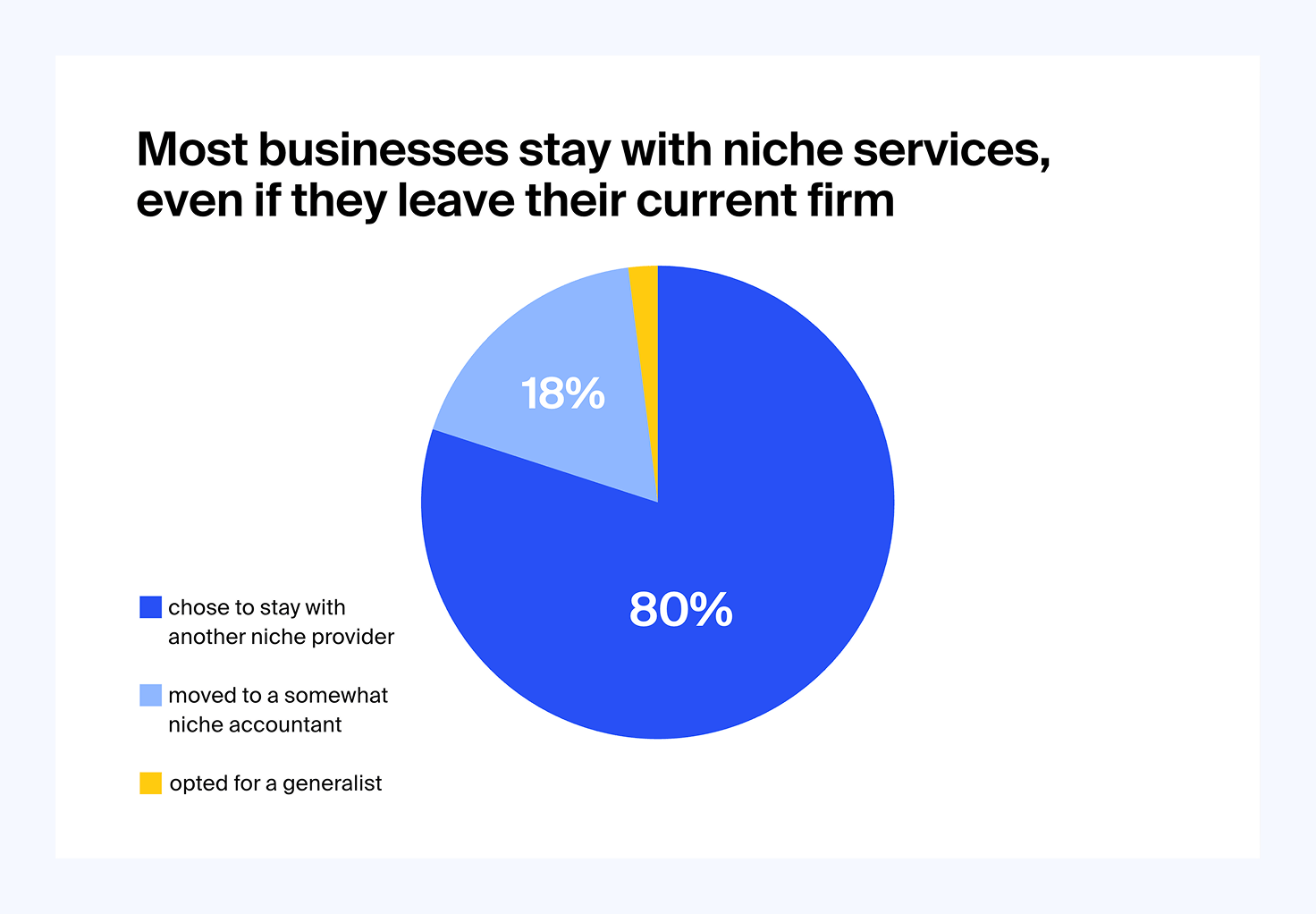
Firms need to recognize this in their growth strategies. The top-spending clients are actively looking for accountants that specialize in their niche, and growing companies don’t stay with generalists for long.
Over 50% of businesses that leave generalists move to accounting firms with proven expertise in their field.
If you want to attract the top-paying clients — and hold on to your most valuable ones — niching down is the way to go.
A word of warning, though: simply niching down doesn’t guarantee success. As businesses grow, so do their demands, and you need to deliver what they can’t get from more generalist firms.
So, what are the top reasons a business leaves a generalist for a specialist?
- 32% leave because of poor service
- 29% leave because of a firm’s lack of industry knowledge
- 26% leave because they’ve outgrown their firm
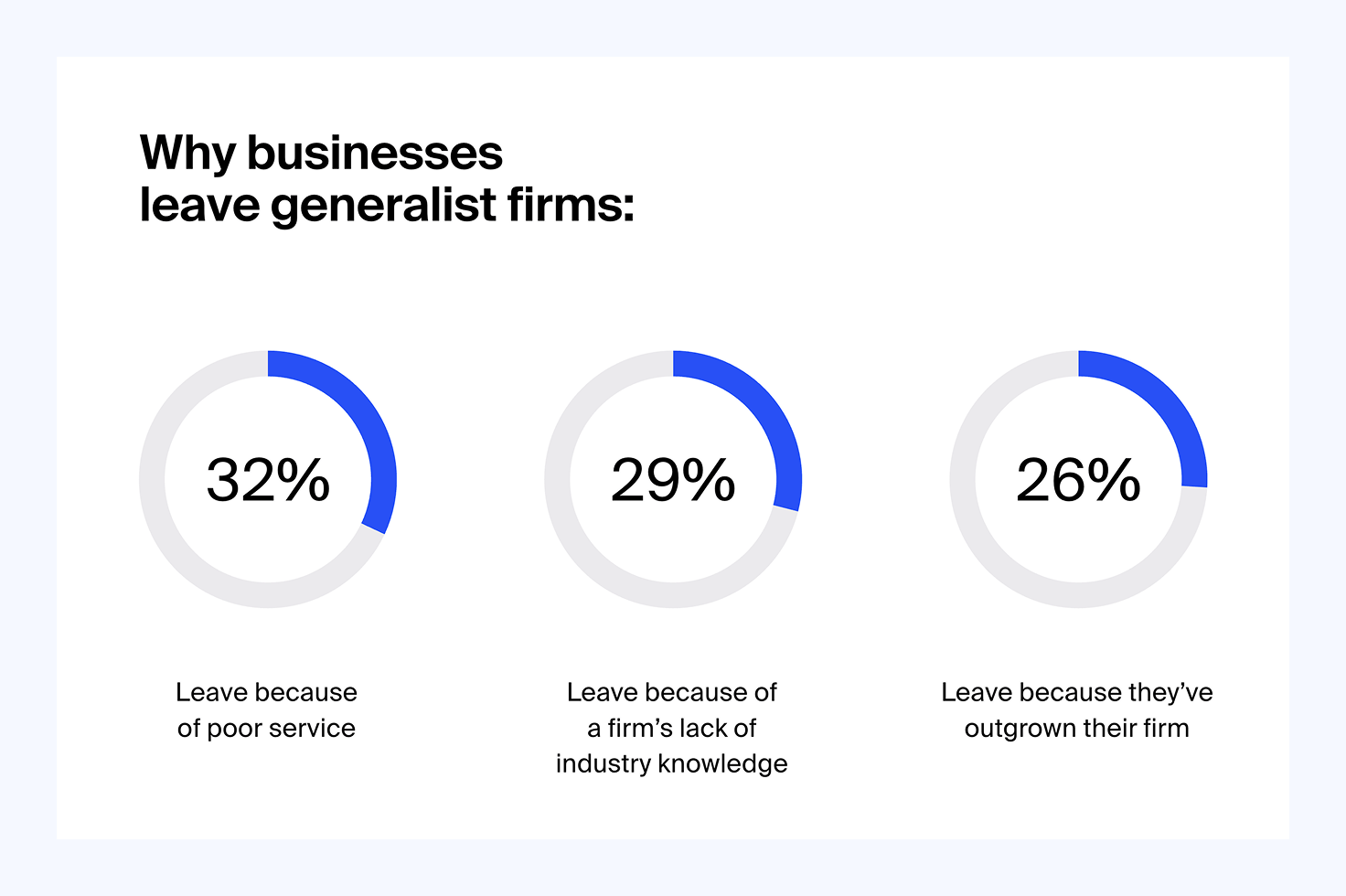
As you and your clients grow, the quality of services needs to match their rising expectations. So, aside from niching down, you have to level up your accounting services to hold on to the top-spending clients.
We also asked clients who had left a niche firm in the past to give their reasons why. 38% leave niche firms because prices are too high and 36% leave because the firm uses outdated technology or processes.
Biggest challenges for accounting firms in 2026
Key accounting statistics:
- Economic uncertainty is the top concern (38%) for accountants in 2026
- Large firms are the most concerned (45%) about the economy
- Accountants believe AI is the biggest opportunity for firms, but 36% are worried about understanding and using it
- 33% of firms say a lack of resources is their top growth barrier
- 83% of financial leaders report issues with a talent shortage
What are accountants most worried about in 2026?
Disruption brings opportunities and challenges for accounting firms, and they’re not always easy to separate. According to Xero’s State of the Industry Report, accountants believe AI is the #1 opportunity for accounting firms, but they also list it in their biggest worries:
- Dealing with economic uncertainty — 38%
- Understanding and using AI — 36%
- Evolving client expectations — 35%
Large firms say dealing with economic uncertainty is their greatest challenge (45%), while solo practitioners are the least likely to (30%). It’s telling that the percentage increases for every firm size.
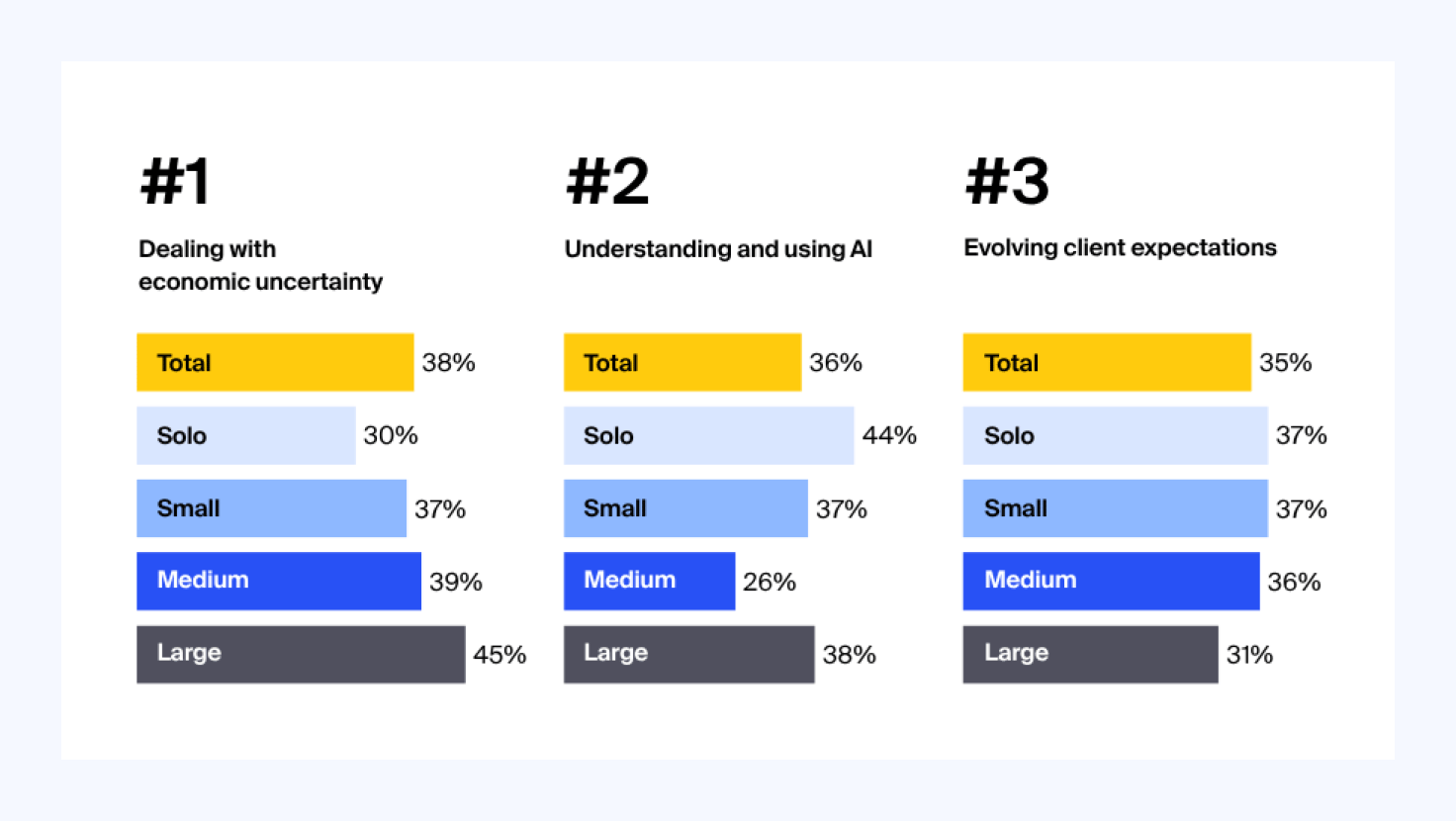
In contrast, solo practitioners and small firms are the most concerned about meeting client expectations (37%). Medium (36%) and large firms (31%) are more confident in this regard.
Solo practitioners are also the most worried about understanding and using AI (44%), followed by 38% of large firms that cite AI as a major challenge. Only 26% of medium-sized accounting firms say they’re concerned about implementing AI.
Navigating the accountant and CPA talent shortage
In 2024, 83% of financial leaders reported issues with a talent shortage, an alarming rise from 70% in 2022. Bachelor’s degree completions in accounting declined by 10.3% between 2021 and 2023, with Master’s degrees dropping by 7.6% over the same period.
The growing demand for accountants and CPAs is reflected in compensation projections. The Finance and Accounting Salaries and Salary Trends report forecasts an average +2.1% year-over-year salary gain across finance and accounting roles in 2026.
Salaries alone may not be enough to capture the top accounting talent, though. 79% of accountants want to work remotely or as part of a hybrid model, but a growing majority of firms say they won’t hire any remote talent. 62% of accounting firms said they wouldn’t hire any remote staff in 2025, up from 52% the previous year
33% of accounting firms say a lack of resources is their top growth barrier
In UpSlide’s Accounting and Advisory 2025 Report, 33% of accounting firms say a lack of resources is their biggest growth barrier.
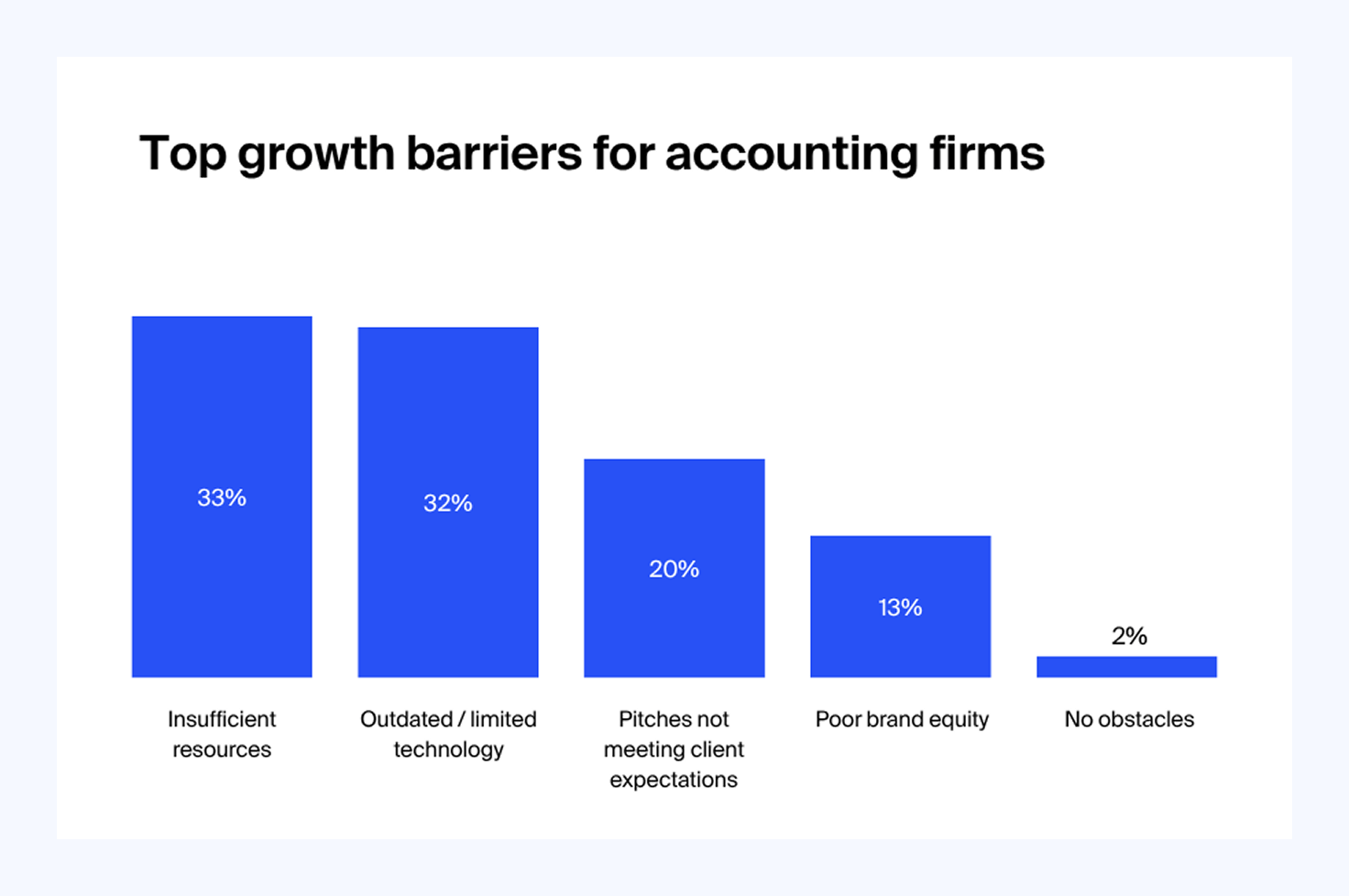
The report finds that “workflow weaknesses are standing in the way of growth” — and the barriers are higher at each growth stage. 41% of mid-size firms attribute losses to lacking a streamlined, effective tech stack.
C-suites are the most concerned, with 56% saying inefficient processes impact their firm’s ability to compete.
Technology in accounting and finance
Key accounting statistics:
- 60% of accounting firms plan to increase technology spend
- 80% of accountants feel AI will have a positive impact on their firm
- 77% of US firms plan to increase AI investment over the next three years
- 97% of accounting firms say they use tech inefficiently
- 66% of accountants feel overwhelmed by the complexity of their tech stack
Technology adoption and impact
In the 2025 Intuit QuickBooks Accountant Technology Survey, accountants report dedicating 62% of their time to compliance: tax filings, financial statements, bookkeeping, and auditing.
In the same report, 95% of accountants say technology helps free up capacity for strategic advisory services.
They say the top three impacts of technology on accounting services are:
- Boosting overall efficiency — 55%
- Providing advanced analytics for deeper business insights — 54%
- Automating repetitive compliance tasks — 48%
Meanwhile, Accounting Today finds that 60% of accounting firms planned to spend more on technology in 2025. That leaves 38% that planned to maintain their tech budgets for the year and only 2% that planned to spend less.
Spotlight Reporting asks accounting firms which technology they’re looking to implement in 2025 and 2026.
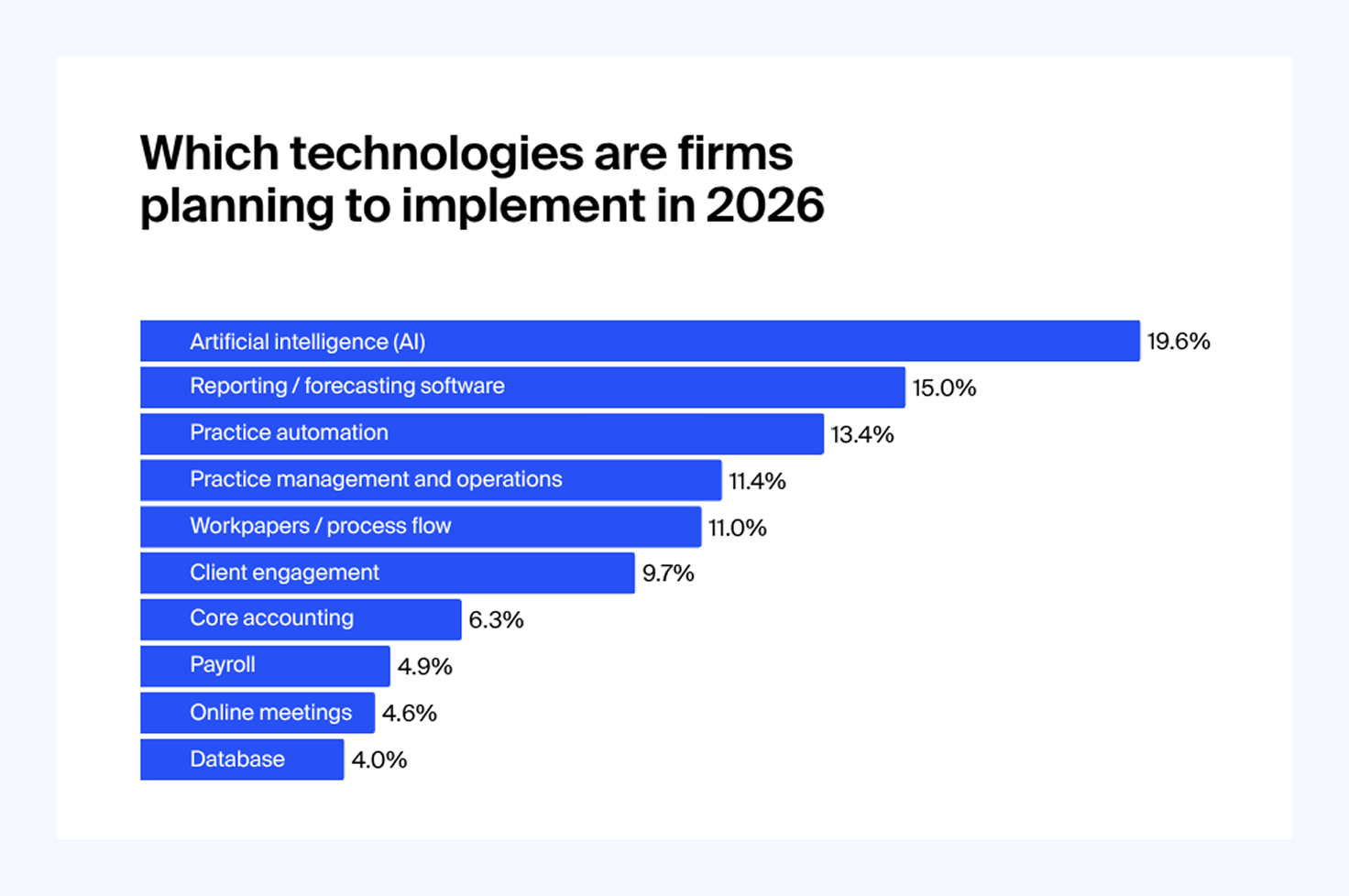
Implementing technology is one thing; getting a meaningful impact and ROI from it is something else. Especially at a time when only 10% of organizations currently see a significant ROI from their agentic AI investment.
The positive is that 50% expect returns within three years, and another third anticipate ROI within five years.
Bringing this back to accounting, Mordor Intelligence is tracking the impact of different technologies on the global accounting market.
| Driver | (~) % Impact on CAGR Forecast | Impact Timeline |
| Cloud-first finance-stack adoption | +2.1 % | Medium term (2–4 years) |
| Hyper-automation of bookkeeping workflows | +1.8 % | Short term (≤ 2 years) |
| AI-led anomaly detection & compliance | +1.5 % | Long term (≥ 4 years) |
| Mobile-first accounting experience | +1.2 % | Short term (≤ 2 years) |
| Real-time A/R–A/P financing via open banking | +0.9 % | Medium term (2–4 years) |
| ESG-grade audit-trail refresh cycles | +0.7 % | Long term (≥ 4 years) |
According to its analysis, fully investing in cloud systems has the biggest overall impact, but the “hyper-automation” of bookkeeping workflows offers a comparable and more immediate impact.
AI-led anomaly detection & compliance is among the longest timelines, but it still offers one of the strongest impacts overall. And we see a similar balance of impact of short-term returns from mobile-first accounting experiences.
Artificial intelligence (AI) in accounting statistics
AI brings both opportunities and challenges, but accountants are more excited about the technology than worried about it. In Xero’s 2025 State of the Industry Report, accountants named AI as their biggest opportunity (31%).
Furthermore, 79% of practices are optimistic about the future and 80% feel AI will have a positive impact on their firm.
In the US, 77% of accounting firms plan to increase investment in AI over the next three years — slightly ahead of those in Europe (75%), but lagging behind Asia-Pacific (82%).
This follows a quadrupling of AI implementation across the regions in 2025 from the previous year.
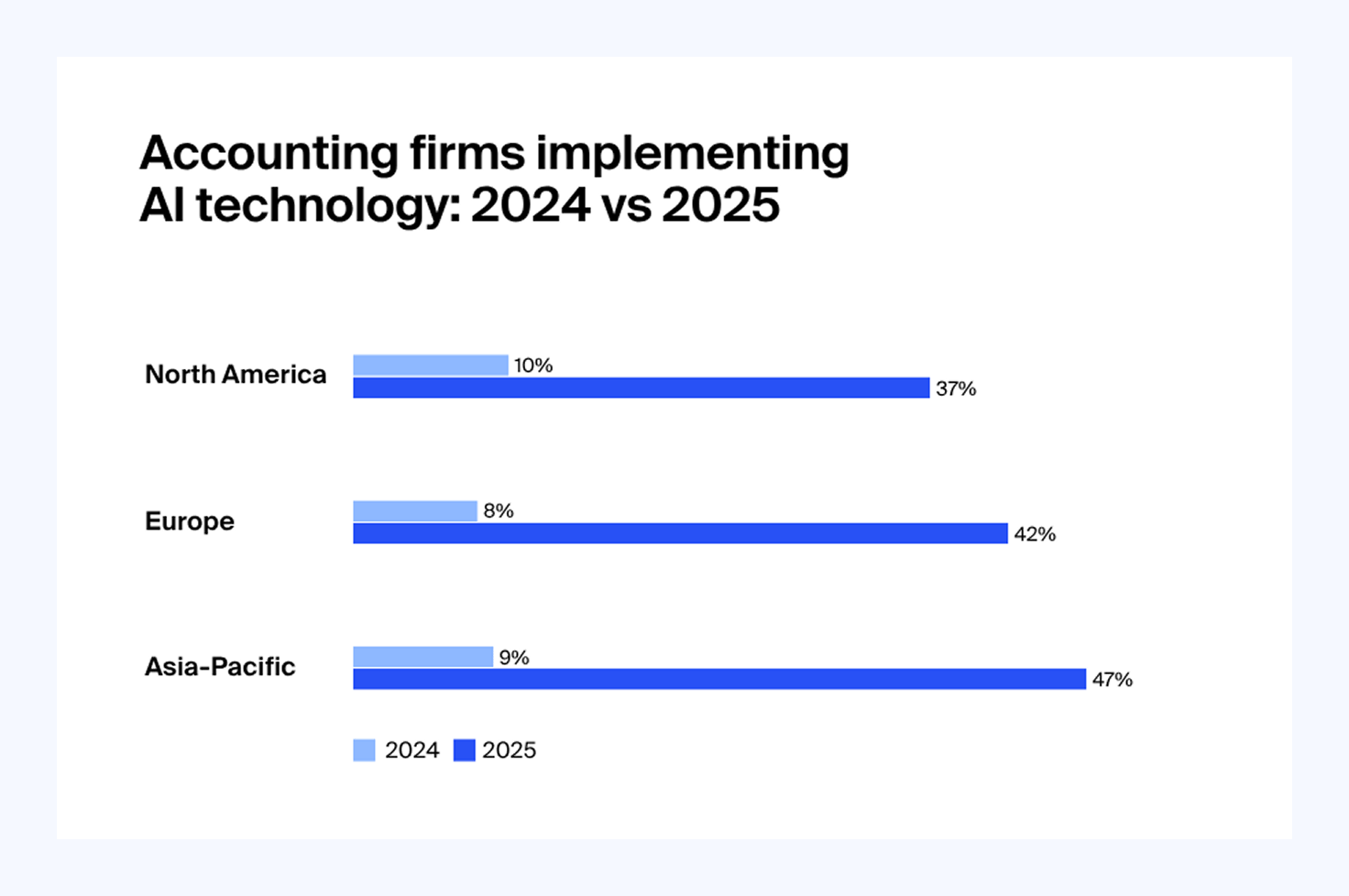
AI is establishing itself as an everyday tool in the accounting industry. In 2025, 46% of accountants say they use AI every day and 81% say it improves their productivity. Despite the challenges of implementing AI, accountants are overwhelmingly positive about its potential:
- 95% say AI reduces compliance time, freeing up resources for strategic advisory
- 86% agree that the technology reduces mental load
- 85% believe not adopting new tech will hinder growth
97% of accounting firms say they use tech inefficiently
According to a survey conducted by CPA.com and BILL, 97% of accounting firms say they use technology inefficiently. To make matters worse, 43% say inefficient technology use is increasing manual work instead of reducing it.
Respondents highlight the following inefficiencies limiting their gains from technology:
Top inefficiencies of accounting technology implementation
| Technology creating more manual work instead of reducing it | 43% |
| Delayed adoption of new technologies | 41% |
| Lack of integration between tools | 38% |
| Over-reliance on outdated tech | 35% |
| Difficulties with scaling to meet firm’s evolving needs | 34% |
| Underutilization of technology features | 34% |
Mordor Intelligence cites data sovereignty and privacy regulations as the biggest barrier to successful implementation. The cost of switching from legacy systems to newer technology and a scarcity of AI-ready accounting talent round up the top three barriers in its research.
Accountants raise a different issue in Intuit’s accounting technology survey: a dependence on too many tools. The report finds accounting firms use an average of 8 different digital tools with 89% saying better integration is needed to drive growth.
The dependence on too many tools is creating critical growth barriers in accounting tech strategies:
- High subscription costs — 44%
- Integration challenges — 41%
- Time-consuming data entry — 41%
- Staff training on multiple platforms — 33%
As a result, 66% of accountants say they feel overwhelmed by the complexity of their tech stack at least once a week.
Client expectations and priorities
Key accounting statistics:
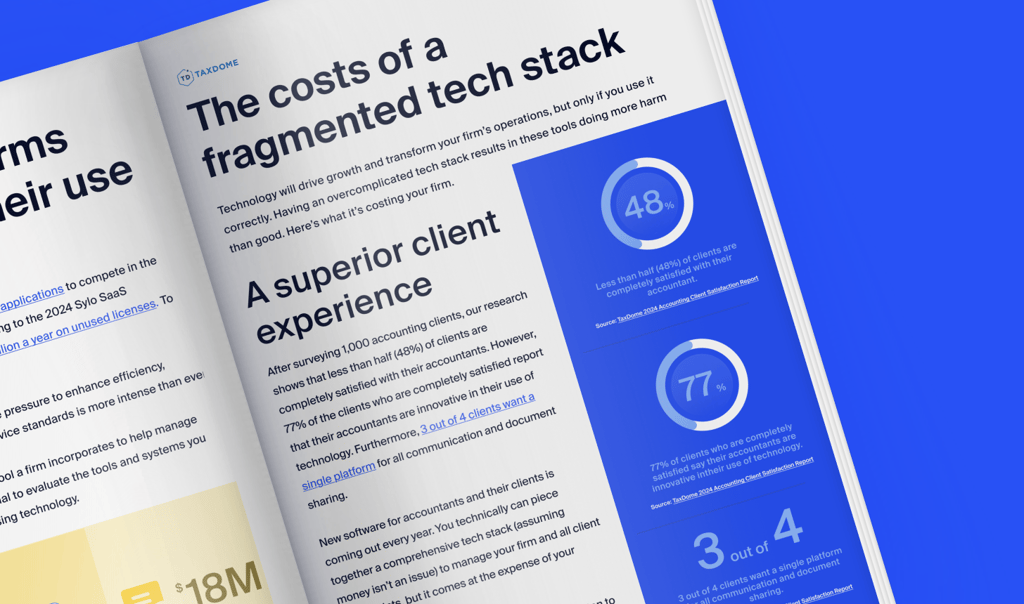
- Only 48% of clients said they are fully satisfied with their accountant
- 77% of satisfied clients cite their accountant’s innovative use of technology
- 89% say they want assurances that their information is stored securely
- 71% of accounting clients want a simple, clear onboarding experience
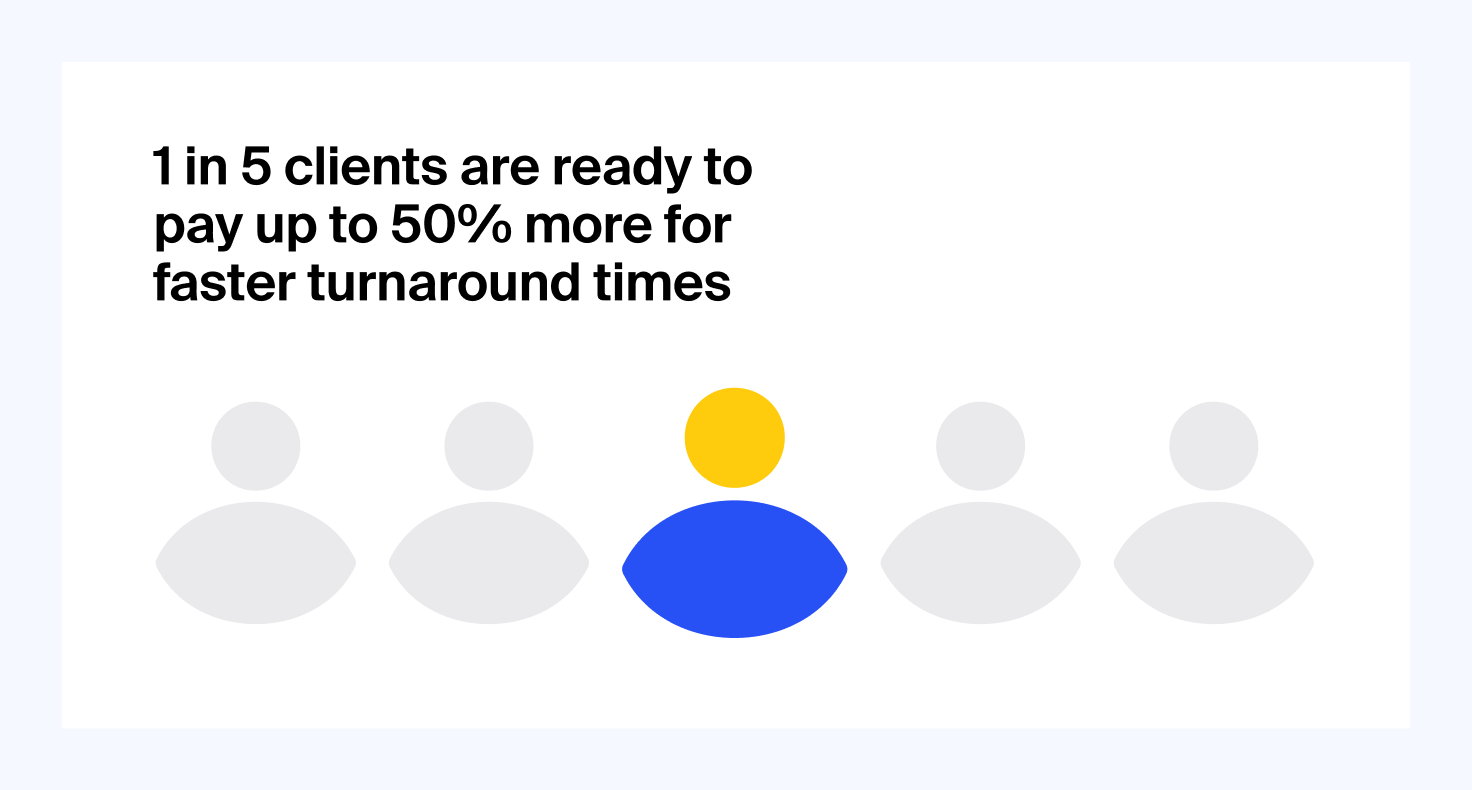
- 1 in 5 clients say they’d pay up to 50% extra for faster services
What do clients want from accounting firms?
Client attitudes towards accounting firms are also changing, and we wanted to find out what they really care about. In the TaxDome Client Satisfaction Report, we asked business taxpayers what they value the most from an accounting firm.
- 84% want to be informed about last-minute changes
- 84% value a personalized approach to their tax strategy
- 82% want to see a clear order of steps to be followed
- 78% want to be updated regularly on their filing status
- 73% want to understand why specific actions are being recommended
- 70% want everyone involved in tax filing to be included in communications
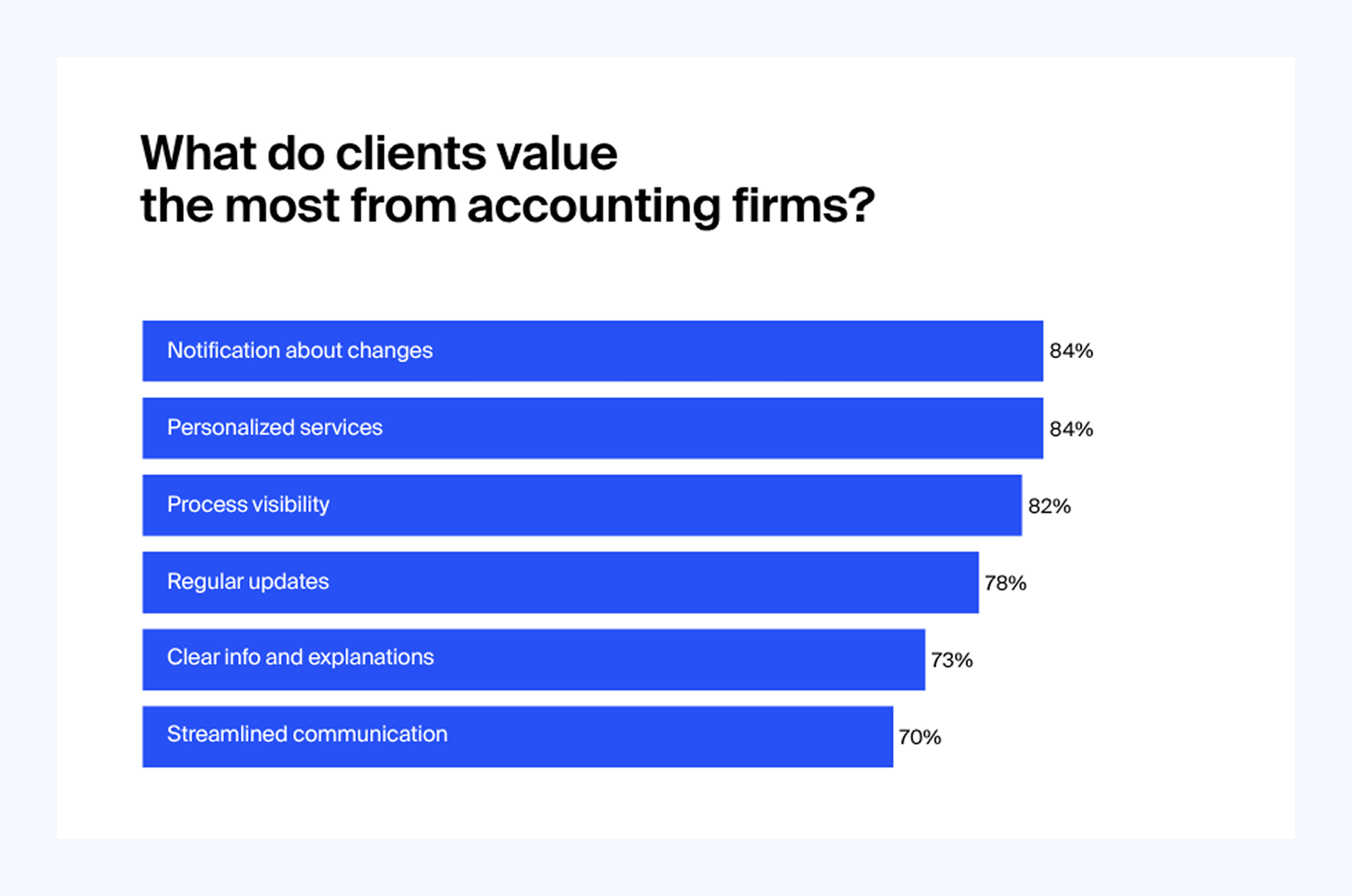
Ultimately, clients want their individual needs met at a deeper level, and they want to see the results for themselves. They want to see progress in real time, without having to ask for updates.
In fact, 1 in 3 clients dislikes following up with their accountant. Clients want their accountant to provide regular updates and make it clear why specific actions are being taken.
In terms of personalizing services, clients highlight two key areas they value most:
- 71% of accounting clients want an onboarding experience that explains how they’ll work with you, including key processes, such as document sharing and communication.
- 61% of accounting clients appreciate personalized intake forms that ask for information upfront, especially if the forms are tailored to them and only request relevant info.
We can summarize all of these points into one insight: clients want the highest quality of service with minimal inconvenience — and they’re willing to pay for the privilege.
When 1 in 5 clients say they’d pay up to 50% extra for faster turnaround times, accounting firms need to question whether they could deliver services more efficiently.
How do clients feel about accounting technology?
We’ve discussed accountants’ attitudes towards technology, but where do your clients stand on digitizing accounting services?
Well, firstly, clients want to know their accountants are doing everything possible to keep their data secure. 89% say they want assurances that their information is stored securely and 76% want their accountant to provide proof of secure data storage.
Beyond this, clients are largely positive about accounting technology — as long as it serves their interests. Accounting firms need to demonstrate that their technology enhances client experiences without compromising safety.
We see this balance of interests throughout our Client Satisfaction Report:
- 76% of clients want a secure portal for uploading sensitive information
- 77% value 2-factor authentication for digitally sharing information with their accountant
- 79% agree that secure portals make document sharing, signatures, payments, and messaging safer and more efficient
- 3 in 4 clients say they want a single platform for all communications and document sharing
Businesses want to know their data is safe, but they appreciate accountants using technology to improve outcomes for them.
In our survey, only 48% of clients said they are fully satisfied with their current accountant but 77% of those who are fully satisfied cite their accountant’s innovative use of technology.
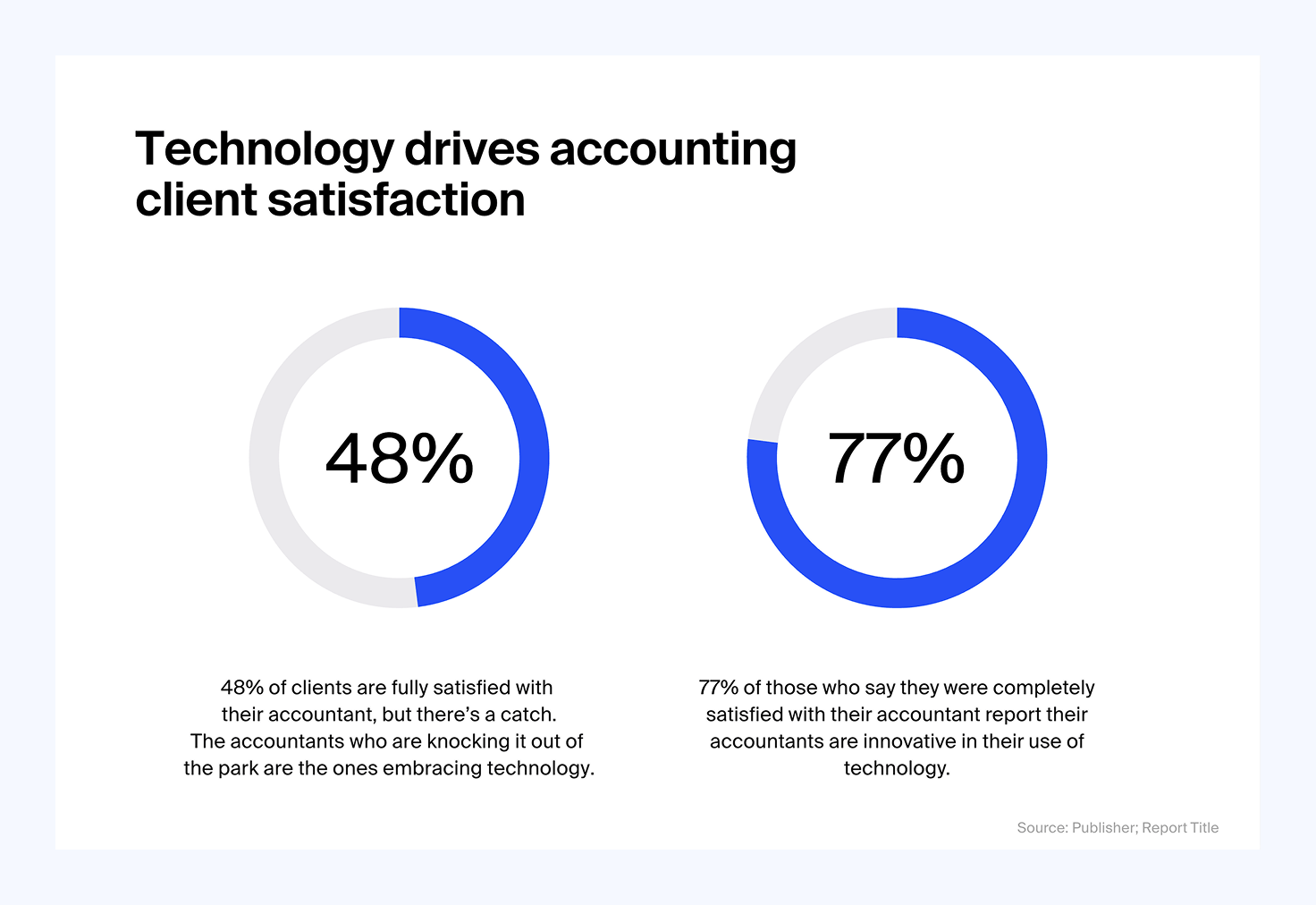
The caveat is that the technology firms implement should both improve the quality of services and simplify the client experience. Almost 80% of clients say that easy-to-use tools are a crucial aspect of working with accountants.
The state of accounting in 2026
Despite industry disruption, the key takeaways from these accounting statistics are remarkably positive. Growth is healthy, the demand for advisory is rising, and technology offers solutions to problems new and old.
Key takeaways:
- Growth is strong: most firms reported revenue gains in 2025 and remain optimistic for 2026
- The path to success is changing: client expectations are increasing and firms need to keep up with their growth ambitions
- Advisory as a core service: demand for strategic advisory is soaring and it drives more ROI than other services
- Automation powers the transition: the top accounting firms are automating the most repetitive and time-consuming tasks so they can free up resources for advisory
- Clients crave technology: they want to use one secure platform that makes the whole client experience as effortless as possible
- Big-spending clients are niching down: growing companies turn to firms that specialize in their field — and once they go niche, they don’t go back
- Retention rules: Service quality, convenience, and confidence (security) are the keys to retaining top clients
If 2025 proved anything, it’s that the top accounting firms are turning challenges into opportunities with smarter tech choices. The firms pulling ahead this year are the ones stepping up to meet client demands and innovating ways to operate more efficiently.

Aaron produces practical content for TaxDome, drawing on 11 years in SaaS copywriting and marketing. He helps accounting and tax professionals get the most from TaxDome and other tools, making complex topics clear and actionable.
Get your free guide

Thank you!
The guide copy has been sent to your email. Please check your inbox!
Recommended articles

9 best QuickBooks alternatives in 2026 for every business type

How to start an accounting firm: a step-by-step guide to running your own practice

Top 13 project & task management software for accountants and tax professionals in 2026