 US – English
 UK – English
 Canada – English
 Australia – English
 Danmark – Dansk
 DACH - Deutsch
 France – Français
 España – Español
 Sverige – Svenska
 Italia – Italiano
 Nederland – Nederlands
 Portugal – Português
 Suomi – Suomi
 Norge – Norsk
 日本 – 日本語
 Romanian – Română












CFO vs Controller: understanding the differences in financial leadership
Run your entire firm on one platform
The CFO and controller are indispensable leaders at the helm of an organization’s financial operations. Though they have distinct roles, they share a crucial mission: orchestrating a company’s financial fortunes as an unstoppable duo.
This article compares the CFO and controller roles, exploring their unique expertise, outlooks, and leadership styles. Read on to discover the way their synergy ensures financial excellence.
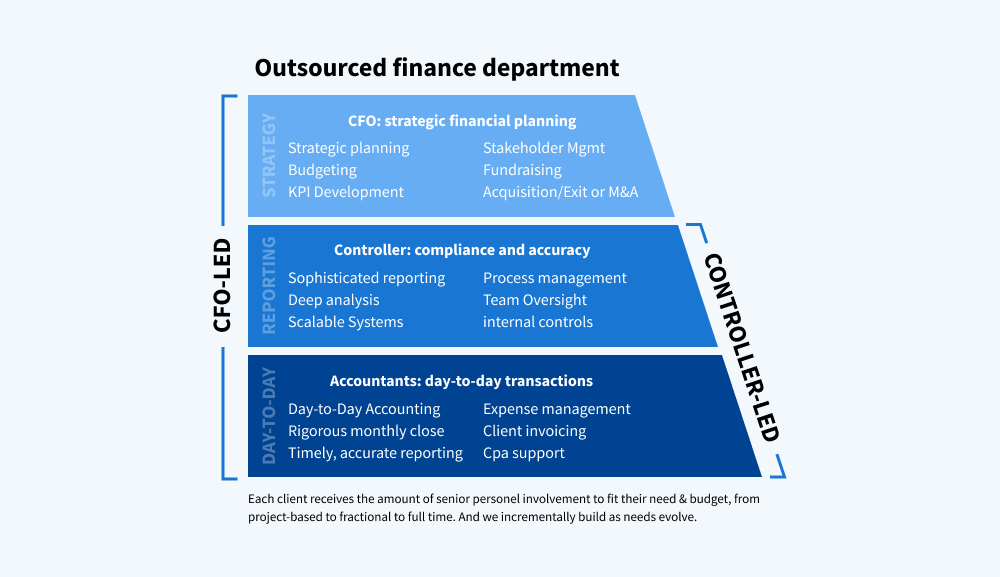
Table of сontents
What is a CFO?
The chief financial officer (CFO) is the highest-ranking finance executive within an organization, overseeing all financial operations and activities. They translate strategic objectives into actionable financial plans, leveraging leadership skills and deep financial expertise.
On a day-to-day basis, a CFO’s duties typically involve:
- Conducting in-depth financial analyses to develop forecasts, financial models, and key performance metrics
- Collaborating with departmental leaders to provide financial guidance and assess their financial performance
- Optimizing working capital through effective cash flow management and inventory control strategies
- Supervising the preparation and submission of financial statements, regulatory filings, and other statutory reporting obligations
- Managing relationships and communication with lenders, investors, and other key financial stakeholders
For a more comprehensive understanding, refer to our in-depth article, What does a CFO do?
What is a controller?
A controller is a senior accounting and finance professional responsible for overseeing an organization’s accounting operations, financial reporting, and internal control procedures. They ensure the accuracy, integrity, and compliance of financial records and statements.
Core controller responsibilities include:
- Enforcing accounting policies and supervising the department
- Maintaining robust internal controls to safeguard assets and financial data reliability
- Overseeing the preparation and review of financial statements
- Coordinating external audits and ensuring regulatory compliance
- Analyzing financial data to support strategic decision-making by senior management
- Monitoring and optimizing accounting processes and systems
Controllers bridge the gap between accounting and senior leadership, providing critical financial analysis and insights.
Key differences between CFOs and controllers
The table below summarizes the key distinctions between CFOs and controllers:
| CFO | Controller | |
| Core expertise | Broad financial management | Specialized accounting |
| Strategic outlook | Long-term strategic vision | Operational focus |
| Leadership approach | Sets financial strategy and tone | Executes directives |
| Stakeholder interactions | Internal and external | Primarily internal |
| Reporting structure | Reports to CEO and board | Reports to CFO |
| Educational and professional background | Business and finance degrees | Accounting degrees, CPA |
| Compensation and salary range | $332,500 – $563,000 | $212,054 – $295,784 |
| Typical tools and technologies | Financial modeling, BI tools | Accounting software, ERPs |
Now, let’s delve deeper:
Core expertise
While controllers specialize in accounting, CFOs have broader expertise across the finance domain:
- Controllers’ core competencies lie in accounting principles, financial reporting, compliance, and internal controls
- CFOs develop comprehensive skills in strategic finance, financial analysis, modeling, and corporate finance decision-making
The controllers’ expertise in accounting ensures financial integrity, and the CFOs’ extensive financial knowledge makes value creation and strategic leadership possible.
Strategic outlook
While controllers focus on operations, CFOs take a more strategic, forward-looking perspective:
- Controllers primarily maintain an operational focus, ensuring adherence to financial processes, policies, and day-to-day accounting activities
- CFOs provide financial leadership aligned with long-term organizational goals, growth plans, and value creation initiatives
Controllers execute financial operations compliantly, enabling CFOs to apply strategic financial planning that charts the company’s overall direction and future growth.
Leadership approach
While controllers execute directives and maintain financial discipline within established policies, CFOs set the overall financial strategy and guide financial decision-making across the organization.
Stakeholder interactions
Controllers focus on internal communication with departmental managers to ensure financial compliance and reporting accuracy. In contrast, CFOs engage with both internal teams and external stakeholders, such as investors, analysts, and auditors, to represent the company’s financial standing.
Reporting structure
Controllers typically report to the CFO within the organization, whereas the CFO is a senior executive reporting directly to the CEO and board.
Educational and professional background
The typical educational paths and career trajectories of controllers and CFOs differ significantly:
- Controllers often possess accounting degrees, coupled with certifications such as CPA, and extensive experience in accounting roles
- CFOs commonly hold advanced degrees in finance or business administration, accompanied by progressively senior finance and leadership roles
While controllers build deep, specialized expertise in accounting, CFOs cultivate a broader, multidisciplinary background that combines financial acumen with strategic management capabilities.
Compensation and salary range
The compensation levels for controllers and CFOs reflect the differing scopes of their roles:
- Controllers typically earn an average salary of $252,144 in the United States
- CFOs command an average salary of $438,800
The higher pay for CFOs represents the greater organizational impact and value created through their financial leadership compared to the more specialized controller role focused on accounting operations.
Typical tools and technologies
The core tools leveraged by controllers and CFOs align with their respective roles and responsibilities:
- Controllers primarily utilize accounting technology, enterprise resource planning (ERP) systems, and data analytics tools to manage financial reporting, auditing, and compliance activities
- CFOs rely more heavily on financial modeling software, business intelligence platforms, and data visualization tools to perform financial forecasting, strategic analysis, and translate data into actionable insights
While controllers leverage technologies geared toward accounting operations and controls, CFOs employ tools that support strategic financial planning, analysis, and decision-making for the broader organization.
FAQs
What are the primary differences between a CFO and a controller?
The primary differences are in their core expertise (CFOs have broad financial expertise, and controllers specialize in accounting), strategic outlook (CFOs are forward-looking, and controllers are operationally focused), and leadership approach (CFOs set strategy, and controllers execute directives).
Is a controller higher than a CFO?
No, a controller is not higher than a CFO within an organization’s hierarchy. Controllers typically report to the CFO, who is a senior executive reporting directly to the CEO and board of directors.
Can a CFO also fulfill the responsibilities of a controller simultaneously?
While it is possible for a CFO to temporarily assume controller responsibilities in certain situations, it is uncommon for a CFO to fulfill both roles simultaneously on a long-term basis due to the distinct nature of their responsibilities.
Can a controller become a CFO? What is the typical career path?
Yes, it is possible for a controller to advance to the role of a CFO, although the career path may involve additional education and professional development. Typically, controllers with extensive accounting experience and a proven track record may pursue advanced degrees in finance or business administration to broaden their expertise.
In what ways do CFOs and controllers collaborate within a company?
CFOs and controllers work closely together to ensure the financial health and compliance of the organization. Controllers provide financial data and ensure compliance, while CFOs use this information for strategic financial planning and decision-making.
How do the educational and professional backgrounds of CFOs and controllers typically differ?
It is common for controllers to hold accounting certifications and a bachelor’s or master’s degree in the field. In contrast, CFOs commonly hold advanced degrees in finance, business administration (MBA), or related fields.
Conclusion
In summary, CFOs and controllers play distinct yet complementary roles in ensuring an organization’s financial health and strategic growth trajectory. While their responsibilities and focus areas differ, their effective collaboration is crucial for translating strategic objectives into operational financial realities.

Mari develops TaxDome content by combining customer insights, industry research, and real-world trends. Her structured, automation-driven approach ensures messaging is clear, relevant, and supports more connected and efficient accounting firms.
Get your free guide

Thank you!
The guide copy has been sent to your email. Please check your inbox!
Recommended articles

How to start an accounting firm: a step-by-step guide to running your own practice

Accounting process improvement: Practical strategies, tools, and real-world examples

What is accounting workflow management? The complete guide with real-world examples