 US – English
 UK – English
 Canada – English
 Australia – English
 Danmark – Dansk
 DACH - Deutsch
 France – Français
 España – Español
 Sverige – Svenska
 Italia – Italiano
 Nederland – Nederlands
 Portugal – Português
 Suomi – Suomi
 Norge – Norsk
 日本 – 日本語
 Romanian – Română












CPA vs accountant: what’s the difference?
Run your entire firm on one platform
Key takeaways:
- CPAs and accountants differ in terms of their service offerings, expertise, legal authority, cost, and more. Which one you should work with depends on your specific needs.
- CPAs are held to rigorous standards by professional accounting bodies. This involves passing complex exams and meeting strict criteria for education, work experience, professional ethics, and continuous professional development.
- As a result, CPAs tend to offer highly specialized services, such as external audits, IRS representation, business consulting, and forensic accounting.
- Accountants aren’t held to the same strict standards as CPAs and tend to have more limited expertise. They are a sensible and cost-effective choice for routine accounting services such as financial reporting, bookkeeping, payroll, and tax preparation.
- The TaxDome Accountant and Advisor Finder is the fastest way to find trusted accountants and CPAs in your area
The terms “accountant” and “CPA” are often used interchangeably. This is understandable — accountants and CPAs have plenty in common. However, there are also important distinctions between these two professional roles.
In this article, we’ll explore the key differences between CPAs and accountants. We’ll focus on factors such as qualifications, expertise, services offered, and costs. So when the time comes to work with an accounting professional, you’ll have the information you need to make the right choices.
Table of сontents
- What’s the difference between an accountant and a CPA?
- What is an accountant?
- What is a CPA?
- Accountant vs CPA costs
- How to find a CPA or an accountant in your area
- Responsibilities and services
- Education and certification
- Training and licenses
- When to Hire a CPA vs an Accountant
- Frequently asked questions
- To sum up
Table of сontents
- What’s the difference between an accountant and a CPA?
- What is an accountant?
- What is a CPA?
- Accountant vs CPA costs
- How to find a CPA or an accountant in your area
- Responsibilities and services
- Education and certification
- Training and licenses
- When to Hire a CPA vs an Accountant
- Frequently asked questions
- To sum up
What’s the difference between an accountant and a CPA?
Accountants and CPAs have a lot in common, but there are also plenty of differences that distinguish these two roles. While both accountants and CPAs help individuals and businesses manage financial processes, CPAs stand out from their counterparts in various ways.
What is an accountant?
An accountant — or for the purposes of this comparison a regular accountant — is a financial professional who manages and analyzes financial transactions for both businesses and individuals. They may also oversee key operational processes such as payroll, bookkeeping, and tax preparation.
Accountants often have relevant qualifications, such as a degree in accounting or finance. But they aren’t held to the same rigorous standards as CPAs. As such, they tend to focus more on day-to-day accounting processes rather than highly specialized accounting fields.
What is a CPA?
A certified public accountant, also known as a CPA, is a highly qualified accountant who has met rigorous educational and professional requirements overseen by a professional accounting body, such as the American Institute for Certified Public Accountants (AICPA). To become a CPA, you must:
- Pass a series of exams
- Demonstrate a minimum level of work experience
- Adhere to a strict code of professional ethics
- Maintain your designation through continuous professional development (CPD)
Like regular accountants, CPAs can handle day-to-day accounting tasks. But because they have met such rigorous professional standards, CPAs are sought after for highly complex, specialized, and high-value accounting work.
CPAs maintain their designation on an ongoing basis by meeting the requirements set out by a professional accounting body.
While accountants tend to handle routine accounting tasks, CPAs often engage in more complex services. In some cases, CPAs are authorized to provide services that regular accountants cannot, such as performing external audits and representing clients in front of the IRS.
Accountant vs CPA costs
Cost is another major differentiator between CPAs and accountants. Because CPAs have met rigorous standards around expertise, experience, and professional ethics, they can charge more than regular accountants. CPAs also tend to work in more specialized areas of accounting, which come at higher costs than routine accounting services.
In this section, we’ll compare the costs of working with an accountant and CPA across different services. As you can see, accountants tend to be a more cost-effective choice for routine accounting services. For more complex services, a CPA is the best — and in some cases the only — choice.
Accountant costs
The amount an accountant charges varies depending on factors such as their level of experience and expertise, where they are based, and the complexity of the specific job. Here are some ballpark figures for working with an accountant in the US:
- Bookkeeping: $30 to $100 per hour, depending on the size and complexity of the business
- Individual tax return: $100 to $500+, depending on the complexity of the return
- Corporate tax return: $300 to $2,000+, depending on complexity and business type
- Payroll management: $50 to $500+, depending on the number of employees
- Consulting: $100 to $250 per hour, depending on experience and location
Further reading: for a deeper dive into accountant costs, check out our dedicated blog post: How much does an accountant cost? A comprehensive guide to accountant fees and charges.
CPA costs
CPA costs are influenced by the same factors as accountant costs. You’ll pay a premium for experience, specialist expertise, and CPAs from large, established firms.
- Individual tax return: $250 to $800+, depending on the complexity of the return
- Corporate tax return: $500 to $5,000+, depending on complexity and business type
- Consulting: $250 to $500 per hour
- IRS representation: $250 to $500 per hour
- Auditing: $10,000 to more than $10 million depending on the complexity and size of your business
Further reading: learn more about the cost of working with a CPA in our recent blog post: How much does a CPA cost in 2026? Understanding CPA fees, rates, and pricing.
How to find a CPA or an accountant in your area
With approximately 1.4 million accountants and more than 46,000 public accounting firms in the US alone, searching for an accounting professional can be overwhelming and time-consuming. In this section, we’ll explore some tried-and-tested strategies for finding the right accountant or CPA for your needs.
TaxDome Accountant and Advisor Finder (and other directories)
The TaxDome Accountant and Advisor Finder is a directory built to help you find the right accountant or CPA without turning the search into a research project. Instead of comparing dozens of websites, you get the details that matter, expertise, services offered, and the kinds of clients each professional works with, all in one place.
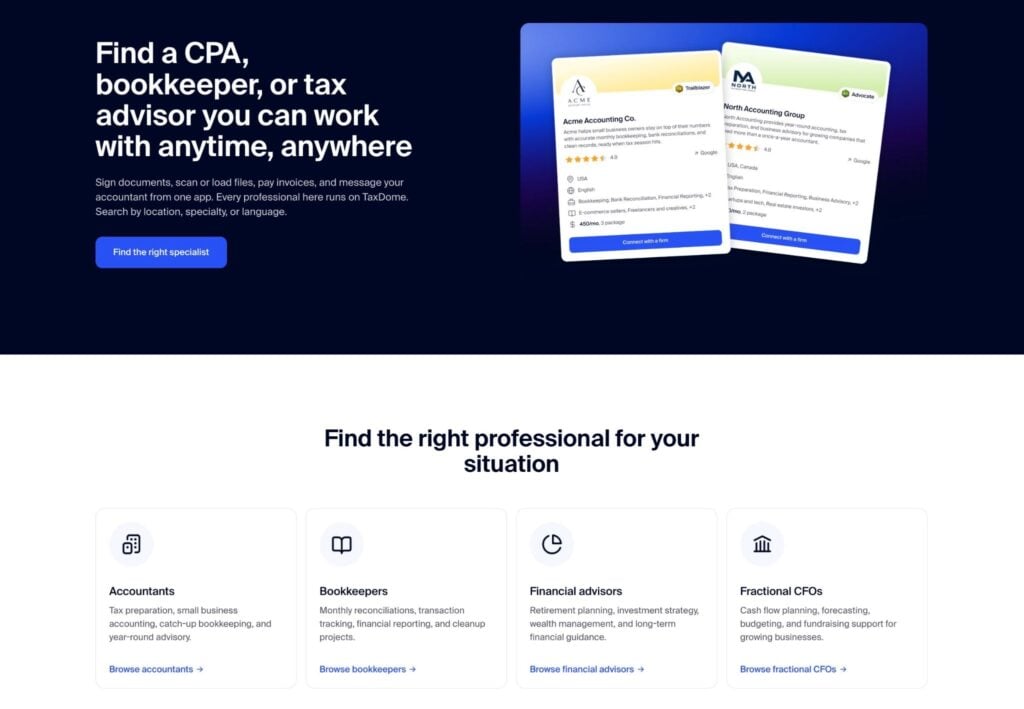
You can filter results by State, Languages, Services, Specialties, and Industries, to find accountants in your area who match your needs. Instead of spending hours or days searching for suitable accountants, the TaxDome directory gives you a shortlist of candidates in minutes.

The profiles in our directory include all the information you need to choose your next accountant with confidence. Review scores are pulled from each firm’s Google Reviews account, and you can click through to their Google Maps profile to verify.
You can compare the locations, services, specialties, and industries of each accountant, side by side. Many accountants provide us with pricing information when they sign up for our directory, so you can compare hourly rates or starting fees.
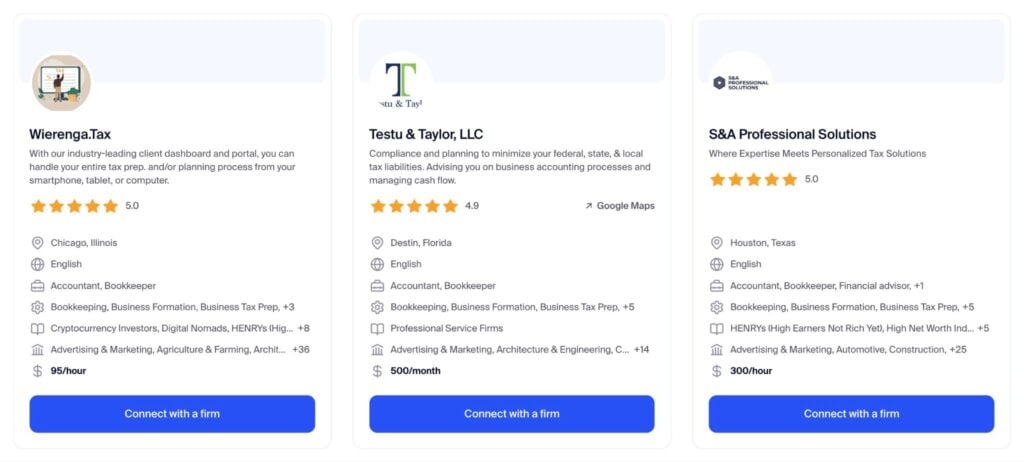
When you find an accountant or CPA who looks like a good fit, you can connect with them directly through our directory. Simply fill out the form on their profile, and we’ll send an inquiry to them on your behalf. You can connect with multiple accountants from the directory, and each firm will reach out to you at the email address you provide.
Many professional bodies in the accounting industry also include their own directories:
- AICPA membership directory. Locate and confirm AICPA members by name or location. Best for verifying that a CPA is an active member in good standing.
- IRS Directory of Federal Tax Return Preparers. Searchable by ZIP code or credential, it lists preparers who hold IRS-recognized credentials, including CPAs, enrolled agents, and attorneys. Useful when you specifically need someone for tax work.
- State CPA society directories. Most states run a “Find a CPA” directory through their CPA society, such as the Illinois CPA Society or NJCPA, where you can search local members by location, service, and industry.
For example, here’s a quick preview of a search result from the directory of the Florida Institute of Certified Public Accountants (FICPA): https://www.ficpa.org/.

Professional networks
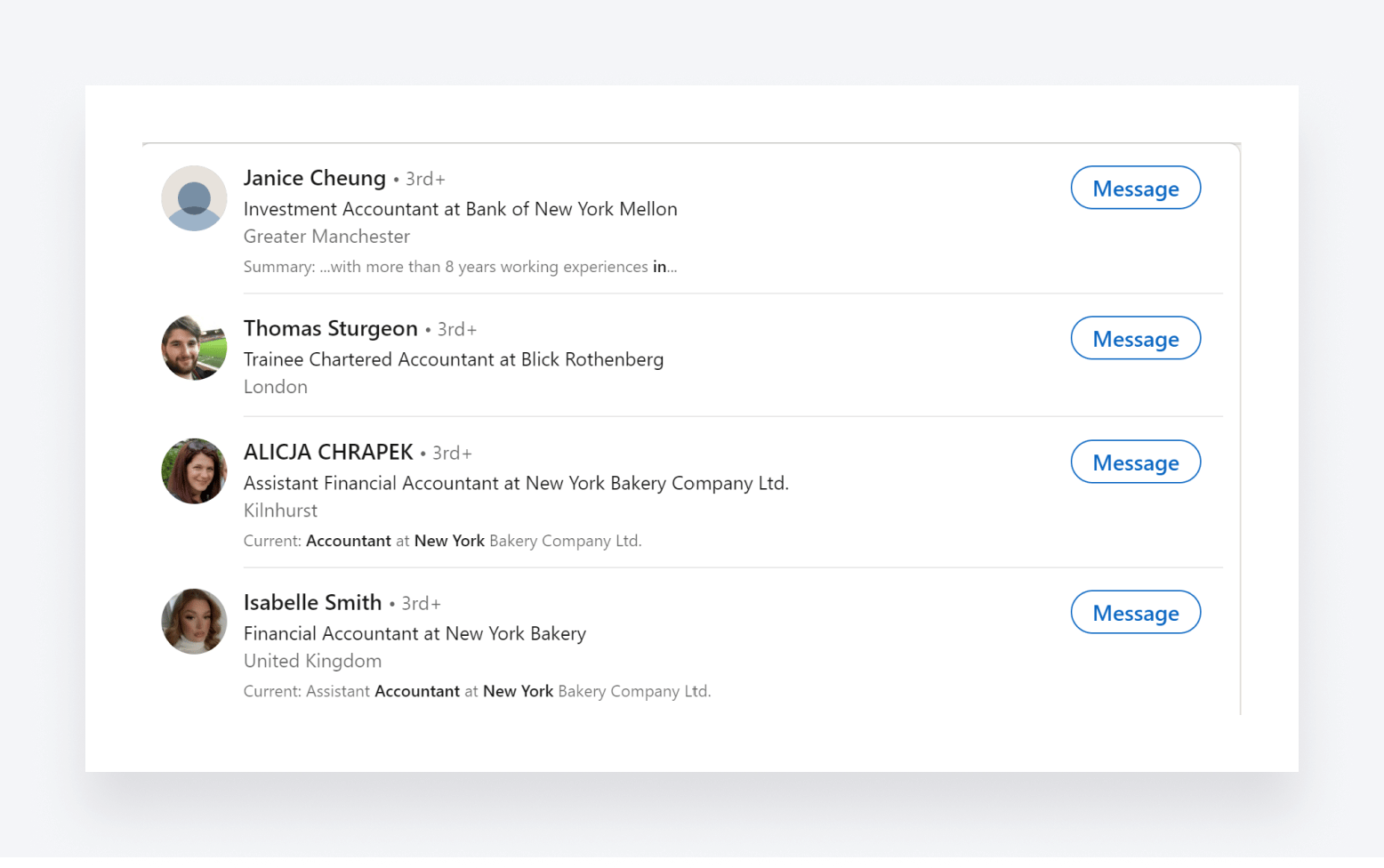
Professional networks are a great place to search for and connect with accountants and CPAs. Virtually all professional service providers and accounting firms will have a LinkedIn profile, for example.
What’s more, you can tap into your existing network and ask people you trust for recommendations. Another option is to join industry groups and ask there. For example, you could join a LinkedIn group for small business owners and ask if anyone can recommend a CPA for tax services.
Online search
When it comes to looking for professional service providers, Google is an obvious place to start. In a few short seconds, you can get thousands of relevant results. Google also provides local business profiles, complete with client reviews, average ratings, opening times, and addresses. The reviews are particularly useful when deciding which accountant or firm to go with.
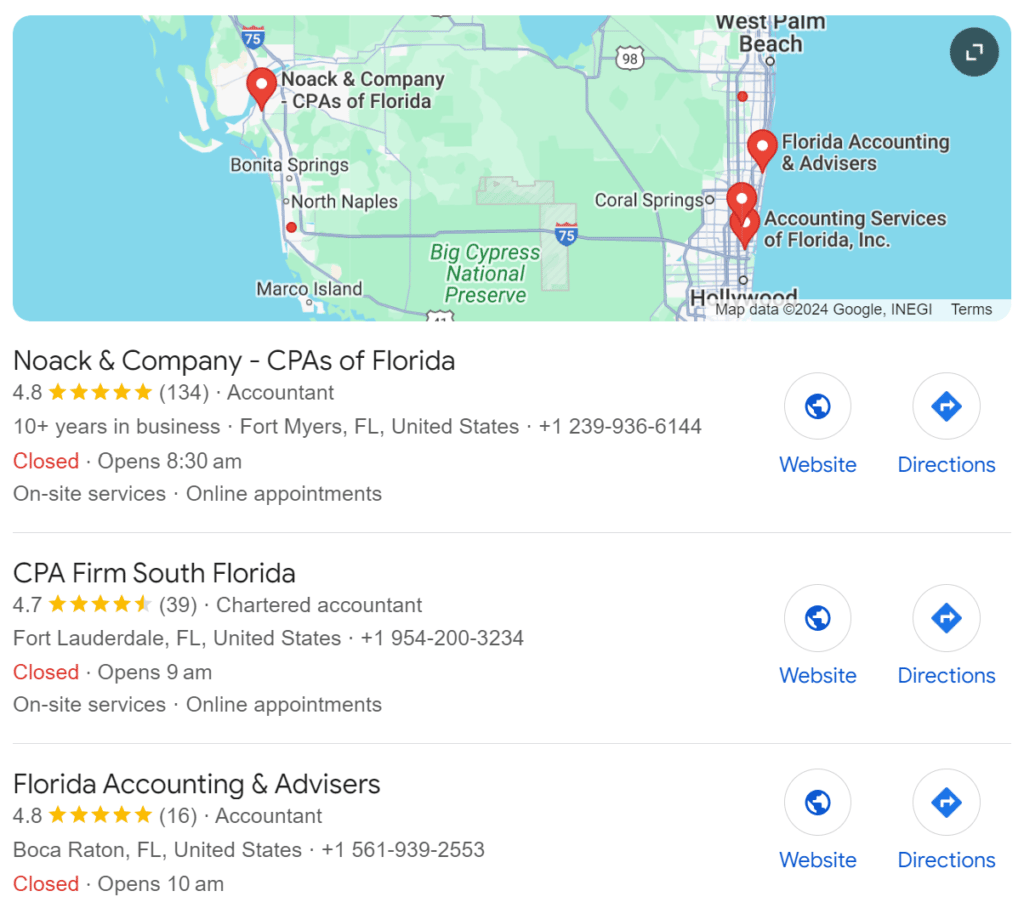
The issue with Google, however, is that the sheer volume of search results can be overwhelming. Plus, you have to essentially vet each accountant yourself, which can be a time-consuming and laborious process.
Responsibilities and services
While there is some overlap between the services accountants and CPAs provide, there are also significant differences. In this section, we’ll provide a quick overview of the scope of each role.
What services do accountants provide?
Accountants perform a wide range of day-to-day accounting tasks. Their job involves overseeing and analyzing financial transactions, as well as other operational processes
involving tax, pay, and compliance. Here are some of the main responsibilities of accountants:
Bookkeeping
Bookkeeping is often seen as a separate practice from accounting. The former involves recording and managing financial transactions, while the latter involves analyzing and interpreting the resulting financial data. That said, there’s often some overlap, and accountants often find themselves managing a business’s books.
Financial reporting
One of the core responsibilities of an accountant is preparing financial statements, including balance sheets, income statements, and cash flow statements. These provide a snapshot of a business’s financial position, forming the backbone for major corporate decisions.
Tax preparation
Tax preparation is another standard accounting task. Each tax season, accountants help businesses and individuals prepare and file their income tax returns accurately and on time. Some accountants focus entirely on tax preparation. Others may offer additional tax services, such as tax planning and consulting.
Payroll management
Payroll is a crucial function that ensures that employees and contractors get paid accurately and on time. Accountants may be responsible for calculating wages, deducting withholding taxes, managing employee benefits, and generating payroll reports.
Financial analysis
In addition to financial reporting, accountants will be tasked with analyzing financial data and presenting insights to key stakeholders within the business. These insights could span business performance, profitability, growth projections, and potential risks.
What services do CPAs provide?
In addition to the day-to-day tasks that regular accountants perform, CPAs tend to handle more complex, specialized, and high-impact accounting work. In some cases, they are legally authorized to perform certain duties that regular accountants are not. Here are some examples of typical services a CPA may provide:
Auditing
CPAs often conduct audits to ensure that a company’s financial statements are accurate and compliant. While a regular accountant can conduct an internal audit, external audits can only be performed by a CPA.
Tax planning and advisory
CPAs offer more complex tax services than regular accountants. They help clients reduce their tax liabilities through tax planning and advisory services. In some cases, clients may be large corporations with complex international tax obligations.
Representation before the IRS
Alongside enrolled agents and tax attorneys, CPAs are legally entitled to represent taxpayers in front of the Internal Revenue Service (IRS) during audits, disputes, or other tax-related matters. This typically involves communicating with the IRS, requesting information, and entering into agreements on the client’s behalf.
Forensic accounting
CPAs often specialize in niche accounting areas such as forensic accounting. This involves reviewing financial records and transactions to identify instances of fraud, embezzlement, or other financial crimes.
Business consulting
CPAs regularly advise companies and business leaders on financial strategies. This could involve providing insights into the financial implications of major corporate transactions, such as mergers, acquisitions, and investments.
For a quick look at the different responsibilities and services offered by accountants and CPAs, take a look at the comparison table below:
| Service | Accountants | CPAs |
| Bookkeeping | Record and manage daily financial transactions | CPAs generally focus on higher-level tasks |
| Financial reporting | Prepare accurate financial statements | Prepare and audit financial reports for accuracy and compliance |
| Tax services | Tax preparation for individuals and small businesses | Complex tax filing for large corporations, plus tax planning and advisory |
| Auditing | Basic internal audits only | Rigorous external audits for PLCs and other organizations |
| IRS representation | No authorization | Authorized to represent clients in IRS audits and disputes |
| Consulting | Consulting on tax and financial performance | In-depth financial consulting and business strategy |
Education and certification
Both CPAs and accountants must prove a minimum level of education and qualifications to forge a career. In this section, we’ll explain the differences between the two educational pathways.
What education or certification do accountants need?
To become an accountant, you typically require a bachelor’s degree in accounting, finance, or another related field. With an accounting degree ticked off, you can go about looking to gain real-world work experience, without the need for additional certification. Once you’ve landed that first accounting job, you are an accountant by definition.
What education or certification do CPAs need?
To gain the CPA designation in the US, on the other hand, you must meet stringent requirements set out by AICPA and the state in which you will practice.
One such example is AICPA’s 150-hour requirement for relevant education. This is usually achieved through a combination of undergraduate and post-graduate training. So, for example, a budding CPA may have to combine a relevant bachelor’s degree with a master’s degree or other post-graduate course to meet this requirement.
In addition, becoming a CPA involves passing the Uniform CPA Exam — a 16-hour exam split into three mandatory core sections plus one additional section of your choice, each taking four hours. The core sections are:
- Auditing and Attestation
- Financial Accounting and Reporting
- Taxation and Regulation
For the fourth section, you can choose from:
- Business Analysis and Reporting
- Information Systems and Control
- Tax Compliance and Planning.
To pass the test, you must score at least 75%. Pass rates are surprisingly low, with two out of three core sections having a pass rate of under 50%. This is a testament to the high standards required to be a CPA.
Once qualified, CPAs can pursue additional certifications to allow them to specialize in niche areas of accounting. Options include:
- Certified Management Accountant (CMA)
- Certified Internal Auditor (CIA)
- Certified Fraud Examiner (CFE)
Training and licenses
Practical training pathways differ greatly for accountants and CPAs. Generally, CPAs must complete more hands-on training than regular accountants due to the higher standards imposed on them.
What training and licenses do accountants need?
For regular accountants, training depends on the employer and the type of accounting service they provide. Accountants typically get most of the practical knowledge they need from formal education, i.e. a bachelor’s degree in accounting. They then receive on-the-job training from their employer, or complete vocational training courses in specific areas of accounting, such as bookkeeping, payroll, or tax filing.
There’s no licensing requirement for regular accountants. Once they’ve landed their first job, they’re free to pursue a career in accounting without the need to maintain a professional license. That said, some employers might require accountants to obtain specific certifications to work in certain areas of accounting.
What training and licenses do CPAs need?
CPAs must meet minimum requirements for hands-on training and work experience. These differ from state to state but typically involve one to two years of relevant work experience. CPAs often participate in structured internships as part of their studies, focusing on areas such as financial reporting, audit, or regulatory compliance.
There are also stringent licensing requirements for CPAs. After passing the CPA exam and meeting all other requirements, a CPA must obtain a state-issued license to practice public accounting. To maintain their license, a CPA must adhere to ongoing requirements, including:
- A minimum amount of continuous professional education (CPE) each year
- An ongoing commitment to professional ethics in accordance with AICPA’s Professional Code of Conduct
When to Hire a CPA vs an Accountant
If you’re looking for accounting expertise, it’s important to understand whether you need an accountant or a CPA. For some services, it’s more cost-effective to work with an accountant. But for others, it’s advisable or even necessary to engage a CPA.
When to hire an accountant
Typically, an accountant is a great choice for routine, day-to-day accounting tasks — especially for individuals and small and medium-sized businesses (SMEs). Here are some scenarios where an accountant is your best choice:
- Bookkeeping: for recording and managing basic financial transactions, an accountant or bookkeeper is the best option.
- Basic tax preparation: accountants are adept at handling income tax returns for individuals and small businesses.
- Payroll management: small businesses with a limited number of employees can rely on accountants to ensure accurate and timely payroll.
- General financial reporting: if you need an expert to manage basic financial reporting, such as income statements or balance sheets, an accountant is a sensible choice.
CPAs can handle these tasks as well, but you’ll be overpaying for expertise that isn’t necessarily required in these situations.
When to hire a CPA
If you need expertise in a specific area of accounting or have particularly complex financial needs, a CPA is often your best choice. In some cases, a CPA may be your only choice due to their legal authorization. Here are some situations where you should hire a CPA:
- Complex tax returns: CPAs are a sensible choice for highly complex tax returns, including multiple income streams or international income. Likewise, CPAs are well suited to managing the tax affairs of large, complex corporations.
- Tax planning and advisory: while regular accountants can also handle tax planning, CPAs are a good choice if you need deep industry knowledge or have complex needs.
- Audits: if you need an independent financial audit for compliance reasons, only a CPA has the legal authority to conduct the audit and ensure that it meets legal requirements.
- Complex financial reporting: for large corporations or businesses with complex financial structures, a CPA is your best choice — especially if your reporting needs to meet regulatory or investor requirements.
- IRS representation: in the event of an IRS audit or dispute, only a CPA, enrolled agent, or tax attorney can represent you in front of the IRS. Regular accountants don’t have legal authority for this type of service.
- Business consulting: if you need high-level financial consulting relating to mergers, acquisitions, or restructuring plans, a CPA can provide strategic advice relating to the financial implications and risks.
Frequently asked questions
Is a CPA the same as an accountant?
No. Every CPA is an accountant, but not every accountant is a CPA. A CPA is a licensed accountant who has passed the CPA exam and met strict education and experience standards.
What can a CPA do that an accountant can’t?
A CPA can perform external audits and represent you before the IRS. Regular accountants can prepare taxes and keep your books, but they have no legal authority to officially represent you before tax authorities.
Do I need a CPA, or will an accountant do?
For routine bookkeeping, payroll, and standard tax returns, an accountant is usually enough. You need a CPA for audits, IRS representation, complex tax planning, or filings that must meet regulatory requirements.
Is a CPA more expensive than an accountant?
Yes. CPAs charge more for their licensing, specialist expertise, and the complex work they take on. An accountant is the cheaper option for routine tasks like bookkeeping and standard tax returns.
Is hiring a CPA worth it?
It depends on your needs. If you require audits, IRS representation, or complex tax planning, a CPA is worth the premium. For routine accounting, an accountant can be equally competent while charging significantly less for their time.
How can I hire the right accountant or CPA?
The TaxDome Accountant and Advisor Finder is the fastest way to find the right accountant or CPA in your area. Alternatively, you can look for accounting associations and professional bodies or tap into your professional network.
To sum up
Understanding the difference between a CPA and an accountant is crucial when making the right decision on who to work with. Accountants are a sensible and cost-effective choice for day-to-day accounting services. If you require more complex or specialized services, however, a CPA is your best bet.
Finding the right accountant or CPA can be a lengthy process — but it doesn’t have to be. With an industry-specific professional directory such as TaxDome Advisors, you can connect with top-rated accountants and CPAs in just a few clicks. All of the professionals listed there use TaxDome to enhance their work and provide you with a stellar client experience.
So, to find a client-focused, tech-savvy accountant in your area, head over to the TaxDome Accountant and Advisor Finder today!

Aaron produces practical content for TaxDome, drawing on 11 years in SaaS copywriting and marketing. He helps accounting and tax professionals get the most from TaxDome and other tools, making complex topics clear and actionable.
Get your free guide

Thank you!
The guide copy has been sent to your email. Please check your inbox!
Recommended articles

What is accounting workflow management? The complete guide with real-world examples
ChatGPT for accountants: 12 strategies to automate your workflows

12 best free online accounting courses with certifications for 2026