 US – English
 UK – English
 Canada – English
 Australia – English
 Danmark – Dansk
 DACH - Deutsch
 France – Français
 España – Español
 Sverige – Svenska
 Italia – Italiano
 Nederland – Nederlands
 Portugal – Português
 Suomi – Suomi
 Norge – Norsk
 日本 – 日本語
 Romanian – Română












How to hire an accountant for small business: the ultimate guide
Run your entire firm on one platform

Key takeaways:
- When to hire: hire when your business is scaling, restructuring, or taxes become too complex to manage yourself.
- Accountant vs. bookkeeper: a bookkeeper records daily transactions, while an accountant analyzes that data and plans around it.
- Vetting: prioritize CPAs or EAs with industry-specific experience and modern digital workflows over the cheapest hourly rate.
- How to find one: use a secure firm directory to source small business accountants who are responsive, organized, and used to working with clients like you.
Managing the books alone works for a while, until it doesn’t. Between reconciling accounts, tracking deductible expenses, and figuring out which IRS forms apply, most small business owners get a wake-up call the moment something small slips through: a missed deduction, a messy Schedule C, an estimated tax payment sent late. What started as a manageable weekend chore turns into a real source of stress right as the business grows complicated enough to need more than a spreadsheet.
Hiring an accountant for small business needs solves that problem, and the right hire becomes more than someone who files a return every April. In looking at how small businesses find and vet accounting help, we’ve found that a strong small business accountant behaves like a strategic partner: someone who catches the deduction an owner missed, flags a cash flow problem before it becomes a crisis, and advises on the tax impact of a decision before it’s made, not after.
That distinction between reactive tax prep and proactive advice is worth understanding before the search starts. This guide covers when to hire a small business accountant, how the role differs from a bookkeeper, what the engagement typically costs, and the questions worth asking before signing a contract.
Table of сontents
- Why hire an accountant for your small business?
- When is the right time to hire an accountant for a small business?
- How to choose the right accountant: a step-by-step vetting process
- How much does it cost to hire an accountant?
- Essential questions to ask before signing a contract
- FAQs
- Find an organized, responsive accountant near you
Table of сontents
- Why hire an accountant for your small business?
- When is the right time to hire an accountant for a small business?
- How to choose the right accountant: a step-by-step vetting process
- How much does it cost to hire an accountant?
- Essential questions to ask before signing a contract
- FAQs
- Find an organized, responsive accountant near you
Why hire an accountant for your small business?
A small business accountant brings value well beyond preparing a return. On the tax side, a small business accountant identifies deductions and credits an owner is unlikely to find alone, structures the business to minimize what it owes, and keeps filings compliant so a routine audit doesn’t turn into a costly one.
Beyond taxes, a small business accountant reviews cash flow on a regular basis, catching the gap between healthy revenue and an empty bank account before it becomes urgent. Many also serve as an ongoing advisor, weighing in on whether a new hire, a big purchase, or a change in business structure makes financial sense before the decision is final rather than after the numbers already reflect it.
The stakes of getting this right are real. In TaxDome’s 2025 Niche Business Accounting Report, which surveyed 350+ business decision-makers directly, 32% of businesses that left an accounting firm cited poor service and 29% cited a lack of industry knowledge as their reason, exactly the kind of mismatch a careful vetting process is meant to prevent.
The result is a small business accountant who protects against costly mistakes while actively contributing to the business’s growth, rather than someone who only appears once a year.
Bookkeeper vs. accountant: what’s the difference?
The terms get used interchangeably, but the roles are different. A bookkeeper handles the day-to-day transactions: data entry, bank reconciliations, and keeping the books current. A small business accountant works a level up, analyzing that data for tax planning, financial strategy, and forward-looking advice.
Many small businesses need both, and the two roles often work together rather than compete. If the immediate need is keeping transactions organized rather than tax strategy, our guide to hiring the right bookkeeper for a small business covers that vetting process in detail.
When is the right time to hire an accountant for a small business?
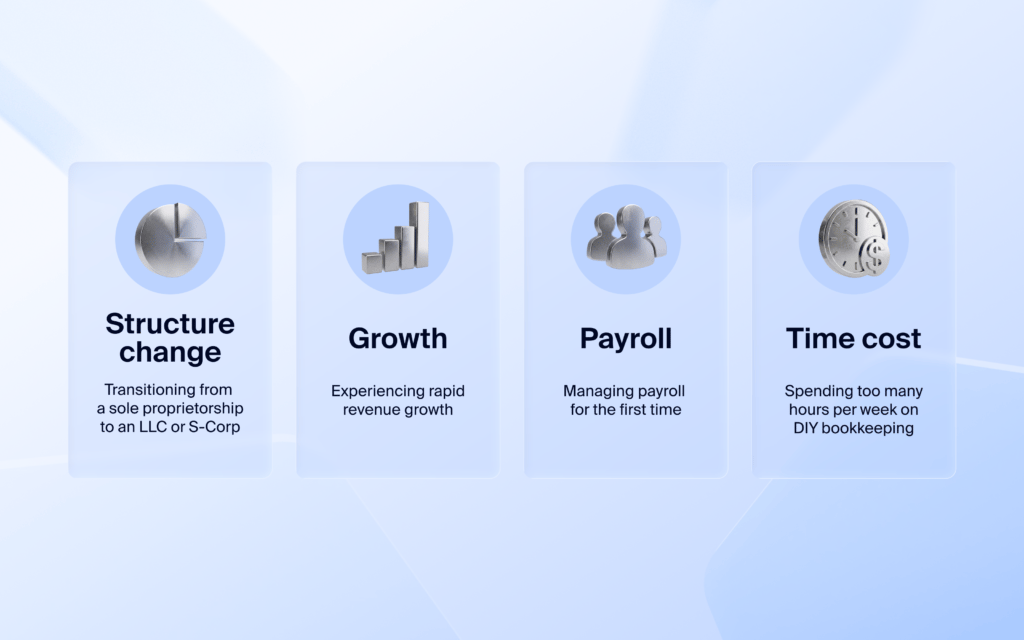
There’s rarely one single moment that makes hiring a small business accountant obvious, but a few common triggers tend to arrive together. Transitioning from a sole proprietorship to an LLC or S-Corp changes how the business is taxed and adds compliance requirements most owners haven’t dealt with before. Rapid revenue growth adds complexity faster than it adds hours in the day. Managing payroll for the first time introduces withholding, filing deadlines, and penalties that are easy to get wrong without experience.
For many owners, the clearest signal is simpler: spending hours every week on DIY bookkeeping and tax prep instead of running the business. When that time cost outweighs what a small business accountant would charge, the math has already made the decision.
How to choose the right accountant: a step-by-step vetting process
Hiring an accountant for small businesses doesn’t have to rely on luck. Finding a small business accountant who fits the business, not just one with a license, takes a structured approach. The four steps below cover what to define before searching, how to verify who you’re hiring, and what to prioritize once a few candidates are on the table.
1. Define your financial needs
Before contacting anyone, define the scope of what a small business accountant actually needs to do. Seasonal tax filing is a different engagement than quarterly check-ins, and both are different from outsourced, fractional CFO-level services that include forecasting, financial modeling, and strategic planning. A business generating steady revenue with a single owner has very different needs than one juggling multiple revenue streams and a growing team.
Getting specific about scope before the search starts makes it easier to compare quotes later, since a low hourly rate for basic tax prep isn’t directly comparable to a flat retainer that includes ongoing CFO-level advisory.
2. Verify credentials and licenses
Not every accountant carries the same credentials, and the difference matters more than it might seem. A Certified Public Accountant (CPA) has passed the Uniform CPA Examination and is licensed by a state board, while an Enrolled Agent (EA) is licensed directly by the IRS after passing a comprehensive exam covering individual and business returns. General accountants without either credential can still prepare returns and manage books, but they carry more limited authority.
That authority matters most during an audit. CPAs, enrolled agents, and attorneys hold unlimited representation rights before the IRS, meaning they can represent a client on any tax matter, including audits, before any IRS office. A general accountant without one of these credentials typically can’t represent the business directly if the IRS has questions. For a closer look at how the roles differ day to day, see our guide on CPA vs. accountant.
3. Seek out industry-specific expertise
Industry-specific expertise is worth paying for. An accountant who has spent years working with e-commerce inventory challenges, real estate depreciation rules, or SaaS recurring revenue models catches issues a generalist would miss entirely. In TaxDome’s own research surveying 350+ business decision-makers, companies earning over $1 million annually were twice as likely to hire a niche accounting specialist than smaller businesses, and were willing to pay up to 25% more for that expertise. The premium buys fewer surprises down the road, not just familiarity with the terminology.
4. Evaluate technology and communication tools
Modern accounting should feel digital and responsive, not like mailing documents back and forth. Look for a small business accountant who works from a secure cloud portal rather than email attachments, offers a structured way to message and get updates, and supports paperless document sharing from the start. A firm still relying on manual, ad hoc communication is a preview of how every future tax season will go.
How much does it cost to hire an accountant?
Pricing for a small business accountant generally falls into three models: hourly rates, flat monthly retainers, or project-based fees for a defined deliverable like year-end tax preparation. Hourly rates typically range from $50 to $150 for a junior accountant and $150 to $500 or more for an experienced CPA, depending on location and complexity. Credentials affect price too: according to the 2025 NATP Fee Study, as reported by Accounting Today, the average CPA-prepared Form 1040 costs $280, an EA-prepared one averages $228, and a non-credentialed preparer runs about $185.
Flat monthly retainers suit businesses that want predictable bookkeeping and advisory costs bundled into a single invoice, while project-based fees fit a one-off need like a single tax filing or an amended return. For a full breakdown by service type and business size, see our guide on how much an accountant costs.
| Pricing model | Typical use case | What to expect |
| Hourly rate | Tax planning, ad hoc advice | $50-$150/hr (junior), $150-$500+/hr (experienced CPA) |
| Flat monthly retainer | Ongoing bookkeeping and advisory | Predictable cost, bundled into one invoice |
| Project-based fee | Year-end tax prep, one-off filings | Fixed price for a defined deliverable |
Essential questions to ask before signing a contract
Before signing anything, a short list of vetting questions clarifies whether a small business accountant is the right fit and helps avoid surprises once the engagement is underway.
| Question | Why it matters |
| How often will we communicate? | Sets expectations for check-ins versus radio silence between filings |
| What tax software do you use? | Confirms compatibility with a secure client portal and paperless workflow |
| How do you charge for ad-hoc advice? | Avoids surprise invoices for quick questions outside the main engagement |
| What is your process for gathering monthly financial documents? | Reveals whether document collection is organized or manual |
FAQs
Why is hiring an accountant for small businesses worth the cost?
A small business accountant typically pays for themselves through deductions an owner would otherwise miss, compliance mistakes avoided, and time freed up to run the business rather than manage its books.
What’s the difference between a small business accountant and a bookkeeper?
A bookkeeper records day-to-day transactions and keeps the books current. A small business accountant analyzes that data for tax planning, compliance, and financial strategy. Many businesses use both.
Do I need a CPA, or is a general accountant enough?
It depends on the complexity of the work. Routine bookkeeping and simple filings don’t require a CPA, but audits, IRS representation, and complex or specialized tax situations generally call for a CPA or enrolled agent.
How much should I expect to pay for a small business accountant?
Cost depends on the pricing model and the accountant’s credentials, ranging from hourly rates to flat retainers to project-based fees. The cost breakdown above covers typical ranges for each.
Find an organized, responsive accountant near you
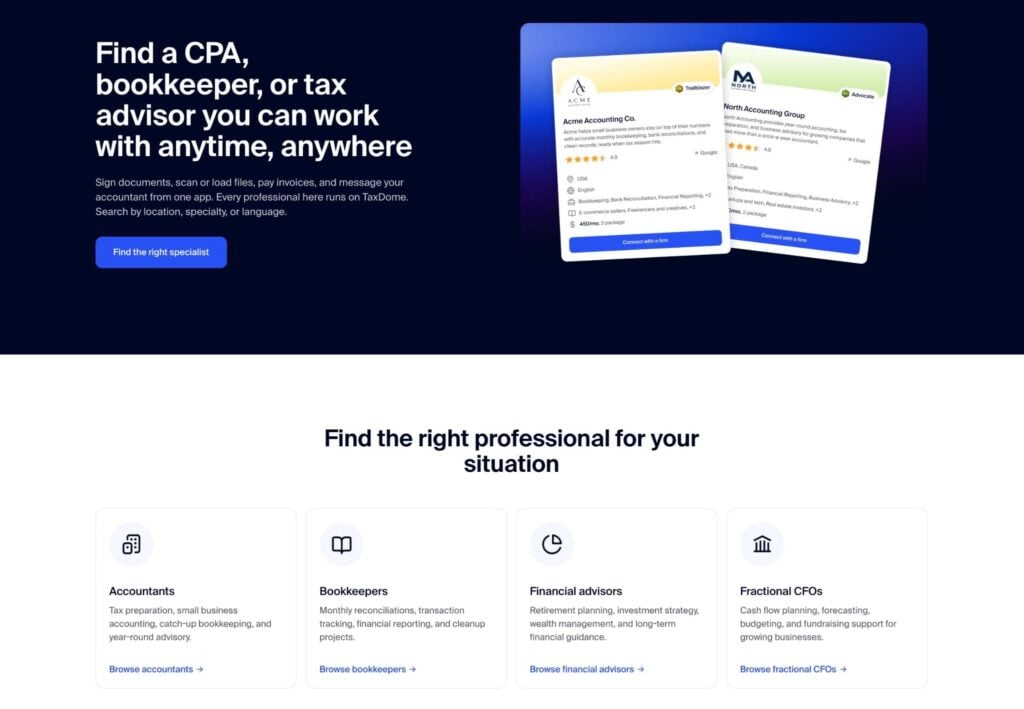
Searching for a small business accountant who is organized, responsive, and easy to work with doesn’t have to mean sorting through directories and cold outreach. The TaxDome Firm Directory lets business owners filter trusted accounting, bookkeeping, and tax firms by location, specialty, and language, making it easier to land on a firm that runs on modern digital workflows from the first conversation.

Jeff writes for TaxDome with experience in accounting, finance, and invoicing industries. He focuses on educating users about accounting trends and maximizing productivity through practical guidance on TaxDome’s features.
Get your free guide

Thank you!
The guide copy has been sent to your email. Please check your inbox!
Recommended articles
In-house accounting vs outsourcing: costs, trade-offs, and the hybrid option (2026)
Niche Business Accounting Report statistics: what business clients will pay for specialized expertise

Buy Now, Pay Later: offer clients payment flexibility