 US – English
 UK – English
 Canada – English
 Australia – English
 Danmark – Dansk
 DACH - Deutsch
 France – Français
 España – Español
 Sverige – Svenska
 Italia – Italiano
 Nederland – Nederlands
 Portugal – Português
 Suomi – Suomi
 Norge – Norsk
 日本 – 日本語
 Romanian – Română











Should I do my own bookkeeping or hire a bookkeeper?
Run your entire firm on one platform

Key takeaways
- DIY bookkeeping isn’t free. Once you price in your own time, it often costs more than outsourcing, especially past a few hours a month.
- A commonly cited rule of thumb: under roughly 100 transactions a month, with no employees, is where DIY still tends to make sense.
- Outsourced bookkeeping pricing ranges from $149 to $1,750 a month depending on the provider, freelance rates average $43 an hour and can climb to $80 or more, and a full-time hire earns a median of $49,210 a year, according to Bureau of Labor Statistics data.
- Cleanup work, catching up months of neglected books, is typically priced at a premium over regular ongoing bookkeeping.
- A bookkeeper and an accountant serve different roles, and most growing businesses eventually need both.
Should you do your own bookkeeping, or is it time to hire a bookkeeper? The honest answer comes down to whether you’re better served saving money or saving time, because doing your own books is rarely free once your time is priced in.
To help you decide, we compared the real costs of DIY bookkeeping vs hiring an expert. In short: for a very small, early-stage business with simple finances, doing your own bookkeeping can be the right move. For most growing businesses, the costs of doing your own bookkeeping quickly add up until you’re spending more time in the books than running your company.
Table of сontents
- What does bookkeeping actually involve?
- The real cost of doing your own bookkeeping
- The case for doing your own bookkeeping
- Signs it’s time to hire a bookkeeper
- DIY vs. hiring: side-by-side comparison
- How much does a bookkeeper cost?
- Bookkeeper vs. accountant: which do you need first?
- How to find the right bookkeeper for your business
- FAQs
- The bottom line
Table of сontents
- What does bookkeeping actually involve?
- The real cost of doing your own bookkeeping
- The case for doing your own bookkeeping
- Signs it’s time to hire a bookkeeper
- DIY vs. hiring: side-by-side comparison
- How much does a bookkeeper cost?
- Bookkeeper vs. accountant: which do you need first?
- How to find the right bookkeeper for your business
- FAQs
- The bottom line
What does bookkeeping actually involve?
Bookkeeping is the ongoing recording and organizing of a business’s financial transactions. Accounting is a separate, higher-level discipline that interprets that data to guide decisions, prepare tax filings, and advise on strategy. In short, bookkeeping produces the numbers, and accounting makes sense of them.
Day to day, bookkeeping typically covers:
- Recording income and expenses as they happen
- Reconciling bank and credit card accounts
- Categorizing expenses correctly
- Invoicing and tracking accounts receivable
- Paying bills and managing accounts payable
- Payroll-adjacent recordkeeping, if you have employees
- Producing basic reports, like a profit and loss statement and a cash position snapshot, that get handed off to an accountant or reviewed by the owner
Later on, we’ll look at how bookkeepers and accountants work together and how to tell which one you need first.
The real cost of doing your own bookkeeping
Doing your own bookkeeping isn’t free. It’s time-priced, and time has a cost even when no invoice shows up for it.
Here’s a simple way to calculate your actual cost: multiply the hours you spend on bookkeeping each month by what your time is worth doing revenue-generating work, then add whatever you’re paying for software.
For example, say you spend 8 hours a month on bookkeeping, and your time is worth $100 an hour if you spent it on client work or sales instead. That’s $800 a month in opportunity cost, plus roughly $30 to $200 a month for accounting software. Add it up, and you’re often past what outsourced bookkeeping would cost you outright.
There are hidden costs beyond time, too:
- Missed deductions and miscategorized expenses that cost you at tax time
- Late fees when bills or filings slip through the cracks
- Books that fall further behind during your busiest periods, when you have the least time to catch up
- Cleanup costs, if bookkeeping gets neglected long enough that it needs correcting, which are typically billed at a premium over regular monthly bookkeeping
To be fair, DIY genuinely is the cheapest option in dollar terms for very simple, low-volume businesses, especially pre-revenue or very early-stage ones. The math above only tips against DIY once your time and your transaction volume both start to add up.
The case for doing your own bookkeeping
DIY bookkeeping works well for a specific kind of business, not as a permanent default. It tends to make sense if:
- You’re a solo business owner with a low transaction volume, roughly under 100 transactions a month is a commonly cited rough threshold, with no employees and no inventory
- You’re very early-stage, with tight cash and more available time than budget
- You have some financial literacy and, more importantly, the discipline to do your books consistently rather than in batches once a quarter, which is where books typically start to break down
- You’re using modern software like QuickBooks, Xero, or Wave, which has lowered the skill floor needed for basic categorization and reconciliation
If most of these apply to you, doing your own books is a reasonable choice for now. The next section covers the signs that it’s time to reconsider.
Signs it’s time to hire a bookkeeper
Watch for these signs that DIY bookkeeping has stopped paying off:
- You’re spending more than a few hours a month on it, and it’s cutting into revenue-generating work
- Reconciliations are piling up, or you’re not doing them monthly
- You’ve started missing invoices or payments, or you’re getting blindsided by cash flow surprises
- You’ve added payroll, employees, or contractors and 1099s
- You’re collecting sales tax across multiple states or jurisdictions
- Tax season turns into a scramble, or your accountant has to clean up your books before they can even start
- Your business has grown to the point where you genuinely don’t know if last month was profitable without digging through records
- You’re preparing for a loan, an investor conversation, or a sale, and you need clean, current books
- You dread doing it so much that it keeps getting pushed off, which is a real and common reason to make the switch
DIY vs. hiring: side-by-side comparison
Here’s how the three main options stack up:
| DIY bookkeeping | Outsourced / virtual bookkeeper | In-house bookkeeper | |
| Price | Software only, roughly $30 to $200 a month. Your own time isn’t included in that number. | Roughly $149 to $1,750 a month across surveyed providers, more for complex or multi-entity setups. | Median salary of $49,210 a year, plus benefits and payroll overhead that commonly add roughly 40% or more on top. |
| Best for | Single owners with low transaction volume, no employees, no inventory. | Most growing small businesses that want predictable pricing without adding headcount. | Higher transaction volume, payroll, or businesses that want a dedicated, embedded resource. |
| Time cost to owner | Several hours a month, and it scales up as the business grows. | Minimal. Mostly review and occasional questions. | Minimal day to day, but ongoing management and oversight time. |
| Risks | Errors, missed deductions, books falling behind, and costly cleanup later. | Less day-to-day familiarity with your business, and scope mismatches if your needs change. | Highest fixed cost, hiring and turnover risk, and a single point of failure if the role isn’t backed up. |
How much does a bookkeeper cost?
The short answer: outsourced or virtual bookkeeping pricing ranges from $149 to $1,750 a month depending on the provider, freelance and independent bookkeepers average $43 an hour and can charge $80 or more, and a full-time in-house bookkeeper earns a median annual wage of $49,210, according to the Bureau of Labor Statistics, with the middle 80% earning between $34,600 and $72,660 a year.
What drives the cost:
- Transaction volume: more activity means more time
- Whether payroll is part of the scope
- The number of accounts or entities involved
- Industry complexity: some sectors carry more compliance overhead than others
- Whether the engagement covers only basic categorization and reconciliation, or extends to full accounts payable and receivable, payroll support, and reporting
Add benefits and overhead to an in-house salary, and the true cost climbs well past the base wage. Nationally, benefit costs account for roughly 30% of total compensation for private-industry workers, according to the latest BLS data, which works out to roughly 40% or more on top of wages alone.
The real comparison weighs outsourced cost against what your own time is actually worth, not outsourced cost against zero. That’s the calculation from the real cost of DIY bookkeeping section above.
Bookkeeper vs. accountant: which do you need first?
A bookkeeper records and organizes your transactions day to day. An accountant interprets that data, prepares tax filings, and advises on strategy and bigger financial decisions.
Most small businesses eventually need both: a bookkeeper to keep the books current, and an accountant or CPA for taxes and strategic decisions. If you’re also weighing whether it’s time to bring in an accountant, our guide on how much an accountant costs breaks down when that step makes sense and what it typically runs.
How to find the right bookkeeper for your business
Once you’ve decided to hire, a few decisions will shape who you look for:
- Decide scope first: do you need only basic categorization and reconciliation, or full accounts payable and receivable, payroll support, and reporting?
- Decide format: freelance or independent, an outsourced bookkeeping firm or virtual service, or an in-house hire. Each comes with different cost and control trade-offs, recapped in the comparison table above. Our guide to finding and hiring a bookkeeper walks through this decision in more detail.
- Check credentials where relevant, such as QuickBooks ProAdvisor certification or AIPB or NACPB certification. These are useful signals, but not the only ones that matter.
- Ask about communication and file sharing. This is worth asking upfront, since it shapes what your day-to-day working relationship will actually look like.
- Get references, especially from businesses of a similar size or in your industry.
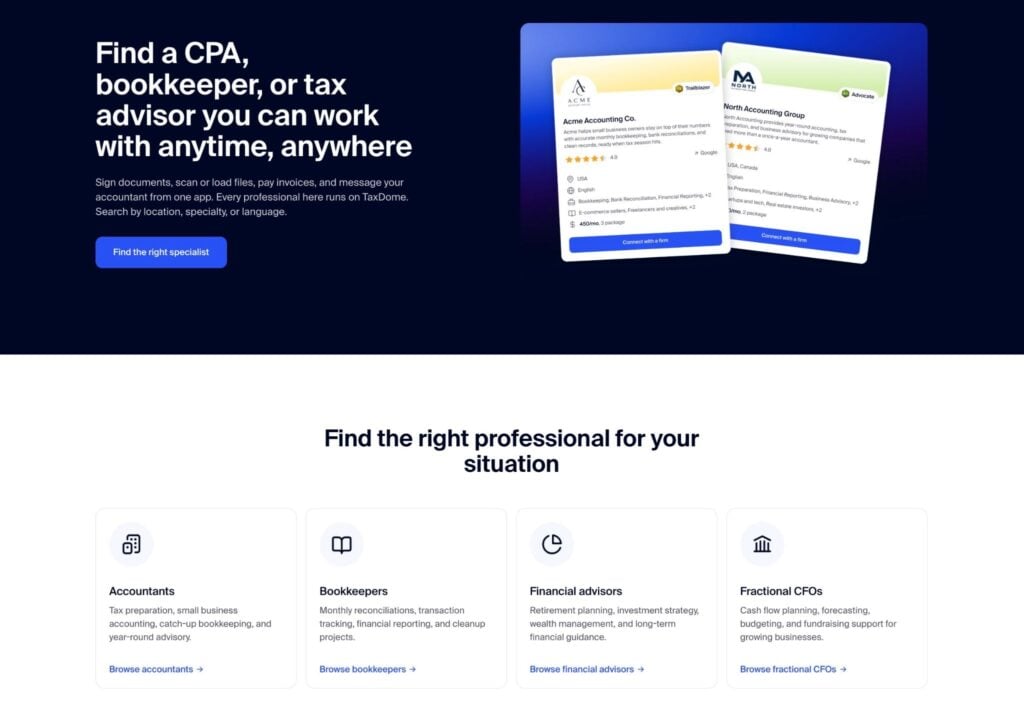
If you’d rather compare vetted bookkeepers than search cold, TaxDome makes that easy:
FAQs
Should I hire a bookkeeper for my small business?
If you’re spending more than a few hours a month on bookkeeping, falling behind on reconciliations, or growing past roughly 100 transactions a month, hiring a bookkeeper usually pays for itself in time saved and errors avoided. Very early-stage businesses with simple, low-volume finances can often manage on their own.
Can I do my own bookkeeping?
Yes, if your business is simple: one owner, no employees, no inventory, and a manageable number of transactions each month. Modern accounting software has made basic categorization and reconciliation more accessible, but it still requires consistency. Bookkeeping done in occasional batches tends to fall apart faster than it saves money.
How much does a bookkeeper cost?
Outsourced or virtual bookkeeping pricing ranges from $149 to $1,750 a month depending on the provider, freelance bookkeepers average $43 an hour and can charge $80 or more, and a full-time in-house bookkeeper earns a median annual wage of $49,210, according to the Bureau of Labor Statistics. Your actual cost depends on transaction volume, payroll, and how much of the work is basic categorization versus full reporting.
What’s the difference between a bookkeeper and an accountant?
A bookkeeper records and organizes your day-to-day financial transactions. An accountant interprets that data, prepares tax filings, and advises on strategy. Most businesses eventually need both, with the bookkeeper’s clean records feeding directly into the accountant’s work.
How many hours a month does bookkeeping take?
It depends on transaction volume and complexity, but a commonly cited range is a few hours to around eight hours a month for a simple small business, more if you have payroll, multiple accounts, or inventory to track.
Is it cheaper to do bookkeeping myself?
Only in raw dollar terms, and only for very simple, low-volume businesses. Once you price in the hours it takes to do your own books, plus the cost of software, missed deductions, and eventual cleanup if things fall behind, DIY often ends up costing more than it looks like on paper.
The bottom line
Bookkeeping always costs something, whether you pay for it in dollars or in hours pulled away from running your business. For a very early-stage, low-volume business, doing your own books can be the right, cost-effective choice. For most growing businesses, the math shifts faster than owners expect, and hours spent reconciling accounts are worth more spent elsewhere. If you’re ready to compare vetted bookkeepers instead of searching cold, TaxDome’s bookkeeper finder lets you browse providers by specialty and location. Every professional listed works through the same secure client app, so you know what the day-to-day relationship will look like before you reach out.

Jeff writes for TaxDome with experience in accounting, finance, and invoicing industries. He focuses on educating users about accounting trends and maximizing productivity through practical guidance on TaxDome’s features.
Get your free guide

Thank you!
The guide copy has been sent to your email. Please check your inbox!
Recommended articles
Niche Business Accounting Report statistics: what business clients will pay for specialized expertise

Buy Now, Pay Later: offer clients payment flexibility

Top AI tools for accountants in 2026: key features and use cases compared