 US – English
 UK – English
 Canada – English
 Australia – English
 Danmark – Dansk
 DACH - Deutsch
 France – Français
 España – Español
 Sverige – Svenska
 Italia – Italiano
 Nederland – Nederlands
 Portugal – Português
 Suomi – Suomi
 Norge – Norsk
 日本 – 日本語
 Romanian – Română












Career-boosting accounting goals: real examples and how to set them
Run your entire firm on one platform

In a busy accounting role, it’s easy to get lost in deadlines and routine tasks. Without clear goals, professional growth can stall and so can your chances of moving up.
In this guide, we’ll cover the most valuable types of accounting goals, share real examples you can tailor to your own role, and give you a framework for setting and achieving them. You’ll also get practical materials you can use right away to start building a compelling case for your next promotion.
Table of сontents
- Why setting the right accounting goals matters
- Technical expertise goals for accountants
- Productivity goals for accountants
- Leadership goals for accountants
- Business impact goals for accountants
- Client relationship goals for accountants
- How to set effective accounting goals and objectives
- Bringing it all together
Table of сontents
- Why setting the right accounting goals matters
- Technical expertise goals for accountants
- Productivity goals for accountants
- Leadership goals for accountants
- Business impact goals for accountants
- Client relationship goals for accountants
- How to set effective accounting goals and objectives
- Bringing it all together
Why setting the right accounting goals matters
Well-defined goals act as a compass for your professional growth. They help you identify which skills will make you more valuable, where to focus your energy, and how to track your progress in a measurable way.
For an accountant, that can mean becoming the go-to person for complex tasks, earning trust with high-profile clients, or positioning yourself for leadership roles. Goals also turn routine work into opportunities — each closed file or completed project becomes part of a bigger career trajectory.
When you know exactly what you’re aiming for, every decision can move you closer to your next achievement instead of keeping you stuck in the same daily loop.
So, what should you aim for? Let’s break down five types of accounting goals that can sharpen your skills, raise your profile, and open the door to new opportunities.
Technical expertise goals for accountants
Delivering accurate, high-quality work forms the bedrock of a strong reputation in accounting. So strengthening your technical expertise is one of the most valuable accounting goals you can set to improve performance.
These goals are about deepening your knowledge in the fundamentals — accounting principles, tax regulations, auditing standards, and industry rules — while staying ahead of changes in each. They also include mastering reporting tools, analytics software, or niche specialties that give you an edge in the market.
Technical expertise goal examples
- Complete continuing education on the latest IFRS or GAAP updates.
- Earn a certification in forensic accounting or data analytics.
- Build advanced Excel or Power BI skills to better analyze client data.
- Study new IRS guidance to offer proactive tax planning advice.
Ways to achieve these goals
- Targeted learning: Take part in webinars, online courses, or in-person workshops tied to your focus area.
- Hands-on practice: Choose projects or clients that demand the skills you’re developing so you apply them in real-world situations.
- Certification roadmaps: Map out the steps, costs, and study time for certifications, then schedule regular study sessions.
Productivity goals for accountants
Accounting deadlines don’t shift, and the workload rarely slows down. Productivity goals help you manage that pressure — getting more done in less time without sacrificing accuracy or compliance.
These goals are about organizing your day in a way that makes sense, trimming out steps that don’t add value, and letting technology take care of the repetitive work. The payoff is twofold: you keep control of your workload during busy stretches and open up time for the projects that get you noticed.
Productivity goal examples
- Shorten month-end close from 7 days to 5 without errors.
- Reduce time spent on client document collection by 40%.
- Cut data entry time in half for recurring transactions.
- Decrease turnaround for client reports from 10 days to 7.
- Reduce missed task deadlines during peak season by 90%.
Ways to achieve these goals
- Review your workflows: Look at your regular tasks and spot where time is being wasted, then cut or simplify those steps.
- Protect your focus time: Block out chunks of your day for deep work so you’re not constantly switching between tasks.
- Create reusable templates: Set up templates for reports, emails, and other repeat work so you can finish them in minutes.
- Automate the routine: Use tools like TaxDome to send reminders, request documents, and handle other repetitive work without lifting a finger.
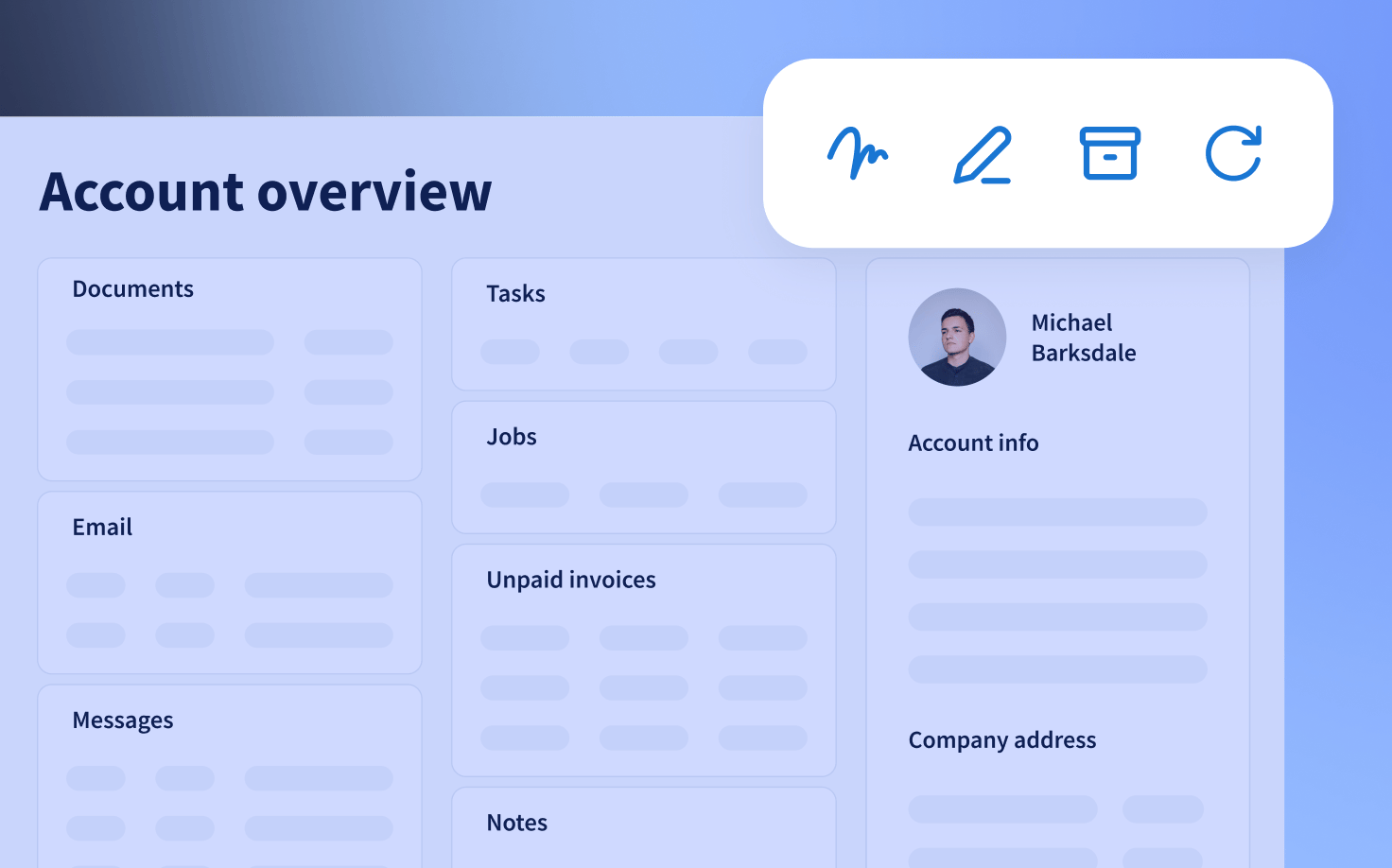
Imagine opening your laptop and seeing every client task, document request, and deadline already in motion without you lifting a finger. With TaxDome, workflows run themselves: reminders go out automatically, documents are requested and filed in the right place, and your team always knows what’s next. Communication with clients, file sharing, and task tracking all live in one secure platform, making it easy for your entire team to stay on the same page.
Leadership goals for accountants
A common career goal for an accountant aiming for promotion is to grow within the leadership area. Setting leadership goals shows you’re ready to take responsibility for more than your own workload — it signals that you can guide others, make decisions, and represent your team’s interests.
These goals center on developing the ability to inspire, direct, and support colleagues so the team consistently delivers stronger results. That might mean shaping how work is delegated, ensuring quality across deliverables, or creating an environment where others can perform at their best.
Leadership goal examples
- Increase the junior staff retention rate by 15% through structured mentoring.
- Improve new-hire productivity to full capacity within 60 days instead of 90.
- Boost the team’s project completion rate on or before the deadline from 70% to 90%.
- Reduce error rates in team-prepared reports by 25% through better training.
- Raise participation in internal knowledge-sharing sessions to 80% of the team.
Ways to achieve these goals
- Project leadership: Take on projects that require coordination between multiple team members or departments.
- Knowledge sharing: Host regular workshops or training sessions to upskill colleagues in specialized areas.
- Process ownership: Identify an area in the workflow that needs improvement and lead the effort to implement changes.
Business impact goals for accountants
One of the most effective ways to advance your career — and your earning potential — is to show that your work directly contributes to the firm’s bottom line. When you can point to measurable results, it’s much easier to make the case for a raise, a bonus, or a promotion.
These accounting goals mean looking at your daily work through a financial lens. Where is revenue slipping through the cracks? Which recurring costs could be trimmed? What errors, delays, or redundancies are eating into profit?
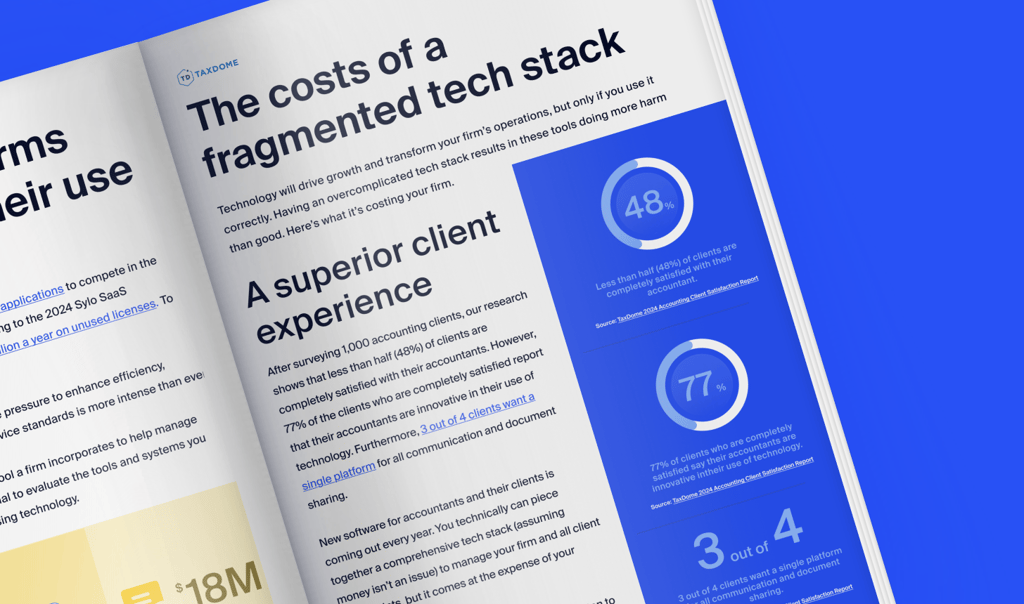
Where most firms lose thousands without realizing it
Even well-run firms lose money to outdated tools, overlapping software subscriptions, and inefficient processes. Our report breaks down the core components of a modern accounting tech stack, compares costs, and highlights where firms can save the most.
Business impact goal examples
- Increase billable hours captured by 10% through improved time tracking.
- Identify and correct unbilled services, adding $25K in revenue annually.
- Reduce write-offs on client accounts by 20%.
- Cut duplicate expense entries to prevent overpayments.
- Replace overlapping software tools and save the firm $10K annually.
Ways to achieve these goals
- Spot the leaks: Keep tabs on where money slips away and close those gaps before they turn into bigger problems.
- See the bigger picture: Connect your everyday tasks to either bringing in money or cutting costs. It makes it easier to see where your effort has the biggest payoff.
- Check your track record: Look at your past numbers — billing times, error rates, write-offs — and use them to set goals you can actually hit.
Client relationship goals for accountants
Strong client relationships can shape your entire career. Clients who trust you will stick with your firm longer, refer new business your way, and often look for additional services you can provide. When you become the accountant they specifically ask for, you’re becoming a key part of their success story.
These goals are about building habits that make clients feel valued and understood. That means listening closely, explaining complex issues in plain language, and keeping them updated so they’re never left wondering where things stand.
Client expectations are higher than ever
Clients today expect more responsiveness, more insight, and more value from their accountants than they did even a few years ago. We explored these shifting expectations in detail in our Client Satisfaction Report.
Client relationship goal examples
- Improve client email response time to under 24 hours.
- Increase client satisfaction scores by 15% over the next 12 months.
- Hold quarterly check-in meetings with all key accounts.
- Implement a post-project feedback process with a 75% response rate.
- Increase the client retention rate for your portfolio from 85% to 95%.
Ways to achieve these goals
- Proactive communication: Reach out to clients with updates before they have to follow up.
- Expectation management: Set clear timelines and deliverables at the start of every engagement.
- Knowledge sharing: Provide clients with resources or insights that help them make better decisions.
- Feedback loops: Regularly gather and review client feedback to spot and address service gaps.
How to set effective accounting goals and objectives
Setting goals is one thing — setting the right ones is what makes the difference. Here’s a simple framework to help you create goals you’ll actually achieve and be proud to share.
Step 1: Choose the right focus areas
Start by picking goals that make sense for your current role but still move you toward the next stage. If you’re a junior specialist, build skills and habits that prepare you for mid-level responsibilities before you aim for the workload of a senior accountant.
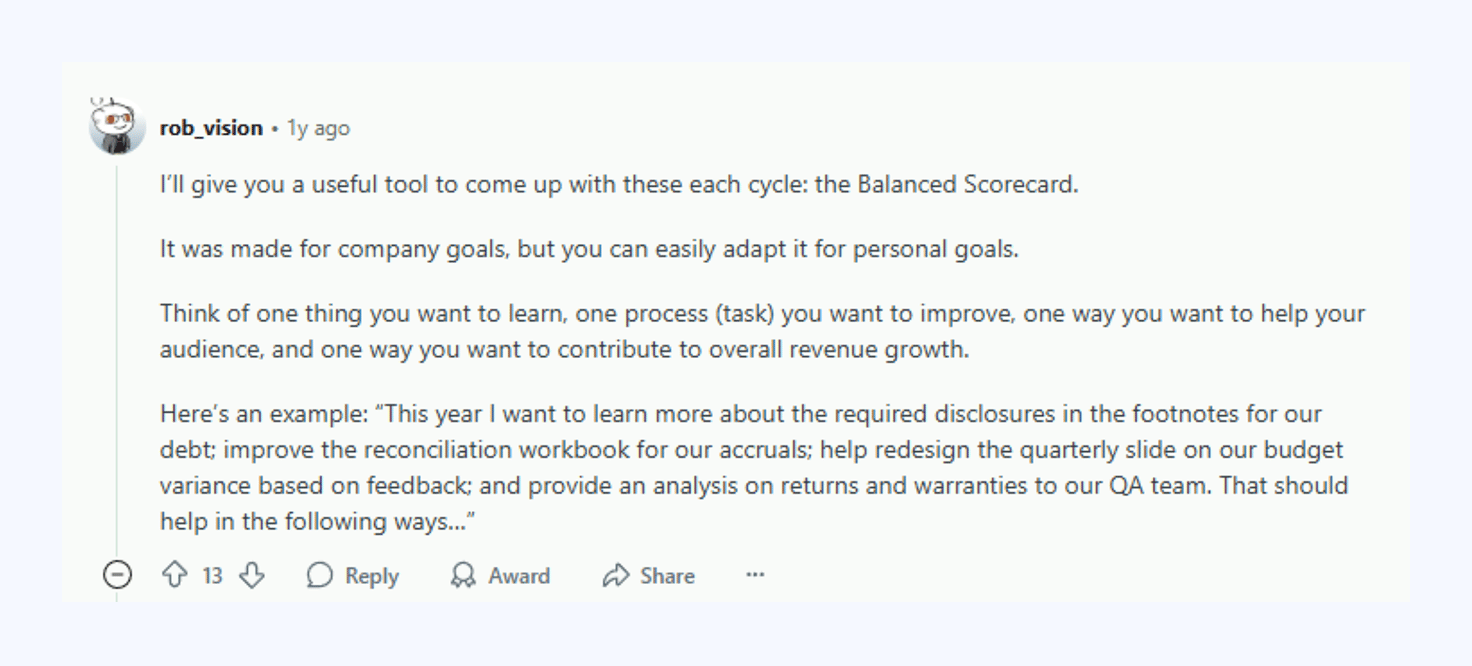
An easy way to find the right balance is to think in four categories:
- something you want to learn,
- a process you want to improve,
- a way to help the people you work with (clients or colleagues),
- a way to contribute directly to the firm’s revenue.
Aim for a mix of short-term and long-term goals so you see wins now while building momentum.
Step 2: Define your metrics and baseline
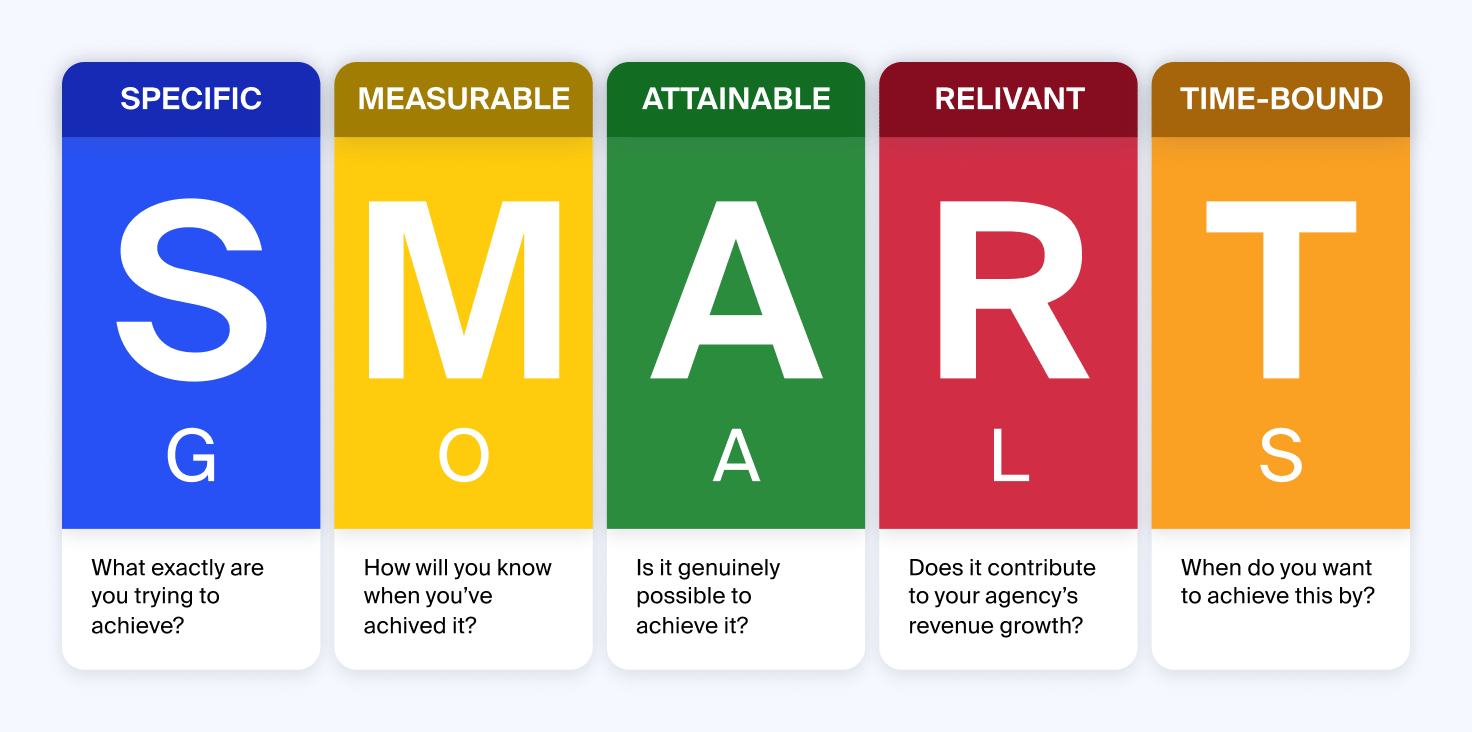
Once you’ve decided what to focus on, make sure each goal is specific, measurable, achievable, relevant, and time-bound. This is how good ideas become SMART objectives you can act on.
Example: “Reduce month-end reconciling items from 12 to 3 by Q3 through a standardized checklist.”
This approach keeps your accounting goals and objectives realistic and easy to defend if you’re making the case for a raise or promotion.
Step 3: Set up your tracking system
Even the best SMART goals for accountants lose their impact if you’re not keeping tabs on progress. Decide exactly how you’ll measure results and where that information will live—whether it’s a simple spreadsheet, a project tracker, or your accounting department’s dashboard. Make updates quick and painless so tracking doesn’t become another chore. Record key details like dates, metric values, and short notes to capture important context along the way.
Step 4: Keep checking in
Don’t just set a goal and forget about it. Every week, take a fresh look at where you are. Ask yourself — is this still the right goal? Has my role changed? What’s getting in the way? Those regular check-ins give you a chance to make tweaks before too much time passes. Sometimes a small adjustment is all it takes to get things moving again.
Step 5: Acknowledge the wins
It’s easy to move straight from one project to the next without stopping to take stock. But noticing your progress — big or small — keeps the momentum going. Maybe you shaved a day off month-end close, earned that certification, or mentored a new team member. Give yourself credit. Those wins build confidence and make the bigger goals feel that much more reachable.
Bringing it all together
The accounting goals and objectives you set are really just a way of steering where you want your career to go. They don’t have to be big, dramatic changes — small, steady wins matter just as much. Learn a new skill, fix a process, or take on a new project. A few years from now, you’ll look back and see that all those little steps have quietly added up to something you’re proud of.

Mari develops TaxDome content by combining customer insights, industry research, and real-world trends. Her structured, automation-driven approach ensures messaging is clear, relevant, and supports more connected and efficient accounting firms.
Get your free guide

Thank you!
The guide copy has been sent to your email. Please check your inbox!
Recommended articles

9 best QuickBooks alternatives in 2026 for every business type
65+ key accounting statistics and insights for 2026

How to start an accounting firm: a step-by-step guide to running your own practice