 US – English
 UK – English
 Canada – English
 Australia – English
 Danmark – Dansk
 DACH - Deutsch
 France – Français
 España – Español
 Sverige – Svenska
 Italia – Italiano
 Nederland – Nederlands
 Portugal – Português
 Suomi – Suomi
 Norge – Norsk
 日本 – 日本語
 Romanian – Română












Should I hire an accountant for my small business? Here’s how to decide
Run your entire firm on one platform

Key takeaways
- An accountant interprets and reports on your finances and advises on tax and business decisions; a bookkeeper records the transactions in the first place.
- Ongoing accounting support for a small business typically runs $1,500 to $6,500 a year, with hourly rates from about $50 for a junior accountant up to $400 for a specialized CPA.
- Very early-stage, single-owner businesses can often get by with software plus a once-a-year tax preparer; the math usually flips once payroll, multiple states, or investor conversations enter the picture.
- Close to a third of small business owners admit to having made a tax error, one of the most common reasons owners bring in professional help.
- Ten concrete signs (below) can help you tell whether you’re at that tipping point.
We looked at real accountant pricing data, service fees, and the situations that most often push small business owners to hire an accountant. Here’s the short answer: hire an accountant once bookkeeping starts eating hours you don’t have, or your tax obligations become more than you can comfortably handle. Say you start employing people, operating in multiple states, or you need more robust financials for investors or lenders to trust.
If your business is a simple, single-owner setup with straightforward income, software plus a once-a-year tax preparer is often enough for now. Below, we break down what an accountant actually does, what hiring one costs, the clearest signs it’s time to make the call, and how to find the right fit.
Table of сontents
- What does an accountant actually do for a small business?
- The real benefits of hiring an accountant
- The case for doing it yourself
- Signs it’s time to hire an accountant
- How much does an accountant cost for a small business?
- Accountant vs bookkeeper vs CPA: which do you actually need?
- How to find the right accountant for your small business
- FAQs
- Bottom line
Table of сontents
- What does an accountant actually do for a small business?
- The real benefits of hiring an accountant
- The case for doing it yourself
- Signs it’s time to hire an accountant
- How much does an accountant cost for a small business?
- Accountant vs bookkeeper vs CPA: which do you actually need?
- How to find the right accountant for your small business
- FAQs
- Bottom line
What does an accountant actually do for a small business?
An accountant interprets and reports on your financial data, and advises on tax and business decisions. These are tasks a bookkeeper doesn’t typically handle, since their job usually stops at recording the data itself.
| Bookkeeper | Records transactions: pays bills, sends invoices, reconciles bank accounts, keeps the books current. |
| Accountant | Interprets those records: prepares financial statements, files taxes, advises on business and tax decisions. |
| Alt text | Side-by-side comparison of a bookkeeper recording transactions and an accountant interpreting financial data. |
Beyond that core distinction, a small business accountant typically handles:
- Tax preparation and planning: including quarterly estimates and strategies to reduce what you owe before the year ends, not just when you file.
- Financial statements: your profit and loss, balance sheet, and cash flow statement, the three reports lenders, investors, and you rely on to see how the business is actually doing.
- Compliance: payroll tax deposits, sales tax filings, and staying ahead of federal and state deadlines.
- Business structure and entity advice: such as whether an LLC, S-corp, or another structure makes the most sense for your tax situation.
- Strategic advice: on pricing, growth plans, and financing decisions, drawing on patterns they’ve seen across other clients.
The real benefits of hiring an accountant
The clearest benefits are time back in your week, fewer costly mistakes, and financials other people will actually trust, though most owners cite a mix of these reasons rather than just one.
- Time saved: hours a month redirected from spreadsheets back into running the business.
- Fewer costly errors (missed deductions, late filings, penalties): close to a third of small business owners admit to having made a tax error, per Intuit’s 2025 Entrepreneurship report.
- Audit-ready, lender-ready, investor-ready financials whenever you need them, not scrambled together the week before a deadline.
- Proactive tax planning that happens year-round, not just in the weeks before your return is due.
- An outside, experienced perspective on financial decisions, someone who has seen the same problem play out at other businesses.
- Reduced personal stress and mental load: one of the most common reasons owners actually give for hiring, even when the numbers alone don’t force the decision.
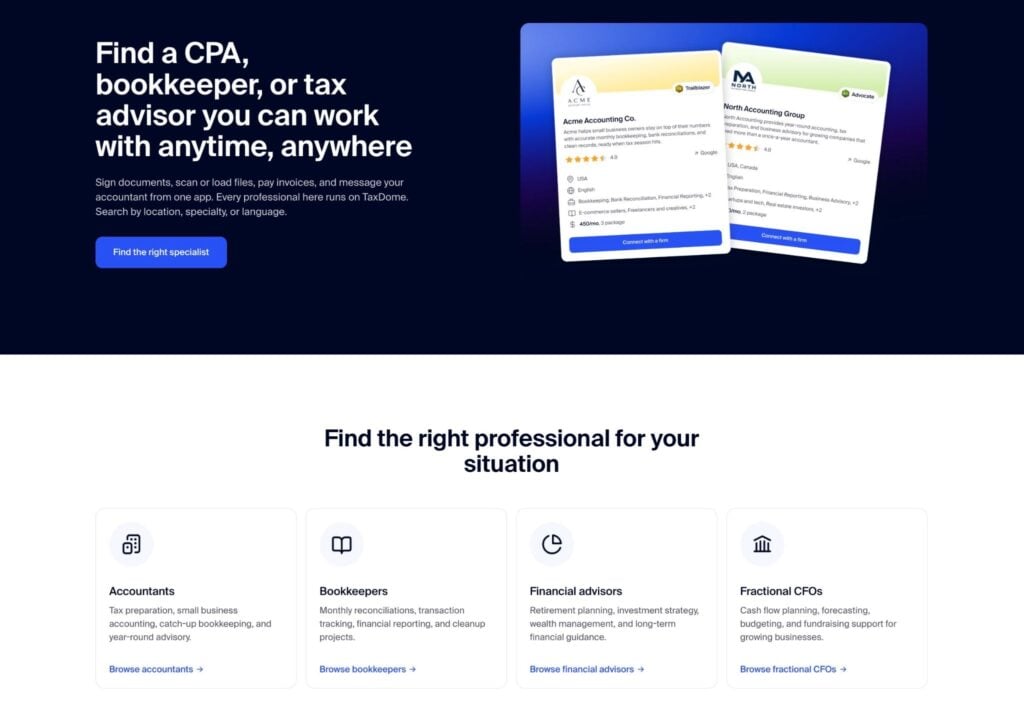
If you’re ready to hire an accountant for our business, compare the most trusted accounting experts that meet your needs with the new TaxDome Accountant and Advisor Finder.
The case for doing it yourself
DIY accounting can work well for very early-stage, simple businesses, and starting there isn’t a mistake.
- Very early-stage or simple businesses (single owner, no employees, straightforward income) can often manage with software like QuickBooks, Xero, or Wave, plus a once-a-year tax preparer.
- If you have an accounting background or you genuinely enjoy the work and have time for it, doing your own books is a reasonable choice.
- Budget-constrained early-stage businesses, where every dollar matters, sometimes need to prioritize other spending first.
In practice, most businesses land somewhere in the middle. Rather than a full-time hire or an ongoing retainer, many owners use software for the day-to-day and bring in a professional for tax season, periodic reviews, and the bigger decisions.
This hybrid approach covers most of what a small business actually needs, without paying for a level of service it hasn’t grown into yet.
Signs it’s time to hire an accountant
If more than a couple of these sound familiar, it’s probably time to bring in an accountant.
- You’re missing filing deadlines, or you’ve already paid an IRS or state penalty.
- Bank and credit card reconciliations are piling up, or you keep finding inaccuracies when you check them.
- You’re spending hours every week on bookkeeping instead of running the business.
- You’ve started hiring employees or dealing with payroll tax for the first time.
- You’re operating in multiple states, or collecting sales tax in more than one jurisdiction.
- You’re seeking a loan, investment, or grant and need financials a lender or investor will trust.
- Your business structure has changed, or you’re considering changing it, such as moving from a sole proprietorship to an LLC or S-corp.
- You’re facing an audit, or you’re worried you might be.
- You don’t know your current cash flow or profitability with real confidence.
- You’re buying, selling, or merging with another business.
How much does an accountant cost for a small business?
Most small businesses budget $1,500 to $6,500 a year for ongoing accounting support, though the right number depends heavily on what you’re asking for.
What drives the final number: the complexity of your bookkeeping, whether you have payroll, how many entities or states you operate in, whether you specifically need a CPA versus a general accountant or bookkeeper, and how organized your records are when you hand them over. Disorganized books mean more billable hours, whoever you hire.
| Service | Typical cost | What affects it |
|---|---|---|
| Bookkeeping (monthly) | $250–$350 basic, $500–$700 mid-range, $1,000+ premium | Transaction volume and service scope |
| Freelance bookkeeper (hourly) | About $43/hour average | Platform and experience level |
| General accountant (hourly) | $50–$150/hour at the junior level | Experience and location |
| CPA (hourly) | $150–$400/hour | Specialization, complexity, geography |
| Tax return prep (Form 1040) | $185 non-credentialed to $280 CPA | Credential and return complexity |
| Ongoing accounting support (annual) | $1,500–$6,500/year | Scope, transaction volume, number of states |
If you specifically need a CPA rather than a general accountant, our full breakdown of CPA pricing covers what drives those higher rates in more detail.
Accountant vs bookkeeper vs CPA: which do you actually need?
Most small businesses need a bookkeeper for the day-to-day and either an accountant or a CPA for taxes and bigger decisions. The difference between the last two comes down to legal authority and specialization.
| Role | What they do | Typical cost | Best for |
|---|---|---|---|
| Bookkeeper | Records transactions, reconciles accounts, keeps day-to-day books current | $250–$1,000+/month or about $43/hour freelance | Ongoing bookkeeping so your books are always current |
| Accountant | Interprets financial data, prepares statements, handles routine tax filing and advice | $50–$150/hour | Annual tax filing, financial statements, general business advice |
| CPA | Everything an accountant does, plus IRS representation, audits, and complex tax strategy | $150–$400/hour | Audits, complex returns, multi-entity structures, lender or investor scrutiny |
How to find the right accountant for your small business
Start by deciding your scope, then vet for experience with businesses like yours before you look at price.
- Decide your scope first: tax-season-only support, ongoing monthly service, or both.
- Ask about their experience with businesses your size and in your industry.
- Confirm their credentials, CPA versus non-credentialed accountant, match what you actually need.
- Ask how they communicate and what tools they use; this tells you a lot about what working together will actually feel like day to day.
- Get references, and check reviews before you commit.
FAQs
Should I hire an accountant for my small business?
If your bookkeeping is taking hours you don’t have, you’ve started running payroll, or you’re preparing to apply for a loan, the answer is usually yes. If your business is simple and you have the time and inclination to manage it yourself, software plus a once-a-year tax preparer can cover you for now.
How much does a small business accountant cost?
Expect to pay roughly $50 to $150 an hour for a general accountant and $150 to $400 an hour for a CPA, or somewhere between $1,500 and $6,500 a year for ongoing support, depending on complexity.
Can I do my own small business taxes?
Yes, if your income is straightforward and you’re comfortable with tax software. Once you have employees, operate in multiple states, or your return gets more complex, the risk of a costly mistake typically outweighs the time you’d save.
What’s the difference between a bookkeeper and an accountant?
A bookkeeper records your day-to-day transactions. An accountant interprets that data, prepares financial statements, and advises on tax and business decisions.
Do I need a CPA or just an accountant?
A general accountant covers most routine tax filing and bookkeeping needs. A CPA is worth the higher rate when you’re facing an audit, need IRS representation, or have a more complex, multi-entity tax situation.
At what point should a small business hire an accountant?
Most owners make the switch when bookkeeping starts eating hours they don’t have, when they hire their first employee, or when they need financials a lender or investor will trust. The checklist earlier in this article covers the most common triggers in more detail.
Bottom line
Whether hiring an accountant makes sense right now comes down to how much of your time it’s costing you to do it yourself, and whether the stakes, taxes, payroll, a pending loan, have gotten high enough that a mistake would cost more than the fee. For a lot of small businesses, the honest answer is: not yet, but soon.

Jeff writes for TaxDome with experience in accounting, finance, and invoicing industries. He focuses on educating users about accounting trends and maximizing productivity through practical guidance on TaxDome’s features.
Get your free guide

Thank you!
The guide copy has been sent to your email. Please check your inbox!
Recommended articles
Accounting process improvement: Practical strategies, tools, and real-world examples

Accounting practice management software: complete guide and comparison

How to start an accounting firm: a step-by-step guide to running your own practice