 US – English
 UK – English
 Canada – English
 Australia – English
 Danmark – Dansk
 DACH - Deutsch
 France – Français
 España – Español
 Sverige – Svenska
 Italia – Italiano
 Nederland – Nederlands
 Portugal – Português
 Suomi – Suomi
 Norge – Norsk
 日本 – 日本語
 Romanian – Română












Referral program strategies for accounting firms: driving growth from loyalty
Run your entire firm on one platform

Client referrals are the gold standard of marketing strategies for accounting firms, but you don’t have to sit back and wait for recommendations. Every client on your system is a potential source of referrals, and some of them only need a gentle nudge to take the next step.
A winning referral strategy turns your most valuable clients into advocates. These are endorsements from trusted business leaders to fellow decision-makers who value their judgment. So, let’s break down the key steps to implementing a program that drives quality referrals for accounting firms.
Table of сontents
Why every accounting firm needs a referral program strategy
Client referrals stand the test of time as a marketing strategy for accounting firms. Even in the digital age, nothing encourages a business to choose an accountant with confidence quite like a trusted recommendation.
In TaxDome’s Niche Business Report, 92% of business clients say referrals are important when choosing an accountant.
Reinforcing this, 58% of businesses say they found their existing accounting through a peer referral — compared to only 3% from advertising. As important as organic search and other digital channels are, referrals still top the list of marketing strategies for accounting firms.
| How did you find your current accounting firm? | |
|---|---|
| Referral (from business or person) | 58% |
| Online search (Google, Yelp, etc.) | 17% |
| Social media | 10% |
| Webinar or event | 6% |
| Cold outreach from accountants | 4% |
| Responded to an advertisement | 3% |
| Other | 2% |
The data is clear: a referral program is crucial for generating high-quality leads for any accounting business. This isn’t a question of traditional vs digital marketing, either. The top firms use every digital channel available to enhance the reach and performance of their referral strategies.
How to implement a referral program for accounting firms: step by step
Running a referral strategy that consistently reaches your ideal client type is easier said than done. You have to select participants carefully and guide them through each phase of the program.
Let’s run through the key steps of implementing an effective referral strategy for accounting firms:
- Identify your best referral sources
- Incentivize referrals the right way
- Create a simple, transparent referral policy
- Promote your referral program
- Partner with other professionals
- Automate referral tracking and follow-up
- Track results and optimize your referral strategy
The goal is to build a referral strategy that generates leads matching your ideal customer profile (ICP) and to do it mostly on autopilot. With the right workflow automations in place, your team can focus on priority tasks and only intervene in referral cases when absolutely necessary.
1. Identify your best referral sources
To identify the most valuable referral candidates, you need to analyze two characteristics:
- Likelihood to refer you: the higher the chance, the better
- Who they’ll refer you to: the closer this matches your ideal client profile, the better
The best candidates are likely to refer you to new businesses that match your ideal client profile. Your customer relationship management (CRM) system includes all of the data you need to identify your most valuable referral opportunities.
- Know your ideal client profile: referrals that win new clients matching this profile are the most valuable
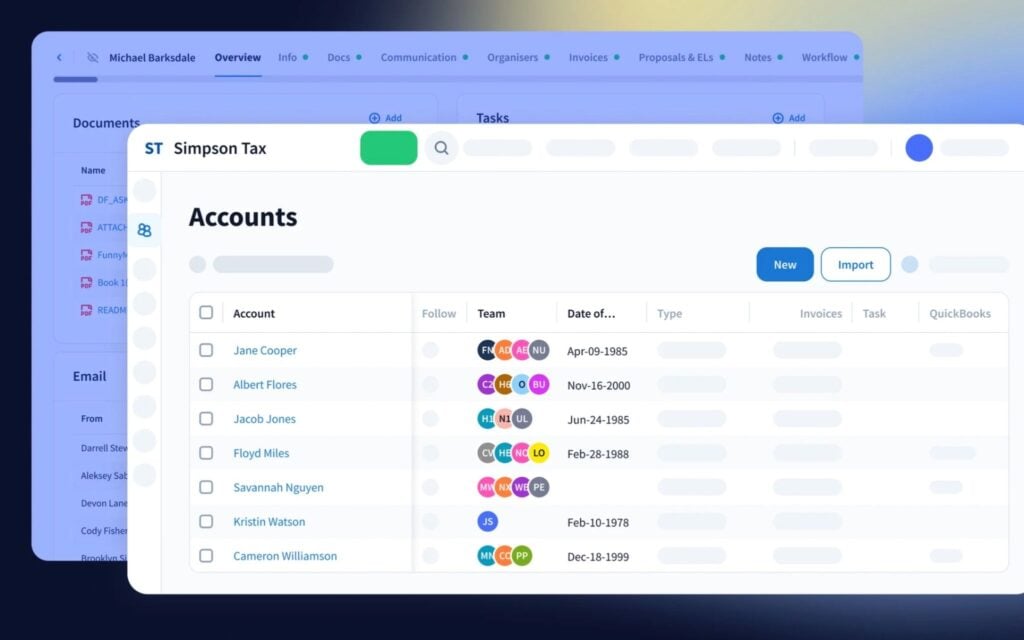
- Identify your most loyal clients: segment your most valuable and engaged clients in your CRM — the most likely to refer
- Analyze your clients’ networks: look at the business contacts your most loyal clients engage with — who they’re likely to refer you to
- Analyze client influence: look at where and how clients engage with potential referrals — are they online thought leaders, are they speaking at industry events, etc?
As your referral strategy matures, identify patterns in your CRM data that characterize the most valuable referral participants — eg: company size, industry, NPS, and customer lifespan.
2. Partner with other professionals for cross-referrals
Clients aren’t the only source of referral you should include in your strategy. Partner with other professionals who can connect you with valuable clients (and vice versa) for mutual referral opportunities.
For example, your firm’s marketing agency, legal advisors, and media contacts could all become invaluable sources of referrals. Given the reciprocal nature of these partnerships, your approach to outreach and incentives will be very different from the client side of your program.
3. Incentivize referrals the right way
Offering the right incentives is crucial for any referral program. Clients should immediately understand what they’ll receive and feel confident that participating is worthwhile. The strongest incentives are clear, easy to claim or receive, and offer genuine value.
Common rewards for referring clients include:
- Account credits or discounts: automatically saving clients money on their next invoice
- Free service: a one-time free service, such as a financial review (this can also act as a cross-selling strategy)
- Service upgrade: a on-time upgrade to an ongoing service (can also act as an upselling strategy)
- Professional development: access to exclusive webinars, insights, or educational material
- Charitable donation: a donation made in the name of the referring client
- Mutual incentives: offer both referring and referral clients an incentive of equal value
- Referral points: an ongoing points system where clients earn credit for every referral
Ethical guidelines are also important. For example, AICPA and ICAEW rules both state that any referral fees or commissions must be disclosed, in writing, to all clients being referred. As a professional courtesy, we recommend that all referrals and incentives are clearly disclosed and understood by all parties.
4. Create a simple, transparent referral policy
Referral programs can get messy without clear, transparent rules in place for everyone. Above all, referring clients need to know exactly what’s required of them and what they get in return. But you also need clear policies in place for clients referred and team members involved in managing the program.
Start by laying out the foundations of your referral policy with clarity:
- Define referrals: decide what qualifies as a referral and set out clear guidelines (keep it simple!)
- Define referrer criteria: for example, minimum NPS, industry, company size
- Set clear rules: define rules for the program and processes — for example, how many referrals can each client make, or what happens if someone refers an existing client?
- Provide clear instructions: ensure all parties have access to all the information they need — both up front and for each stage of the referral process
- Invite chosen clients to your referral: automatically send email invites to referrers with activation links
- Make referring easy: help candidates refer new clients with email links, client portal notifications, and simple forms
- Make rewards easy to claim: allow clients to claim their rewards with a single click or automatically apply rewards to their accounts
- Automate the referral process: create automated pipelines for referrals to minimize the management workload
- Terms and conditions: set your terms and conditions for all parties, including participants, referral clients, and internal teams
To build out your referral program policy, you can download and edit our free checklist template:
5. Promote your referral program effectively
Promoting a referral program is an ongoing process. This starts with encouraging participants to sign up, but you have to guide them through each stage of the program — and this doesn’t end with the first referral.
A successful strategy turns loyal clients into multiple referrals.
Let’s start with messaging because this defines every touchpoint of your referral strategy. Make referral candidates feel special, as if it’s a privilege to be invited into your program. Tell them that they’re one of your most valued clients and that you trust their opinion (prove this with feedback requests and other interactions).
Make the program feel like an exclusive club where VIP clients are trusted and rewarded for introducing you to new prospects.
Next, add a landing page for your referral program to your website. Lead with the branded messaging that sets the tone for your program and follow up with key information and requirements. Add links to important resources, such as instructions and your terms and conditions.
You could also add a signup form for clients who want to participate, so you can manually review their suitability and add them to a “waitlist” if they’re not quite ready.
If your practice isn’t using a website builder to easily create new landing pages, TaxDome’s built-in website builder and template library are ideal.

Now, we need to talk about the most important channel for promoting your referral program to clients: email.
- Email invites: automatically send the initial invite email to candidates who meet your criteria
- Email reminders: schedule automatic reminders for candidates who haven’t referred after specified time periods
- Personalize all emails: add the personal touch your most valuable clients deserve to all interactions (and links for tracking purposes)
- Newsletters: you can also give gentle reminders by adding a block to newsletters that only shows for candidates who haven’t yet referred anyone
The key mistake to avoid here is sending too many reminders to clients and putting them off completely. This is all too easy to do with email automation, but you don’t want to come on too strong.
Remember, this is an exclusive invite — not a desperate request.
6. Create a pipeline to automate follow-ups and statuses
Sending invites to your referral program is only the beginning. You need a system for tracking clients included in the program, all communications with them, and their statuses as they progress through each stage.
Crucially, you want to automate as much of this as possible — otherwise, your referral strategy quickly becomes unmanageable.
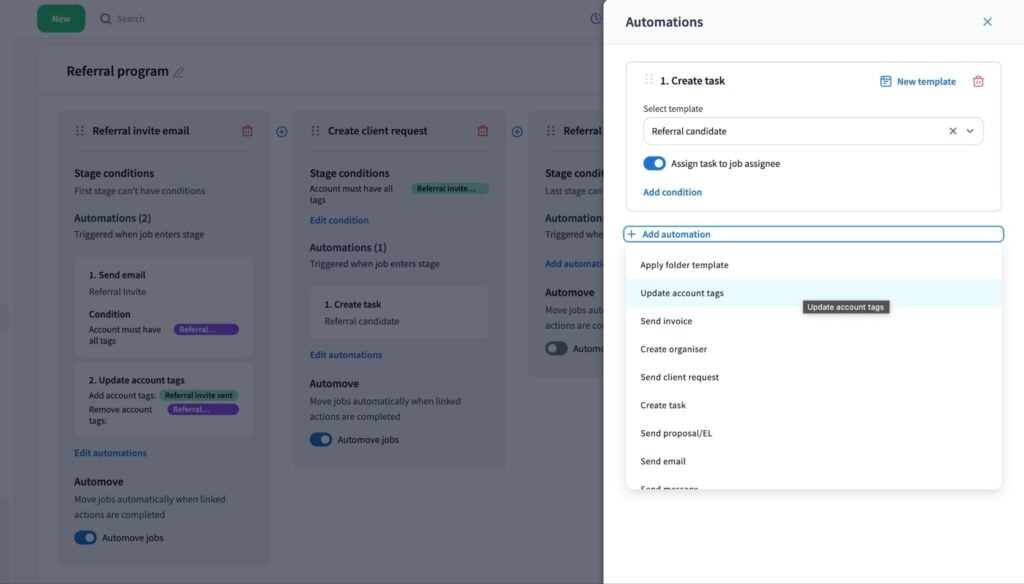
In TaxDome, you can create a complete pipeline for each stage of your program.
You can automate status and changes by applying custom tags to clients as they progress. For example, once a client meets your referral candidate criteria, you can apply a “Referral candidate” tag to them, and automatically send out a personalized invite email with a sign-up link.
As soon as the email is sent, you can automatically update the tag to “Invite sent” and schedule follow-ups until they sign up. You can also send client requests directly to their portal and create tasks for each action they need to complete.
7. Track results and optimize your referral strategy
You need to know your referral program is working and do everything possible to improve results. Tracking the right data gives you a clear view of how your strategy is performing and where it could do better:
- Key performance indicators: for example — referrals, conversion rate, and lifetime value of referred clients
- Supporting metrics: for example — participation rate, active referrals, time to refer,
- Participant feedback: gather feedback to understand how you can improve the referral process for participants and referred clients
- Investigate incomplete referrals: look into cases where candidates initiate the referral process, but don’t complete it
- Test process fixes: test invite timing and follow-up frequency, simplify referral steps,
- Refine incentives and messaging: test different incentives, marketing messages, email
Look beyond the surface-level metrics, such as total referrals, to understand the quality of new clients your program is driving. This guides the most impactful optimization choices that lead to revenue and profit gains.
Deliver a 5-star client experience worth recommending
Positive client experiences are the most important incentive in any referral strategy. Businesses recommend accounting firms that save them money, improve business outcomes, and make every interaction as easy as possible.
No reward you offer for referring clients will compensate for underdelivering the fundamentals.
TaxDome is the practice management system that helps firms deliver a 5-star experience for every client. By improving internal processes, you deliver value to clients faster with consistent results as your firm grows. You also get the most complete system on the market for optimizing client experiences — from onboarding and intake to delivery, retention, and referral.

Aaron produces practical content for TaxDome, drawing on 11 years in SaaS copywriting and marketing. He helps accounting and tax professionals get the most from TaxDome and other tools, making complex topics clear and actionable.

Get your free guide

Thank you!
The guide copy has been sent to your email. Please check your inbox!
Recommended articles

Niche Business Accounting Report statistics: what business clients will pay for specialized expertise

Buy Now, Pay Later: offer clients payment flexibility

Top AI tools for accountants in 2026: key features and use cases compared