 US – English
 UK – English
 Canada – English
 Australia – English
 Danmark – Dansk
 DACH - Deutsch
 France – Français
 España – Español
 Sverige – Svenska
 Italia – Italiano
 Nederland – Nederlands
 Portugal – Português
 Suomi – Suomi
 Norge – Norsk
 日本 – 日本語
 Romanian – Română












How to sell your accounting practice and maximize value: 6-step guide

Run your entire firm on one platform

When you’ve spent years building your firm through hard work and long hours, selling it should be your biggest payoff.
But if you plan too late, adopt the wrong strategy, or overlook the factors that can drive up its value, you could end up walking away with far less than it’s worth.
No matter when you plan to exit, it’s never too early to start positioning your firm for a more profitable sale.
Below is a step-by-step guide on how to sell accounting practice — from valuation to transition — so you can sell with confidence and get the return you deserve.
Table of сontents
- Value your accounting practice
- Preparing to sell accounting practice
- Find the right buyer
- Negotiate and structure the deal
- Address legal and financial considerations
- Transition clients smoothly
- Selling accounting practice: 3 common misconceptions
- How to maximize your sale price (advanced tips)
- How TaxDome can help you increase your practice’s value before selling
Table of сontents
- Value your accounting practice
- Preparing to sell accounting practice
- Find the right buyer
- Negotiate and structure the deal
- Address legal and financial considerations
- Transition clients smoothly
- Selling accounting practice: 3 common misconceptions
- How to maximize your sale price (advanced tips)
- How TaxDome can help you increase your practice’s value before selling
1. Value your accounting practice
Before you sell a CPA practice, you need a clear understanding of what it’s actually worth.
Revenue is just one piece of the puzzle. Today’s buyers also care about:
- A solid reputation and clients who will stick around
- Year-round revenue — not just tax season spikes
- A strong team that will stay on post-sale
- Healthy margins
- Efficient workflows and systems that can scale
- Cloud-based tools already in place
- Minimal reliance on you, the owner
Most accounting practices sell for about 1× annual revenue, though that can vary — typically from 0.9× to 1.1×. Practices with strong financials, efficient ops, and modern tech can command a much higher multiple.
Let’s say your firm makes $100,000 in revenue:
- At a 1x multiple, it might sell for $100,000
- At 2x, that rises to $200,000
- At 4x, your exit could reach $400,000
If you’re getting serious about selling CPA practice, it’s worth talking to a broker. They can give you a clearer picture of what your firm’s worth, how you stack up against others, and how you can lock in the best deal.
2. Preparing to sell accounting practice
A streamlined, well-run accounting or tax practice won’t just attract more buyers, it can command a better price.
Even if you’re not selling immediately, here are the upgrades worth making:
- Clean up operations and raise your margins: automate admin tasks that eat up your time. Cut out processes that are not working. And if some services aren’t profitable, rethink your pricing.
- Shift relationships from you to your team: start moving client communication away from yourself and onto staff. Use modern tools to improve the client experience, but also build trust that doesn’t hinge on you being in the room.
- Invest in your online reputation: a professional-looking website, a steady stream of positive reviews, and a strong digital presence help buyers see your firm as credible. This lowers perceived risk, and demonstrates a higher chance of lead generation for your firm.
Start these changes as early as you can. The better your foundation, the stronger your negotiating position when it’s time to talk numbers.
3. Find the right buyer
Who you plan to sell a CPA practice to can shape what the deal looks like — not just the number, but what happens after.
If you’re selling externally, you’ll likely run into two types of buyers:
- Strategic buyers: usually other firms looking to expand their reach, bring on talent, or offer new services. If your practice fits their roadmap and goals, they may even pay a premium.
- Financial buyers: includes private equity, larger firms, or investors. They often move fast and focus on returns. That could mean a quick exit, but also more changes to your team, clients, and culture.
External sales often fetch higher multiples, but they can also cause friction if clients or staff aren’t on board with the new leadership.
Your other option is internal succession, which involves handing ownership to a partner, rising manager, or family member. It might not get you top dollar, but you’ll likely see a smoother transition — and more control over your legacy.
Get a firsthand perspective on succession planning — check out our article and interview with established CPA and firm owner Mike Sylvester.
Selling CPA practice: how to put your firm on the market
When you’re ready to sell a CPA practice, you’ve got two main options: bring in a broker or list the firm yourself.
Specialized brokers like Poe Group Advisors, CPA Sales, or Accounting Practice Sales can help you set the right price, market to serious buyers, and manage the entire process — ideal if you want a full-service experience or just don’t have the time to do it yourself.
Pros and cons of selling accounting practice through a broker:
| Pros | Cons |
| • Access to buyers already in their network • Support with valuation, due diligence, and legal steps • Saves a ton of time — great if you’re hands-off |
• They take a cut (usually 10–12% of the sale) • You’ll have less control over who buys • Some brokers prioritize a fast close over long-term fit |
Sites like BizBuySell or SuccessionMatching give you broad exposure — but you’re on your own for screening, negotiation, and paperwork. This works well for smaller practices or sellers comfortable managing the process directly.
Pros and cons of selling accounting practice through an online marketplace:
| Pros | Cons |
| • Low listing costs • Full control over vetting and negotiation • Wider audience reach |
• Time-consuming to manage inquiries • No built-in valuation or legal support • Higher risk of unqualified buyers |
Which path you take depends on your priorities. Either way, knowing them — whether it’s price, speed, or continuity — will help guide your next steps.
4. Negotiate and structure the deal
Once you’ve found a buyer for your accounting or tax practice, the focus shifts to negotiating a deal — one that can protect your interests, reduce your tax hit, and give you the kind of exit you actually want.
Here’s what you’ll want to negotiate:
- How you’ll get paid: will it be upfront, over time, or tied to performance through an earnout?
- Your post-sale role: are you stepping away completely, or staying on to support the transition?
- Client and team handoffs: who tells clients? How will staff be brought into the fold?
Most deals fall into two categories:
- Asset sale: the buyer takes over your book of business — clients, contracts, systems — but not the legal entity. This is the most common route in accounting since it limits risk and offers more flexibility.
- Stock sale: the buyer purchases ownership of your entire business entity, which might be the right fit depending on your setup.
Ultimately, the best deal structure depends on your goals and tax picture. Want to walk away clean? Prefer to spread income over time? Have specific concerns about liability or staff continuity? Bring those to the table early as it’ll shape how the deal gets done.
5. Address legal and financial considerations
Before you sell a CPA practice and hand over the keys, make sure you tighten up the legal details and understand the tax implications — so there are no surprises for you or the buyer. This includes:
- The purchase agreement: this needs to clearly spell out the price, payment structure, liabilities, non-compete terms, and what role (if any) you’ll play after the sale.
- Your tax strategy: if needed, talk to a tax advisor — especially if you’re planning on installment payments or want to minimize capital gains. A little planning here can save you a lot later.
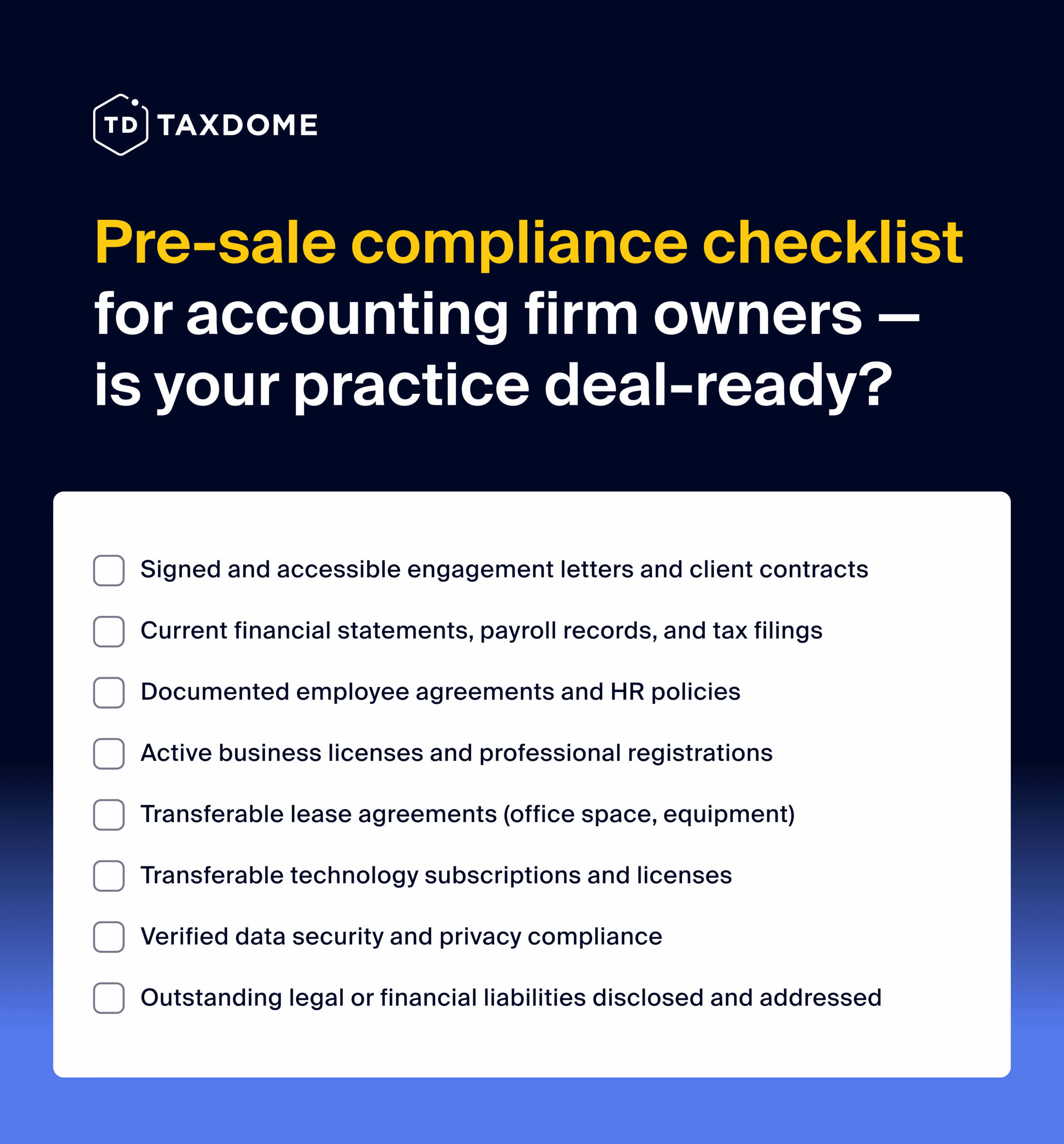
You’ll also need to ensure your firm is compliant and deal-ready. To help you out, here’s a practical checklist you can use to identify any gaps and increase buyer confidence.
6. Transition clients smoothly
Client trust is one of your firm’s most valuable assets — and a key driver of post-sale success.
No matter your timeline — whether that’s to sell accounting practice six months or six years out — start laying the groundwork early.
- Be upfront with clients about the change
- Introduce the buyer or successor early and in person if you can
- Transition key clients to your team before the sale, not after
- Involve staff wherever possible — it builds trust that outlasts your exit
You may even choose to stay on for a short time as an advisor, which can help ease client concerns and keep retention high while the new owner gets settled.
Done right, a smooth transition protects your client relationships, preserves the value you’ve built, and lets you step away on good terms — with clients, your team, and yourself.
Selling accounting practice: 3 common misconceptions
Firm sales in the accounting industry often come with assumptions that don’t match reality. Here are three of the most common:
1. “You’ll need to stay on for months or years”
In some cases, a short transition period — such as two or three weeks — is enough. Buyers need space to build client relationships and establish their own processes. Help communicate the change, reassure your clients, and then step away.
2. “The buyer must be another accounting firm”
Individuals leaving larger firms, or entrepreneurs seeking ownership, can also be strong — sometimes better — buyers. When selling CPA practice, it’s a good idea to focus on motivation and fit, not just firm size or type.
3. “Average selling prices will dictate value”
Multiples vary widely depending on location, client list, staff strength, profitability, and technology. Don’t solely rely on averages; get a formal valuation based on your firm’s unique attributes.
How to maximize your sale price (advanced tips)
If you want your accounting or tax practice to sell well — and not just sell — here’s a final checklist of advanced tips and steps that will make a real difference:
- Start years before you plan to exit: don’t wait until you’re months from retirement. Give yourself time to strengthen operations and sell when the market’s in your favor.
- Protect client continuity: your relationships are a big part of what you’re selling. Improve their experience now, shift key accounts to your team, and if needed, stay on briefly to smooth the handoff.
- Make yourself less essential: the more your team can run things without you, the more valuable your firm becomes. Train them to handle relationships and daily ops independently.
- Clean up your books: clear out liabilities, tighten up AR and AP, and make sure your financials are clean and current. It speeds up due diligence and builds trust.
- Offer more than tax: year-round services like bookkeeping, client advisory services (CAS), and payroll make your revenue more stable — and your firm more attractive. Buyers pay more for predictable income.
- Work with someone who knows the space: a good M&A advisor or broker can connect you with serious buyers, manage the process, and help you walk away with the best deal.
- Update your tech stack. Cloud-based workflow management software and client portals aren’t just nice to have — they show buyers your firm is efficient, scalable, and ready for growth.
How TaxDome can help you increase your practice’s value before selling
The most valuable firms aren’t just profitable; they’re modern, efficient, and scalable. And that’s where TaxDome can help.
Whether you’re planning to sell your accounting practice soon or just thinking ahead, TaxDome gives you the infrastructure buyers look for: centralized operations, cloud-based workflows, and a unified client experience — all on one secure, end-to-end platform that scales with you.
If your goal is to exit on your terms and maximize your firm’s sale price, TaxDome helps you build the kind of practice buyers will pay more for — a practice that runs efficiently today and commands a higher valuation tomorrow.

Josef creates clear, actionable content at TaxDome, highlighting features, updates, and key accounting topics. His focus is on making complex ideas accessible and engaging, helping users understand and apply insights effectively.

Get your free guide

Thank you!
The guide copy has been sent to your email. Please check your inbox!
Recommended articles

Accounting process improvement: Practical strategies, tools, and real-world examples

Accounting practice management software: complete guide and comparison

Should I hire an accountant for my small business? Here’s how to decide