 US – English
 UK – English
 Canada – English
 Australia – English
 Danmark – Dansk
 DACH - Deutsch
 France – Français
 España – Español
 Sverige – Svenska
 Italia – Italiano
 Nederland – Nederlands
 Portugal – Português
 Suomi – Suomi
 Norge – Norsk
 日本 – 日本語
 Romanian – Română












How to write a client termination letter with free template
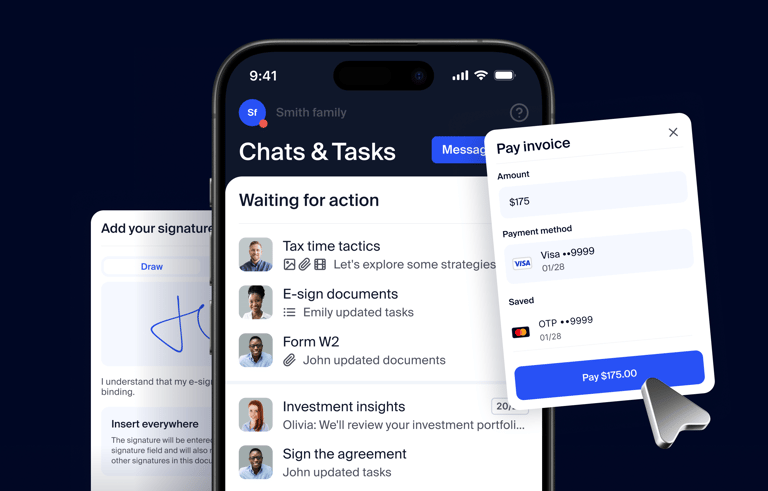
Run your entire firm on one platform
Ending a long-standing engagement is never easy, but keeping the wrong clients often costs more than letting them go. This guide will walk you through the full process of how to terminate a client relationship professionally — from recognizing the signs to writing a clear client termination letter. You’ll also get a downloadable template, best practices for handling the transition, and answers to the most common questions.
Table of сontents
How to know when it’s time to end a client relationship
Not every difficult client is a dealbreaker, but some relationships wear down your team, your time, and your margins. This section helps you spot the difference between a one-off issue and a pattern that signals it’s time to move on.
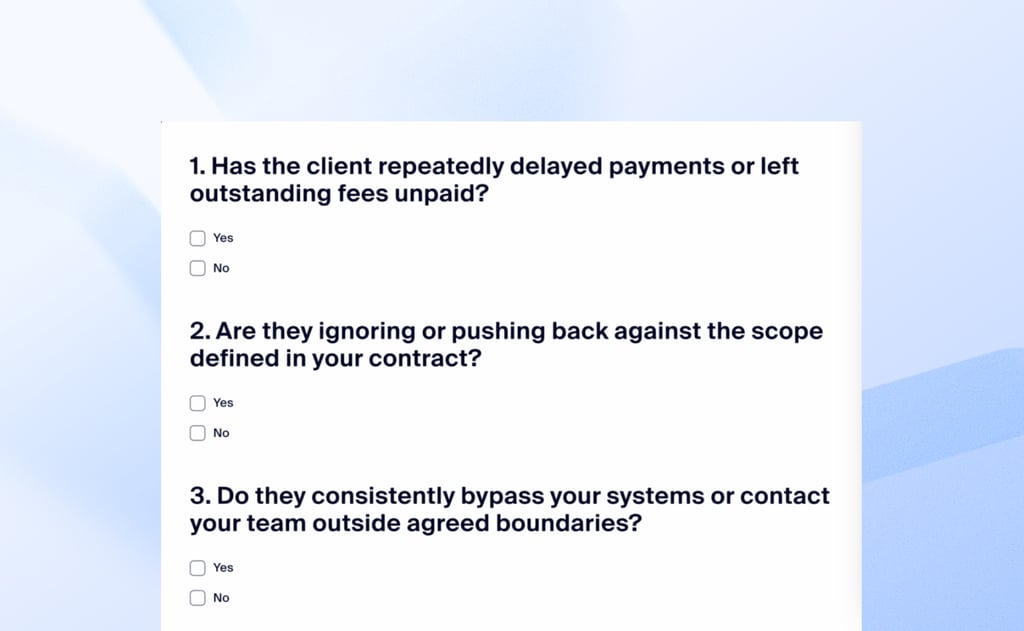
Signs pointing to the end of a contract with a client
Some client issues are temporary. Others signal that the engagement has run its course. Here’s what to watch for:
- Repeated payment delays or outstanding fees: if invoicing turns into chasing or payments drag on routinely, the value exchange has likely broken down
- Scope creep without re-scoping: when expectations expand but timelines and pricing don’t, you’re no longer working under a fair agreement
- Disrespect for your processes and team: clients who bypass systems or disrespect your staff weaken your internal structure — and your authority
- Communication friction: if routine updates turn into tension or emotional pushback, it’s often a sign of growing misalignment
None of these signs mean you’ve failed. They mean the engagement has evolved and possibly outlived its value.
Questions to ask before making the final decision
Not every frustrating client needs to be terminated — some issues can be fixed with clearer communication or firmer boundaries. Before you make a final decision, step back and assess whether the problem is situational or part of a long-term pattern.
Use these questions to gut-check your decision:
- Have I communicated clearly or just assumed they “should know”? Unspoken expectations are a common root of misalignment. Sometimes, clarity solves more than we think.
- Did we set the right boundaries from the start? If you’ve been too flexible for too long, the client may not realize they’re pushing limits.
- Has the issue been addressed directly? If the behavior hasn’t been called out — kindly but firmly — they may not know it’s a problem.
- Is the strain recent or long-standing? Stress around deadlines or tax season is normal. If it’s year-round friction, that’s different.
If the answer still points to parting ways, it’s time to take the next step.
The risks of waiting too long to part ways
Once you’ve identified a clear misfit, hesitation often does more harm than good. Hanging on to the wrong client costs your firm in ways that are harder to measure but impossible to ignore.
Here’s what’s at stake when you delay:
- Morale suffers: your team grows frustrated when they’re stuck managing high-friction accounts
- Opportunities are missed: low-fit clients take time away from high-value ones that could help your firm grow
- Burnout builds silently: overextending your team becomes the norm until someone hits a wall
- Your reputation takes a quiet hit: a strained client doesn’t get your best work, and that often shows
A timely exit backed by a disengagement letter keeps you in control and on course.
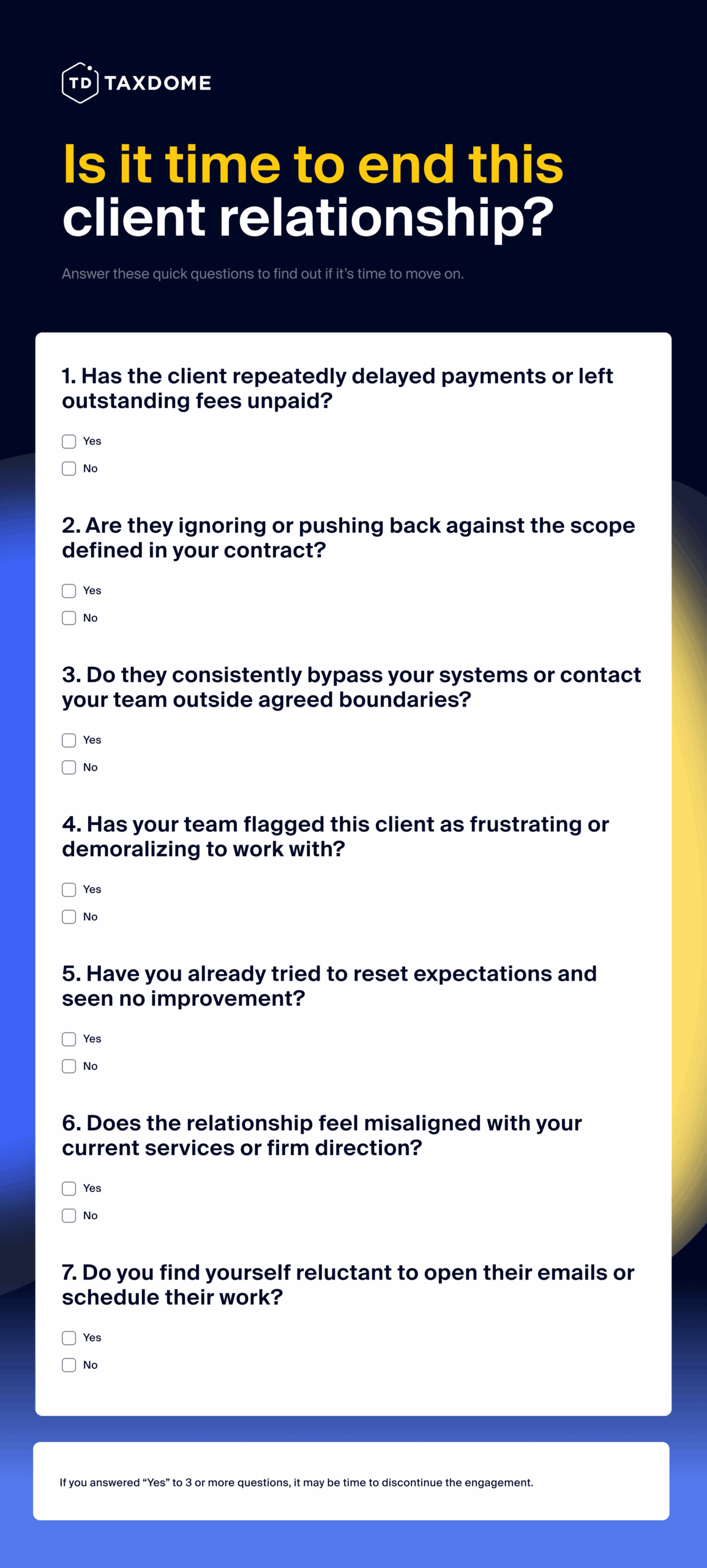
How to end a client relationship the right way
Once you decide to discontinue services, your next steps should protect your firm and ensure a clean transition. These steps help ensure nothing is left behind and the transition doesn’t disrupt your team or reputation.
1. Gather internal documentation and review your contract
Before you take any formal steps, revisit your original agreement. Review the signed contract or engagement letter for any language around termination — including notice periods, final deliverables, and handoff expectations. At the same time, collect all recent communication, outstanding work summaries, and key meeting notes. Using the best AI note taker can help you organize and summarize these key meeting notes efficiently. It ensures you don’t miss any critical details from past discussions and provides clear, searchable records to support a smooth transition process. Having your facts straight helps avoid confusion or disputes.
2. Complete or transition outstanding work
Wrap up any agreed-upon deliverables you’re still responsible for — or document what will not be completed. If the client is moving to another firm, prepare a handoff package with clear file naming, key dates, and relevant notes. Even in disengagement, professionalism matters. This step isn’t about extra effort; it’s about reputational insurance.
3. Settle invoices and close out billing
Outstanding fees should be addressed before you officially disengage. Send a final invoice with a clear payment deadline and confirm that there are no unresolved balances. If needed, reference the billing terms outlined in your contract. Make it easy for the client to pay — and hard to dispute later.
4. Send a client termination letter
Now that everything behind the scenes is in order, it’s time to formalize the end of the engagement. A termination letter — sometimes referred to as a letter of disengagement — clearly states that services are ending, confirms the date, and outlines any remaining steps or obligations.
In short, ending a client relationship professionally is about honoring the contract, settling your responsibilities, and leaving nothing open to interpretation.
How to write a professional client termination letter
A disengagement letter is your final word on the relationship and your protection if things go sideways. It documents your decision, clarifies next steps, and closes out the contract on your terms.
Each part of the letter matters. Here’s how to get it right:
Outline the structure of your termination letter
The best termination letters are structured, direct, and complete. You don’t need to over-explain — just cover the key points:
- Statement of termination: confirm that services will be discontinued, and on what date
- Reference to the engagement: name the specific contract or service arrangement being ended
- Remaining responsibilities: clearly outline any final deliverables you’ll provide — or confirm that everything is complete
- Billing or outstanding fees: include any unpaid amounts and reference your billing terms
- Transition info: mention if you’re handing off records or making yourself available for a short transition period
Pro tip: Don’t bury key details in paragraphs. Use bullet points or short sections so the client can’t miss them.
Use a neutral, respectful tone
This letter isn’t a confrontation and it shouldn’t read like one. Keep your tone neutral, even if the relationship was frustrating. Avoid emotionally charged phrases like “we’ve had enough” or “due to ongoing issues.” Instead, opt for objective language, for example:
“After reviewing our current engagement and upcoming workload, we’ve decided to discontinue services as of [date].”
Pro tip: Assume this letter will be shared with someone else. Write it as if a future auditor, legal advisor, or replacement CPA will read it.
Be clear and specific to avoid misunderstandings
Vague language opens the door to follow-up emails, payment delays, or misinterpretation. Avoid phrases like “we’re wrapping up soon” or “moving in another direction.” Spell things out:
“This letter confirms that our accounting services for Smith & Associates will conclude on September 30, 2025.”
Pro tip: If you’re unsure how clear your letter is, have someone else on your team read it and ask, “What would I still have questions about?”
Proofread for clarity and professionalism
Once the letter is written, double-check every detail: client names, dates, services, and deliverables. Make sure the tone is consistent from start to finish — no passive-aggressive lines or soft apologies sneaking in.
If the disengagement is legally sensitive or the client has previously challenged you, ask your lawyer to review it.
Pro tip: Keep a clean copy on file. It serves as your official record in case any questions arise — even months or years later.
Client termination letter sample (with downloadable template)
Below is an example of a clear and professional termination letter. You can adapt the content to match your firm’s style, services, and policies.
[Client Name] [Company Name] [Client Address]
Dear [Client Name],
This letter confirms that as of [Effective Date], we will discontinue our accounting services for [Client Company Name], as outlined in our engagement letter dated [Original Engagement Date].
Final deliverables
We will complete the following outstanding work prior to termination:
- [List final deliverables, e.g., “Q3 monthly reconciliation,” “final tax return filing”]
These will be delivered no later than [Date]. After that point, no further services will be provided.
Outstanding fees
As of the date of this letter, your account balance is $[Amount], which includes services performed through [Last Billed Date]. Please submit payment by [Due Date], in accordance with the terms outlined in our engagement agreement.
Records & handoff
We are happy to provide your new accountant with the documents necessary for a seamless transition. Please notify us in writing with their contact information. Original records provided to us have already been returned; any copies of documents from our internal files will be provided at our discretion and may be subject to fees.
Account closure
Your client portal access will remain active until [Portal Close Date], after which all login credentials will be deactivated. We recommend downloading any remaining files before that date.
Should you have questions or require assistance during this transition, please contact [Your Name] at [Your Phone] or [Your Email].
We appreciate the opportunity to have worked with you and wish you the best moving forward.
Sincerely, [Your Firm’s Name] [Email Address] [Phone Number] [Website URL]
Looking for more ready-to-use templates? TaxDome offers a full library of templates built specifically for accounting and bookkeeping firms — from engagement letters to onboarding messages and beyond.
What to do after sending a termination letter
The letter may be sent, but your work isn’t done just yet. Wrapping up the engagement internally helps prevent loose ends, missed follow-ups, or repeated mistakes. These post-termination steps ensure your team stays aligned and your systems stay clean.
Notify your internal team and update your records
Make sure everyone who works with the client — from junior staff to billing — knows the relationship has been terminated. Update your CRM, client portal access, project management system, and billing platform to reflect the termination. This avoids future confusion and ensures no one accidentally reaches out or reassigns tasks.
Pro tip: Label the client record as “closed” or “former client” in your system to avoid future confusion. Clear labeling helps later if questions come up or the client tries to re-engage.
Transition files or knowledge to successors (if needed)
If the client is moving to another accountant, a clean transition reflects well on your firm. Package deliverables neatly, provide key timelines, and confirm access expiration dates. Unless it’s a high-risk situation, professionalism during handoff can protect your reputation and avoid complaints.
Pro tip: Assign one point person for the transition. This keeps communication tight and prevents things from getting missed.
Reflect and update your processes
Every termination is a learning opportunity. Ask your team: What could we have flagged earlier? Did the client show signs we missed? Were we too slow to act? Use this insight to revisit your onboarding questions, contract language, or service boundaries.
Pro tip: If you’re seeing patterns in disengagements, it might be time to refine your ideal client profile or your intake process.
FAQ
- Do I have to give a reason when terminating a client relationship?
No, your termination letter doesn’t need to explain why. Keep it professional, reference the end of services, and clearly state the date. You’re not required to justify the decision unless your contract specifically says otherwise.
- What if the client refuses to pay outstanding fees after termination?
If fees remain unpaid after the effective date, refer back to your engagement letter and send a final invoice. Accountants should document all communications and consider small claims or collections if needed. Legal escalation is a last resort — but having a clear, written record makes it easier if you need it.
- As an accountant, can I end a contract at any time?
In most cases, yes — as long as you honor the terms of your agreement. Many contracts include a clause that allows either party to disengage with written notice. Always check your engagement letter before proceeding.
- What’s the best way to handle client records after termination?
Securely store internal documentation, return any client-provided originals, and close out portal access. If another accountant is taking over, send only what’s needed — nothing more. Protect your firm, but keep the transition clean and professional.

Mari develops TaxDome content by combining customer insights, industry research, and real-world trends. Her structured, automation-driven approach ensures messaging is clear, relevant, and supports more connected and efficient accounting firms.

Get your free guide

Thank you!
The guide copy has been sent to your email. Please check your inbox!
Recommended articles

10 best client portals for accountants in 2026: features, pricing, and reviews

Client onboarding software for accountants: Streamlining the first step in client relationships

12 best CRMs for accountants, bookkeepers and tax professionals in 2026