 US – English
 UK – English
 Canada – English
 Australia – English
 Danmark – Dansk
 DACH - Deutsch
 France – Français
 España – Español
 Sverige – Svenska
 Italia – Italiano
 Nederland – Nederlands
 Portugal – Português
 Suomi – Suomi
 Norge – Norsk
 日本 – 日本語
 Romanian – Română












AI in accounting: 2026 trends, examples, and implementation guide
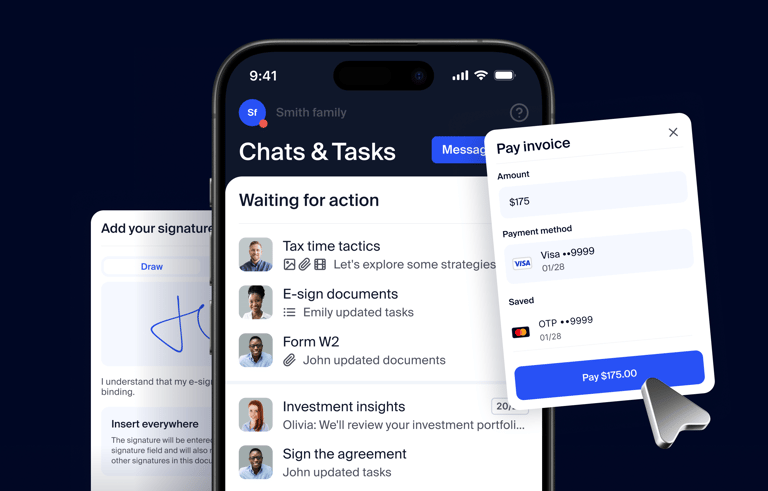
Run your entire firm on one platform
Key takeaways:
- AI is transforming the accounting industry by automating and enhancing key processes, including predictive analytics, data entry, audit, and fraud detection.
- AI is here to augment accountants, not replace them. Think of it as a technological cheat code that enables you to work faster, smarter, and more accurately.
- To maximize the AI impact on accounting, firms must choose tools that align with their needs, goals, and processes. Education is also crucial to AI adoption, focusing not only on the how, but also the why.
- In 2026, the focus has shifted from Generative AI (writing text) to Agentic AI (executing workflows and solving complex tax cases autonomously).
- AI Governance and data ethics are now top priorities for firms to maintain client trust in a machine-driven environment.
In a world defined by technological change, artificial intelligence (AI) is perhaps the most disruptive and revolutionary trend of all. In recent years, AI has grown from a futuristic promise to an everyday tool. Today, 90% of organizations use at least one AI technology in their day-to-day processes.
Naturally, there’s a lot of uncertainty and concern around the adoption of AI. This is particularly true in the accounting industry, where AI tools are already having a big impact. But rather than a threat, AI represents an opportunity to work smarter and faster than ever before.
In this article, we’ll explore the growing role of artificial intelligence in accounting, key technologies to understand, and how you can harness the power of this megatrend to drive productivity, growth, and job satisfaction.
Table of сontents
The role of AI in accounting
AI is transforming the accounting industry, enabling practices to automate, enhance, and streamline all manner of processes. Here are some key examples:
- Autonomous Workflow Routing: AI agents that identify missing documents, request them from clients, and notify the team only when the file is received and verified.
- Predictive Advisory: Using AI to forecast tax liabilities months in advance, allowing for proactive tax planning rather than reactive reporting.
- Real-time Anomaly Detection: Continuous auditing where the AI flags discrepancies the moment a transaction occurs, not weeks later during reconciliation.
But this is just scratching the surface of what AI can do. Tools such as ChatGPT can automate and streamline all sorts of tasks involved in running an accounting practice, from content marketing and strategy to data formatting and question-answering.
How major accounting firms are using AI
Deloitte remains at the forefront of AI adoption in accounting and audit. The firm has significantly evolved beyond its early AI tools and now leverages a suite of advanced generative AI capabilities within its Omnia global audit and assurance platform, as well as specialized solutions like NavigAite.
Deloitte’s AI-powered document review technologies combine generative AI, machine learning, and natural language processing to interpret complex documents, recognize patterns, extract key information, and identify anomalies. This enables audit and assurance teams to process large volumes of documents significantly faster and with higher accuracy, while allowing professionals to focus on higher-value judgment and advisory work.
PwC has evolved far beyond its initial GL.ai bot and is now developing a fully integrated AI-powered audit ecosystem. According to the firm’s 2025 announcements, by 2026 they expect to achieve end-to-end AI automation across the audit lifecycle — from risk assessment to financial statement tie-outs — allowing for faster anomaly detection and more proactive risk insights.
KPMG continues to be a leader in integrating AI into accounting, finance, and advisory services. The firm has developed a comprehensive suite of Intelligent Forecasting solutions that leverage predictive modeling, advanced analytics, machine learning, and generative AI.
These tools enable more accurate predictions of future financial trends by analyzing both internal and external data in real time. This allows accountants and business leaders to move from reactive reporting to proactive planning, dynamic budgeting, rolling forecasts, and scenario modeling.
As a result, organizations can respond faster to market changes, identify risks earlier, and make better-informed strategic decisions.
Will AI replace accountants?
The “replacement” debate is largely settled. AI hasn’t replaced accountants — it has replaced the repetitive clerical tasks that once defined much of the profession.
In 2026, the role of a bookkeeper is rapidly evolving into that of a Data Analyst, AI Orchestrator, and strategic advisor. Professionals who failed to adopt AI are increasingly falling behind, while AI-first firms are managing 50–70% more clients with the same headcount and significantly higher profitability.
The human element remains irreplaceable: high-level ethical judgment, complex problem-solving, litigation support, nuanced client relationships, and final professional responsibility still belong to people.
The ultimate takeaway: AI is not here to replace you — it is here to amplify your capabilities and elevate the value you deliver to clients.
How AI is revolutionizing accounting practices
The potential of AI is so big and broad that it can be difficult to understand how to use it in practice. In this section, we’ll look at some AI in accounting examples that are changing the way firms operate.
Fraud detection
AI can be used to spot unusual patterns, inconsistencies, or anomalies in financial data that may indicate fraudulent activity. Unlike humans, AI can analyze huge data sets in a matter of seconds.
Using AI, accounting firms can reduce the time and resources needed to spot fraudulent activity. Freed up from manual work, fraud specialists have more time to investigate the irregularities the AI flags.
Financial forecasting
AI’s ability to pour over large data sets in an instant can also be applied to financial forecasting. By analyzing historical data and current trends, AI-powered tools can provide accurate financial forecasts.
Using these forecasts, accountants can better understand future trends and risks. This ultimately helps businesses make more informed decisions about budgeting, investments, and long-term planning.
Audit assistance
The audit process is notoriously complex and arduous. AI can simplify large parts of it by pinpointing high-risk areas, automating repetitive tasks, and ensuring that no detail goes unnoticed.
Instead of spending hours manually performing routine checks, audit specialists can turn their attention to analyzing critical insights and providing strategic recommendations.
Regulatory compliance
Regulatory compliance is like a moving target, making it difficult for accountants to keep on top of the latest changes. AI can help here by monitoring updates to tax laws and financial regulations — and flagging areas that are potentially non-compliant.
As a result, accountants can ensure that compliance is baked into their processes and services at all times, without the need for ongoing and extensive manual effort.
Client relationship management
Accounting clients increasingly expect high-quality interactions and personalized services. Without the right technology, accounting firms simply don’t have the resources to meet these expectations effectively. But with AI, they can.
AI tools can automate client communications, ensuring that clients are always kept in the loop. They can learn clients’ preferences and goals, and then use that data to offer bespoke tax advice and more.
Benefits of using AI in accounting
AI is like a cheat code for productivity and performance, enabling accounting businesses to:
- Realize new levels of efficiency and accuracy that were impossible before
- Reallocate resources away from repetitive manual tasks and towards more high-value strategic work
- Take on more clients and scale their operations without needing to grow their team
All of this has a positive effect on a business’s bottom line, helping to drive revenue and improve profitability. It also has a positive impact on job satisfaction and motivation.
In addition to helping you grow your business, AI can transform the way your business operates. Its ability to analyze large amounts of data makes it a powerful tool for fraud prevention, risk management, and financial forecasting.
But that’s not all. AI enables you to transform the way you serve clients. You can deliver a personalized, hands-on client experience with timely communications, all without lifting a finger.
Popular AI accounting tools
Artificial intelligence is still a relatively nascent technology, but it’s already making a huge impact on the accounting world. In this section, we’ll look at three of the best AI-powered accounting software out there.
- QuickBooks. The market-leading accounting software comes with AI-driven cash-flow predictions and forecasting, automated expense and transaction categorization, and an AI-powered receipt scanner that automatically extracts information and links it to an existing expense or account.
- Xero. This popular accounting platform for small businesses offers ML-powered bank reconciliation predictions, a suite of AI-powered forecasting tools, and automated text classification, entity recognition, and form-filling.
- TaxDome AI. In 2026, TaxDome is more than practice management; it’s an AI-powered cockpit. Key features include:
– AI Assistant: Drafts personalized client responses based on previous interactions and current project status.
– Automated Organizer Summaries: Instantly summarizes complex client questionnaires for the accountant’s review.
– Smart Workflow Templates: AI analyzes your firm’s performance and suggests optimizations for your pipelines.
To explore some of the best AI-powered accounting software options in more detail, check out our article: 9 best AI software solutions for accounting in 2024.
How to start using AI in accounting
In this section, we’ll guide you through some steps and best practices you can follow to successfully implement AI in your practice.
1. Identify your needs and objectives
Start by evaluating your current accounting processes and workflows. Which areas are inefficient or ripe for change? Which could be improved using AI?
At this early stage, it’s also a good idea to define clear goals for the adoption of AI and how you will measure success. Do you want to increase efficiency, scale your business, improve the client experience, or boost profitability?
2. Choose the right AI tools and software
Now you know your specific needs and goals, you can start looking for AI accounting solutions that align with your requirements.
You’ll also need to consider how new tools will interact with your current accounting tech stack. Remember: the more tools you use, the more complex your workflows become, and the more you’ll spend on software. For this reason, you might want to look at practice management platforms that provide all the tools you need to run your business, with AI capabilities included, such as TaxDome.
Generally speaking, we recommend focusing on software that:
- Simplifies your overall tech stack and processes
- Is intuitive and easy to use
- Focuses on automation, customization, and scalability
- Integrates seamlessly with other key systems
- Includes comprehensive support, implementation, and education
- Has excellent user ratings on sites such as G2 and Capterra
3. Develop an implementation plan
Once you’ve chosen the AI tools and software you want to implement, it’s time to create a detailed implementation plan. This should include the timeline, steps, and resources needed to integrate new AI tools into your existing systems.
Some software providers walk you through the implementation process. TaxDome, for example, provides hands-on assistance with data migration, setting up the platform and integrations, and customizing its core features to suit your needs.
Education and training is another important factor to consider. For more comprehensive platforms, it makes sense to choose a software provider that offers educational content. With TaxDome, you get access to a suite of educational resources designed to get you up to speed fast, including:
- TaxDome Academy online courses
- Regular webinars covering core features and major releases
- Hands-on bootcamp events
- An extensive library of Help articles
4. Monitor performance and gather feedback
Now you are up and running with your new AI tools, it’s important to monitor performance and measure success against your pre-defined success criteria. Is the new software making your firm more efficient, profitable, or scalable? If not, what challenges are holding you back from achieving your goals?
It’s also worth asking those using new tools for their feedback. Have the new tools made their lives easier? Do they need additional support and training to realize the full potential of your AI-powered software? Do they understand the benefits of using new technologies — for themselves as well as the firm and its clients?
FAQs
We’ve covered a lot of ground in this article so far. But just in case we’ve missed some key information, here are some frequently asked questions about AI in finance and accounting.
How is AI transforming the accounting profession?
By automating routine tasks, providing powerful data insights and forecasts, and improving the client experience, AI is transforming the way accounting practices operate. Instead of being replaced by AI, accountants are now augmented by it, enabling them to work smarter, faster, and more accurately than ever before.
What are the key AI technologies used in accounting?
Key AI technologies used in accounting include machine learning (ML), natural language processing (NLP), and predictive analytics. While these technologies are already yielding impressive results, they are still relatively new and will continue to improve over time.
What are the latest AI trends in accounting for 2026?
- Hyper-personalization: AI-driven portals that provide clients with instant, real-time insights into their financial health.
- Agentic Workflows: Moving from “bots that alert” to “agents that act.”
Natural Language Querying: Accountants chatting with their firm’s data (e.g., “Show me all clients who haven’t paid their 2025 corporate tax yet”).
What are the challenges associated with AI in accounting?
The main challenges associated with AI adoption include security risks, ethical and regulatory concerns, a lack of skills or expertise in leveraging AI tools, and issues around data quality and integration.
To sum up
AI represents one of the biggest technological shifts of all time, with the potential to transform virtually every industry. In accounting, AI is already being adopted at a rapid pace, enabling accountants to increase efficiency, quality, and accuracy across the board.
Adopting AI doesn’t guarantee success, however. Maximizing the value of AI-powered tools requires the right preparation, planning, and skills. Accounting firms that can navigate this new technological landscape effectively will enjoy huge benefits.
To see how TaxDome can transform the way your accounting practice operates with workflow automation, AI-powered reporting, a slick client experience, and much more, request a demo today.

Nicholas produces TaxDome content focused on how technology improves accounting workflows and everyday firm operations.
Get your free guide

Thank you!
The guide copy has been sent to your email. Please check your inbox!
Recommended articles

What is accounting workflow management? The complete guide with real-world examples
ChatGPT for accountants: 12 strategies to automate your workflows

12 best free online accounting courses with certifications for 2026