 US – English
 UK – English
 Canada – English
 Australia – English
 Danmark – Dansk
 DACH - Deutsch
 France – Français
 España – Español
 Sverige – Svenska
 Italia – Italiano
 Nederland – Nederlands
 Portugal – Português
 Suomi – Suomi
 Norge – Norsk
 日本 – 日本語
 Romanian – Română

The Q3 2026 Accounting Industry Index: midpoint findings and benchmarks from 15,000+ firms

Run your entire firm on one platform

Table of сontents
- How firms took on clients, priced work, and got paid in the first half of 2026
- How the Accounting Industry Index measures firm performance
- Client growth benchmarks: 70% of firms grew their client base
- New-client pricing: clients added after the deadline paid higher prices, 19% more
- Payment at signing: larger firms ask for more up front
- Technology fee benchmarks: 81% of firms kept it
- Document collection benchmarks: 83% of clients who start a checklist finish it
- What to set up before next tax season
- Accounting firm benchmarks 2026: frequently asked questions
- Benchmark your firm against the full report
How firms took on clients, priced work, and got paid in the first half of 2026
Key takeaways:
- 70% of accounting firms grew their client base in the first half of 2026, and the top quarter of firms grew 25% or more, according to TaxDome’s Accounting Industry Index.
- Clients added between May and December 2025, after the April deadline, paid higher prices: 19% more in the first half of 2026 than firms’ existing clients.
- Larger firms ask for more at signing: the average share of a firm’s deposits set to the full price rises from 33% at Solo firms to 60% at firms with 25+ employees.
- 81% of firms applying the technology fee in April 2026 were still applying it in June.
- 83% of clients who start a document checklist finish it.
For a long time, the first half of the year meant one thing for accounting firms: get through tax season. In 2026, 7 in 10 firms also came out of it with a larger client base.
That finding comes from The Accounting Industry Index: Q3 2026 edition, published by TaxDome. It gives firm owners accounting firm benchmarks built on anonymized operational data from 15,000+ tax, bookkeeping, and full-service accounting firms.
The detail is in how firms took on clients, priced new work, and got paid. Here are five benchmarks from the report, and what firms can set up now to act on them before next tax season.
How the Accounting Industry Index measures firm performance
The Accounting Industry Index is TaxDome’s quarterly benchmark report. Each edition is built on what firms and their clients do inside TaxDome, with no surveys.
The Q3 2026 edition compares the first half of 2026 (January 1 to June 30) with the same period in 2025, for the same firms. Results are broken out across five firm-size cohorts, from Solo practitioners to firms with 25+ employees.
That lets a firm compare itself with peers at the same stage. It’s the third edition this year, after the Q1 2026 edition on firm growth and the Q2 2026 edition on tax season.
Client growth benchmarks: 70% of firms grew their client base
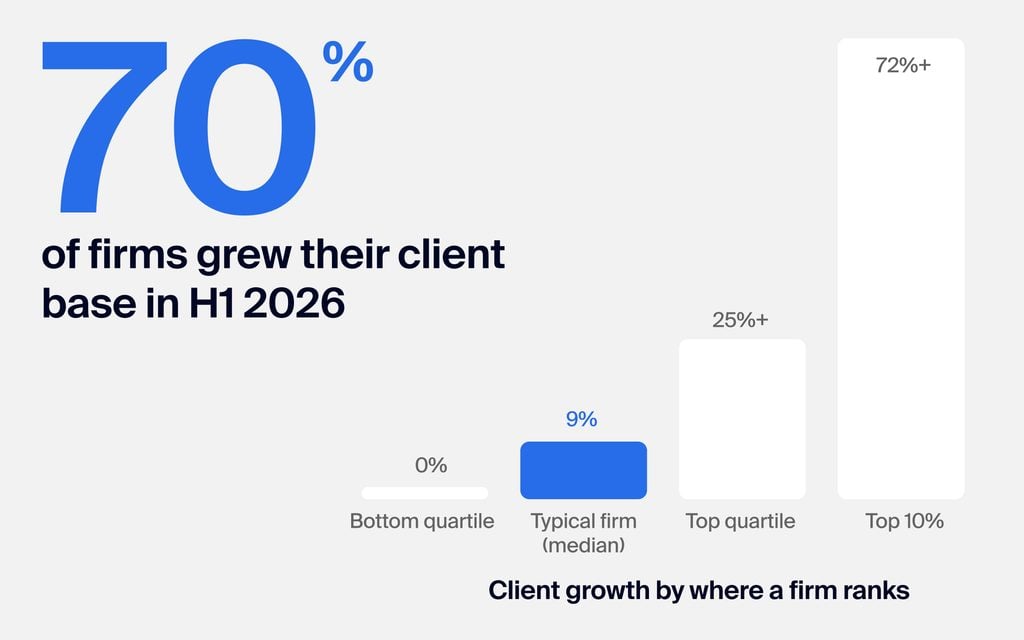
70% of firms ended the first half of 2026 with a larger client base than a year earlier. The typical firm grew its client base 9%, and client bases across all firms combined grew 13%.
The pace varied widely. The top quarter of firms grew their client base 25% or more, and the top 10% grew 72% or more. About 30% of firms held flat or shrank. Among the firms that grew, the leaders added clients at 5x the pace of the slowest growers.
That spread is what makes the benchmark useful. A firm owner can place their own year on it and see how far ahead the leading firms are.
The full report breaks the spread down for each firm size, including the cohort whose top quarter grew fastest.
New-client pricing: clients added after the deadline paid higher prices, 19% more
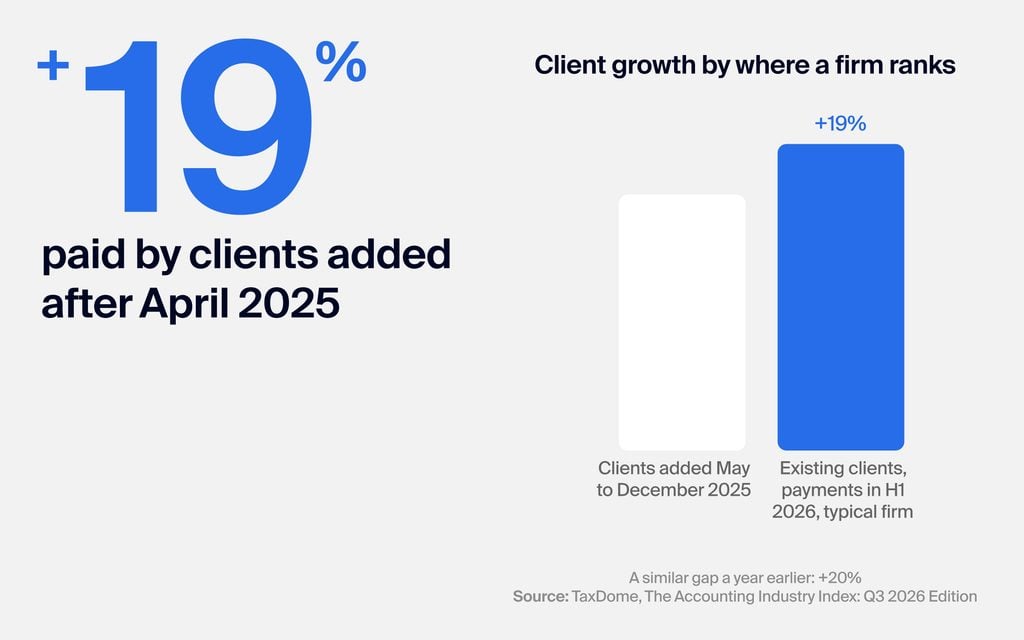
At the typical firm, clients added between May and December 2025 paid 19% more in the first half of 2026 than the firm’s existing clients. About 7 in 10 firms saw the same pattern.
A similar gap appeared a year earlier (20%), which makes it a steady part of how firms grow. Part of it may come from scope, since new clients often bring extra first-year work like catch-up returns or cleanup.
The gap differs by client type. At the typical firm, new individual clients paid 17% more than existing individual clients, while new business clients paid 3% more than existing business clients.
That makes the months after the deadline a strong window for new work, and a reason to have packages and pricing ready before it opens.
See how new-client pricing changes by firm size and by client type in the full report.
Payment at signing: larger firms ask for more up front
Firms gained the option to require a deposit on TaxDome proposals in January 2026. The client pays as they sign, so the engagement starts with the money already in.
In the first half of 2026, 30% of required deposits were set to the full price, so the whole fee was collected the moment the client signed. Nearly half of the firms that require deposits, 47%, set one or more deposits to the full price.
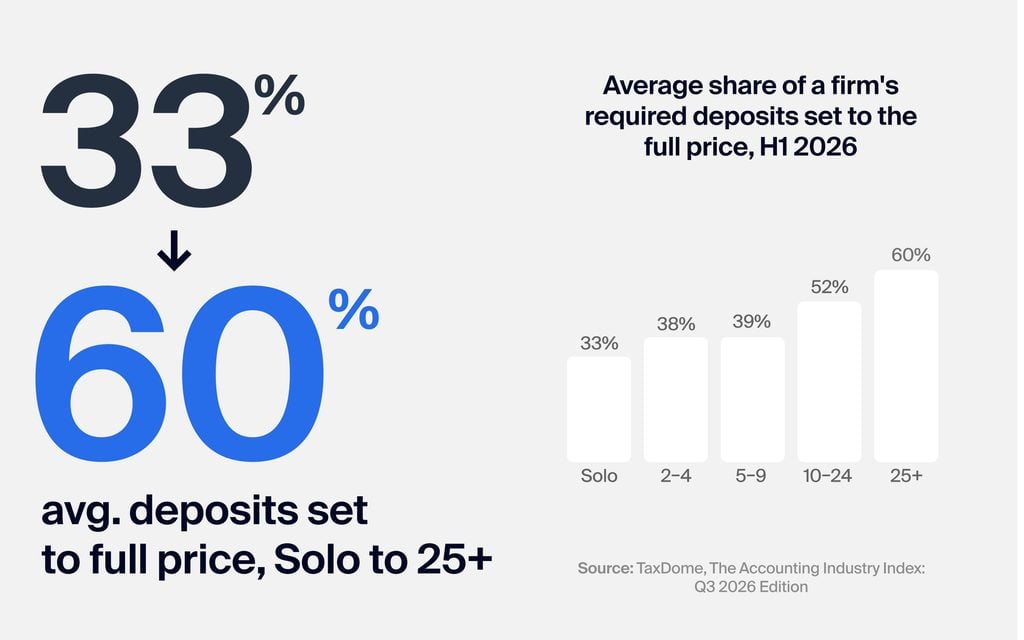
Larger firms go further. The average Solo firm sets 33% of its deposits to the full price, compared with 38% at firms with 2–4 employees, 39% at 5–9, 52% at 10–24 and 60% at 25+.
Firms are asking for a large share up front. The typical deposit is 50% of the proposal’s value.
Yehuda Tenenbaum, EA, founder of Y10 Tax Solutions, builds payment into his proposals. Here’s what he noticed once he did.
The full report shows which firm size sets deposits to the full price most often, and how firms structure their deposits.
Technology fee benchmarks: 81% of firms kept it
Every card payment a firm accepts comes with a processing cost. The technology fee, available on TaxDome since March 2026, means the firm stops absorbing that cost, and clients see a small convenience fee at checkout.
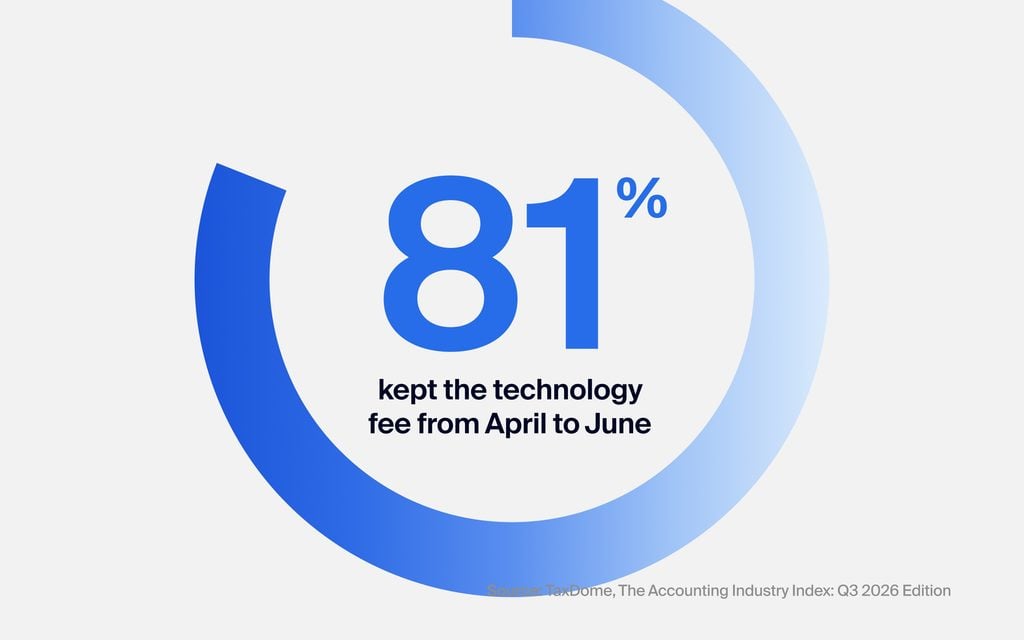
Firms that start using it keep it. 81% of firms applying the fee in April were still applying it in June, after the busiest stretch of the year.
It’s also covering more of what firms collect. From March to June, the share of card payment dollars carrying the fee grew 2.1x.
Most firms applying the fee don’t apply it to every client. The typical firm charges about two clients in three (64%) and keeps it once it’s in place.
The full report breaks adoption down by firm size, and shows how much more likely newer firms on TaxDome are to apply the fee.
Document collection benchmarks: 83% of clients who start a checklist finish it
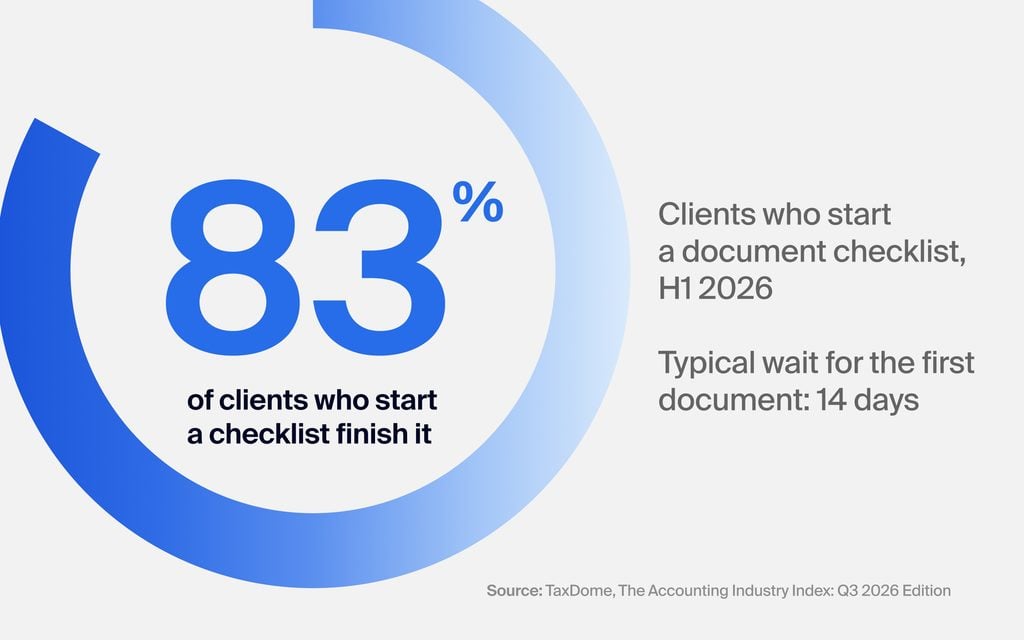
Clients take a while to start a document checklist. The typical checklist asks for 7 documents, and the typical client sends the first one two weeks after it goes out.
Once they start, most finish. 83% of clients who start a checklist finish it, and for the typical checklist, the first and last documents are uploaded on the same day.
For the firm, one request brings a job’s documents in together, without rounds of follow-up. The client gets one list with everything the firm needs.
Checklists also show firms what to change next season. Clients marked 16% of requested items as already provided and 7% as not applicable, which points to the requests worth dropping or rewording.
See how checklist use rises with firm size in the full report.
What to set up before next tax season
Each finding points to the same moment. Engagement letters, packages, deposits, and the technology fee for next season are set in Q4.
Firms that set them now start the season with clients who pay at signing and send documents through one checklist. Each one starts with a single change.
| Area | What the Q3 Index found | Where to start |
| Deposits on proposals | The average share of a firm’s deposits set to the full price rises from 33% at Solo firms to 60% at firms with 25+ employees | Require a deposit, or the full fee, on the package your clients choose most |
| Technology fee | 81% of firms applying it in April still applied it in June | Turn it on for the clients you choose, then extend it from there |
| Document checklists | 83% of clients who start a checklist finish it | Move your next client intake onto one checklist |
| TaxDome Kiosk | Firms using Kiosk each month grew 5.6x, January to June | Start with signatures and invoice payments, the two most common Kiosk actions |
Kiosk brings walk-in clients into the same place as everyone else. A client at the front desk can sign and pay in the same system as the rest of the firm’s work. And clients that have never logged into their client app are doing so after using Kiosk. In fact, between November 2025 and August 2026, among those that logged into the client app for the first time after using Kiosk, 81% did so within a month.
Here’s what the first half of 2026 showed TaxDome’s Chief Revenue Officer, Petar Iliev.
Accounting firm benchmarks 2026: frequently asked questions
What are the key accounting firm benchmarks for 2026?
According to TaxDome’s The Accounting Industry Index: Q3 2026 Edition, 70% of firms grew their client base in the first half of 2026, and the typical firm grew 9%. Clients added after the April 2025 deadline paid 19% more than existing clients, and 30% of required deposits were set to the full price.
How fast are accounting firms growing in 2026?
70% of accounting firms grew their client base in the first half of 2026 compared with the same period in 2025. The typical firm grew 9%, the top quarter grew 25% or more, and about 30% of firms held flat or shrank.
Do new clients pay accounting firms higher prices than existing clients?
Yes. At the typical firm, clients added after the April 2025 deadline paid 19% more in the first half of 2026 than existing clients, a similar gap to a year earlier (20%).
Are accounting firms collecting fees up front?
Some are. In the first half of 2026, 30% of required deposits were set to the full price, and 47% of firms that require deposits set one or more deposits to the full price. The typical deposit is 50% of the proposal’s value.
What is a technology fee for accounting firms?
A technology fee covers the processing cost of a credit card payment, so the firm stops absorbing it and the client sees a small convenience fee at checkout. 81% of TaxDome firms applying the fee in April 2026 were still applying it in June.
What is the Accounting Industry Index?
The Accounting Industry Index is a quarterly benchmark report from TaxDome built on anonymized operational data from 15,000+ accounting firms. The Q3 2026 edition covers the first half of 2026 (January 1 to June 30), compared with the same period in 2025.
Benchmark your firm against the full report
The full report breaks down client growth, new-client pricing, deposits, the technology fee, checklists, and TaxDome Kiosk for each firm size, from Solo practitioners to firms with 25+ employees.

Josef creates clear, actionable content at TaxDome, highlighting features, updates, and key accounting topics. His focus is on making complex ideas accessible and engaging, helping users understand and apply insights effectively.
Get your free guide

Thank you!
The guide copy has been sent to your email. Please check your inbox!
Recommended articles

Accounting Industry Index statistics: Tax season findings from the Q2 2026 edition

Best Karbon alternatives for accounting firms (2026 pricing)

Client Satisfaction Report statistics: what taxpayers expect from their accountants