 US – English
 UK – English
 Canada – English
 Australia – English
 Danmark – Dansk
 DACH - Deutsch
 France – Français
 España – Español
 Sverige – Svenska
 Italia – Italiano
 Nederland – Nederlands
 Portugal – Português
 Suomi – Suomi
 Norge – Norsk
 日本 – 日本語
 Romanian – Română

The Director of TaxDome Payments has 1,600+ clients of his own: why TaxDome put a firm owner in charge of payments
Run your entire firm on one platform
Table of сontents
Patrick Payne knows exactly what it’s like to wait on an invoice, and now he helps decide how firms get paid
Somewhere around 2013, in a coffee shop in the Greater Toronto Area, a young accountant is unzipping a carry-on suitcase. Inside it is a printer. He’s brought it across the city because his client needs to sign a return, and in 2013 a signature means paper, and paper means somebody has to own a printer and be willing to lug it around.
That accountant is Patrick Payne. He’s a few years into a firm he started with five hundred dollars, a used laptop, and a WordPress theme. He doesn’t have an office. He can’t afford one yet. He starts work eight in the morning. He finishes ten at night.
What he doesn’t know yet is that the suitcase will be a story he tells one day, or that he’ll spend the next decade building his firm to more than 1,600 clients across Canada, or that a software company serving more than 40,000 of his peers will offer him a job.
He’s just trying to get the return signed.
Fast forward thirteen years, he’s Director of TaxDome Payments, leading the payment experience of the software his own firm runs on.
On any given day that means he’s configuring another firm’s setup in the morning, then managing his own in the afternoon. A combination unusual enough in this industry that it’s worth telling the story of how it happened.
The early years to breaking point
Patrick has never worked in another firm. He put himself through university stocking shelves at a grocery store while doing tax returns on the side. He then took eighteen months away before coming back to go all in on his firm full-time.
Ask him why he’s never worked for another firm and his answer is about as prosaic as it gets:
That was it. No mentor, epiphany, or bad experience. “I didn’t have a grand plan,” he says. “I just knew I wanted to do things my own way.”
The deal itself looked decent at the time: two tough months in March and April, then ten months to breathe and take on smaller work at his own pace.
Those two months became three, three became six.
Now, Patrick’s firm is busy almost all year. And while that might make some firm owners flinch, he’s reached the point he can run his firm from a distance.
But getting there took years of rebuilding, tax season after tax season.

Patrick’s firm is Your Modern Accountant, founded in 2010 and based in Ontario and British Columbia, Canada. The firm has a staff of 12 and serves more than 1,600 clients, including over 1,350 individuals and more than 250 corporations. Its services cover tax filing, business consulting, payroll, and bookkeeping. The firm started using TaxDome in 2022.
A new setup every tax season
Patrick’s early years were spent either behind a steering wheel or in front of clients.
Just as much as his scenery changed, he changed how he did everything, each tax season. “Every year in the early stages felt like a restart,” he admits.
He switched tax preparation software three or four times before one finally clicked. He moved from the suitcase printer to getting signatures on an iPad, early enough that Canadian clients found it novel. He hired a seasonal accountant, then a couple more, then a full-time person every few years as the work demanded it.
But despite everything he changed, there was one line he was adamant to hold.
The cost of keeping prices low
Patrick wanted his work to stay accessible to the people who needed it. Even as he grew, he kept his prices where they were. That decision had a cost he didn’t see coming.
Many firm owners will relate. It’s a tax on caring for your clients, and almost everybody who’s built a firm from scratch has paid some version of it.
Those prices weren’t the only thing that survived his printer-in-the-coffee-shop days. Another thing, at least until he reached breaking point, was how he ran his firm: out of his own head.
When firm knowledge walked out the door
Without much capital, Patrick’s team ran for years on a mishmash of tools held together by him knowing where everything was.
Eventually, it stopped working, and he remembers exactly when: a seasonal team member quit right in the middle of tax season.
Patrick sat down to piece together what she’d been working on, but came up empty. As if the stress of busy season wasn’t enough. Turns out he’d only been carrying some of the firm in his head.
Then COVID hit. His firm had been fully online since 2018, ahead of most of the profession. But a year where virtually everything took place through screens, without a system, was the final straw.
Running the firm from memory wasn’t going to cut it anymore.
Why TaxDome, and why then
Patrick can’t remember whether it was a TaxDome webinar, demo, or something else he signed up for. What he does remember is the call that came out of it, because the person on the other end of the line went on to be his customer success account manager for several years, someone he calls instrumental in helping him build out and grow his firm.
That would-be intro call, however, came at the height of his tax season. “I had to push the conversation off to May or June just to survive.”
Patrick had looked at practice management systems before and passed. The pricing didn’t work for him. The client experience was worse.
What made him take TaxDome seriously is one sentence that explains how he thinks about his own firm and, later, the product he’d end up leading:
The stress test
By the time Patrick picked the conversation back up that summer, he’d taken on everything the seasonal team member had been working on. And it was showing. “My hair was literally falling out from the stress,” he admits.
It was no surprise. Eleven, twelve, thirteen hour days, with a workload that was never meant to be his and no clear view of what was happening across his own firm. He knew exactly where that road was heading.
So he did what someone who’d already switched tax software three or four times would do before betting his firm on a new one:
The objective? To be sure it wouldn’t buckle in April with his whole client base riding on it.
He needed structure, visibility, and no more team members walking out mid-season.
When he couldn’t find a deal-breaker, he moved his team onto TaxDome in the back half of 2022. By the next season, every client was on it too.
Payments, the final piece
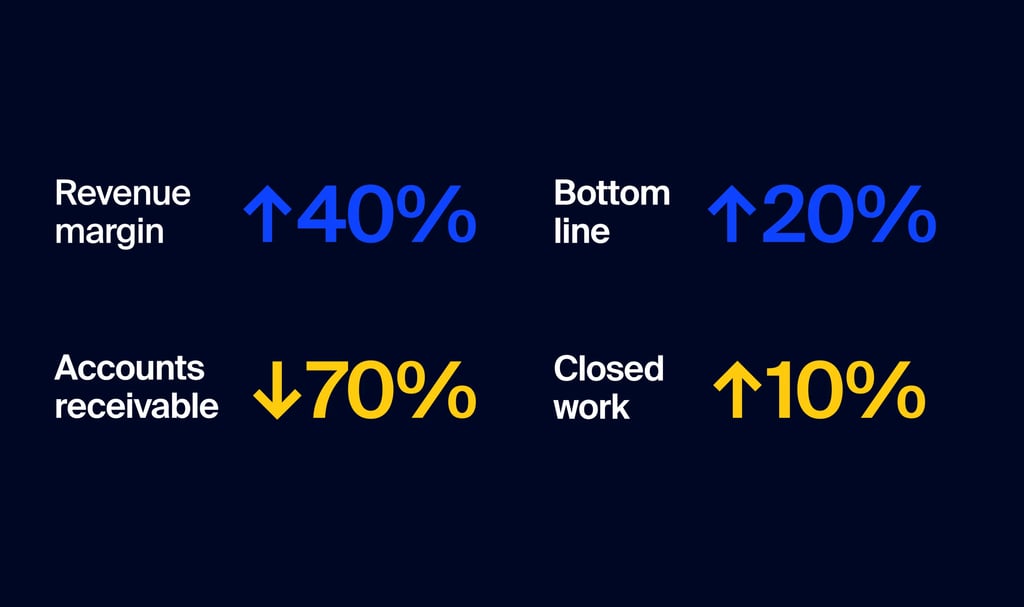
By 2024, two years into TaxDome, Patrick had results on record: AR down 70%, margins up 40%, bottom line up 20%. But what the numbers don’t show is that they came a year apart, and why they did is the interesting part.
The first year on TaxDome gave him work management. Visibility, task tracking, a clear view of who was doing what. Margins climbed.
But his firm was still invoicing and taking payment outside the system, through QuickBooks Online, because that’s what they were familiar with.
Patrick’s accounts receivable didn’t change. Not until the off-season after that first year, when he connected Stripe and brought billing and invoicing inside TaxDome. That’s when it dropped.
What is TaxDome Payments?
TaxDome Payments is TaxDome’s own payment processing. Firms set it up inside TaxDome, and clients pay in the same 4.9-star app (40,000+ reviews) where they already sign, upload their documents, message their accountant directly, and more. With TaxDome Payments, firms can also add an optional 3% technology fee to credit card payments to offset processing costs.
Patrick, until now, has never used TaxDome Payments. It didn’t exist when his firm signed up, and it isn’t available in Canada yet. Those results came from Stripe connected inside TaxDome.
The customer who joined the company
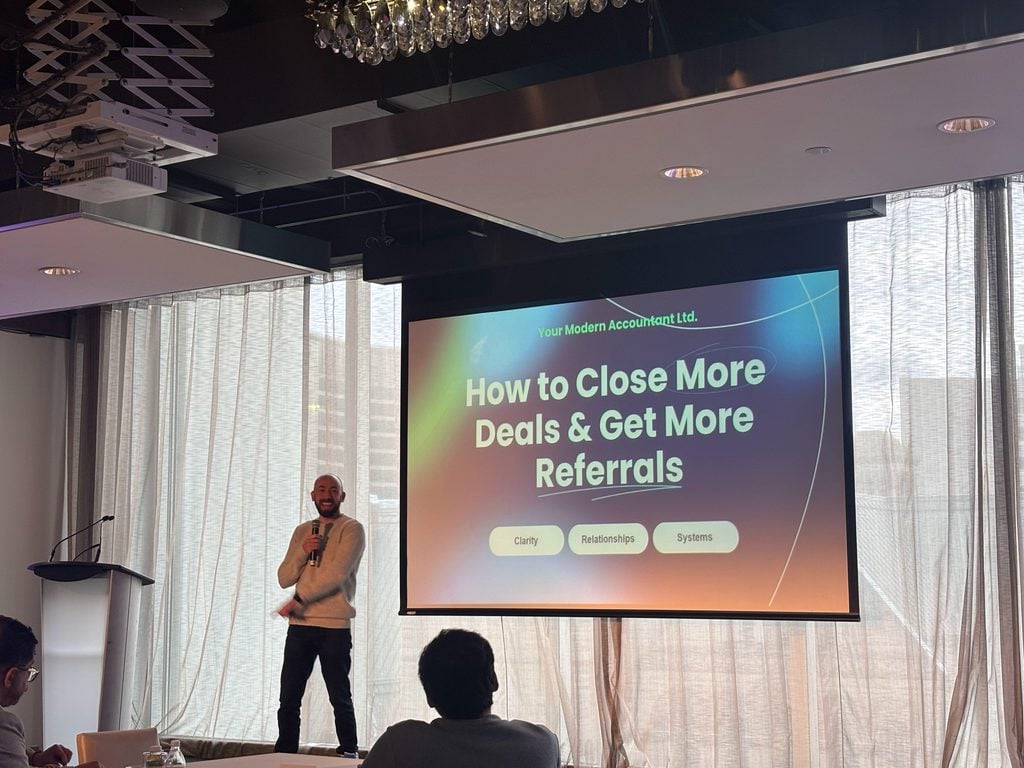
Patrick spent years on the customer side of TaxDome before he led TaxDome Payments. The catalyst came at the tail end of 2025 when the TaxDome Roadshow visited Toronto and Patrick was invited to speak. By the end of the three-day event, Petar Iliev, TaxDome’s CRO, was considering a more permanent role for him.
Patrick joined at the end of March 2026, the middle of Canadian tax season. Which is to say the single worst month of the year for a Canadian accounting firm owner to start a new job. He was navigating his firm’s busiest period while learning TaxDome’s back end at the same time.
You might wonder what a firm owner brings to a payments product. His answer comes down to three words: “I speak accountant.”
It’s also a big reason he said yes. The job meant he could give other firms the payment experience he’d wished for in his own. And years of running his own firm’s billing through TaxDome had already convinced him of one thing:
It didn’t take long for that firm-owner perspective to prove valuable.
What he heard in those early conversations
In his first weeks, he took a closer look at TaxDome Payments. “Once I actually looked under the hood, I realized the execution wasn’t nearly where it needed to be for launch.”
The move away from CPACharge was six weeks out. It meant clients would be able to pay without having to leave the TaxDome app. But firms still had plenty of questions and feedback, and Patrick made a point of taking many of their calls himself.
“They told me everything, and a lot of it was hard to hear, but necessary… I took that feedback and made it a personal commitment.”
There was one call, in particular, that stayed with him:
“A firm owner whose entire workflow — invoice, lock the documents, admin process the payment — broke when CPACharge sunset… That’s a real, justified frustration. Her whole process stopped working overnight.
“We worked through it together, explaining exactly what changed and why, finding workarounds to bridge her until the features she needed were live, and being honest about the gap instead of glossing over it.”
Later, one member of the customer care team who sat in on one of his early sessions wrote afterwards that watching Patrick was like a masterclass.
But the calls were only half of it.
Patrick’s instinct when something needs fixing is to step in and handle it, and his teammates have seen that side of him too. At a recent team offsite, when a just-finished ice sculpture spelling out TaxDome tipped over, he didn’t miss a beat.
Turning feedback into releases
A week in Patrick’s calendar looks like two jobs stapled together.
“On any given week I might be on a TDP setup call with a firm, walking through their QuickBooks Online clearing account configuration so their reconciliation actually ties out, and then turn around and sit in on our internal pipeline review with leadership.”
The through-line is that the first conversation is what he brings to the second.
One firm owner asked for a way to see Stripe’s processing fees alongside TaxDome’s billing reports, because his team was matching the two by hand every month. Patrick committed to a CSV export with the full breakdown: gross, processing fees, net, account names, invoice numbers.
Patrick gave a date, end of May. It was in beta within weeks, and by early June every firm had it.
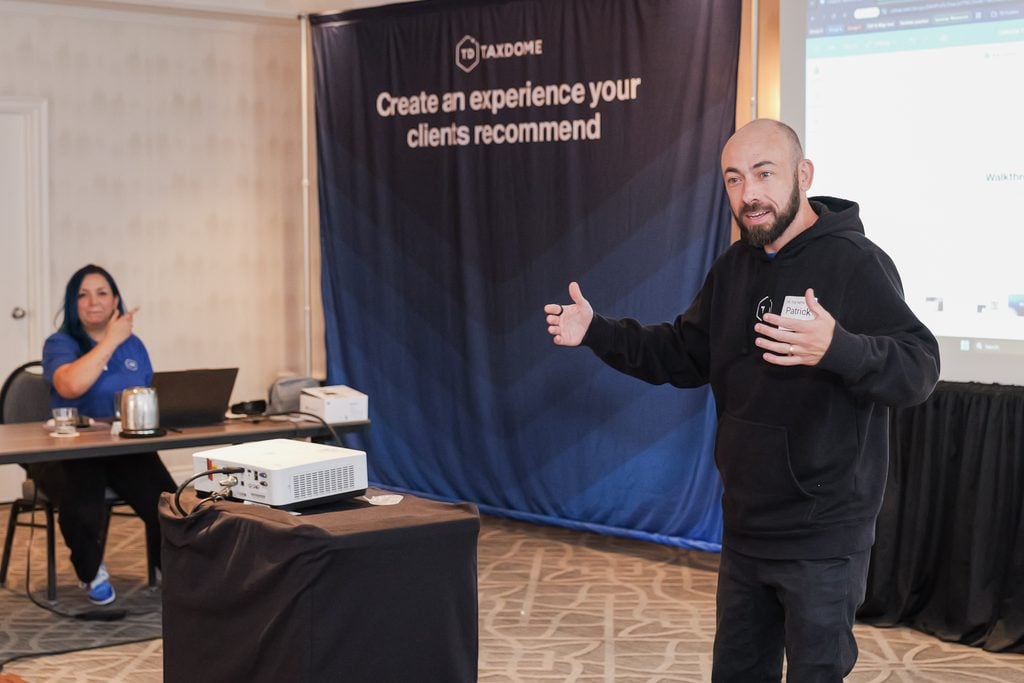
Office Hours, the live sessions he hosts in the TaxDome Community, started around the same time. Firm owners turn up with whatever’s on their mind about payments, and Patrick answers them live, even if that means walking through their setup one by one.
It’s run every week since June, and he has no plans to stop. “We’ll keep running them until people stop showing up and needing the extra help.”
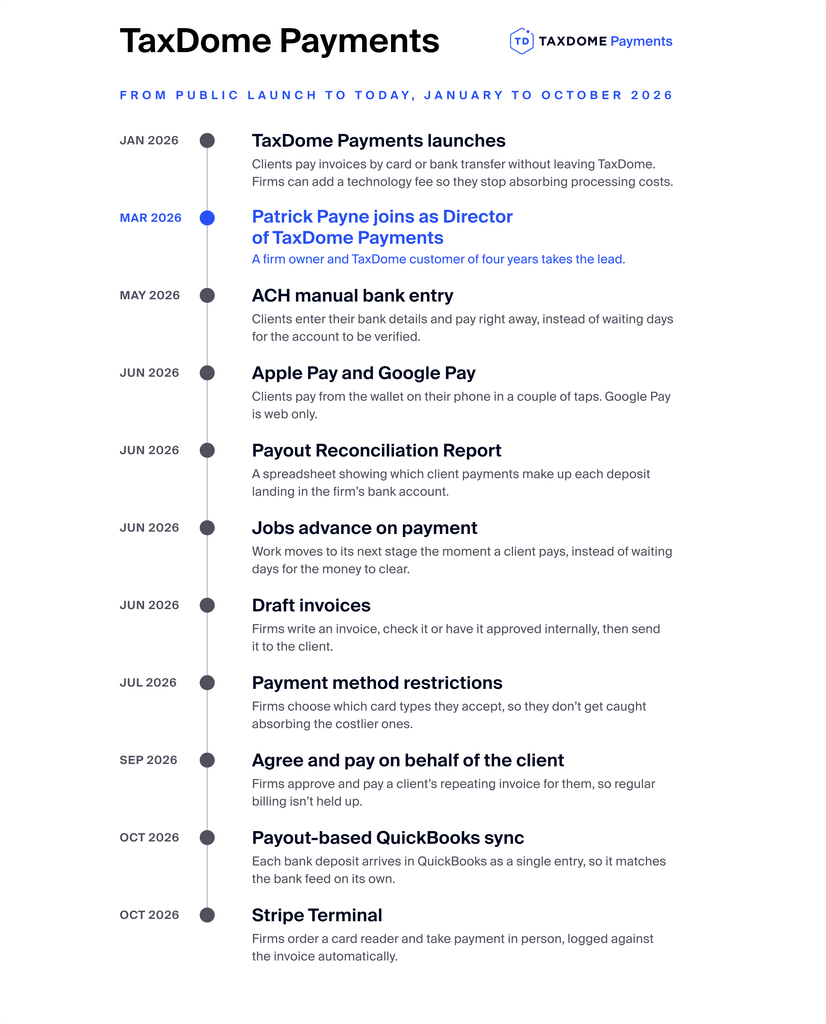
Between sessions, he’s in the Community threads too, answering questions and sharing what’s coming next.
What’s shipped since May
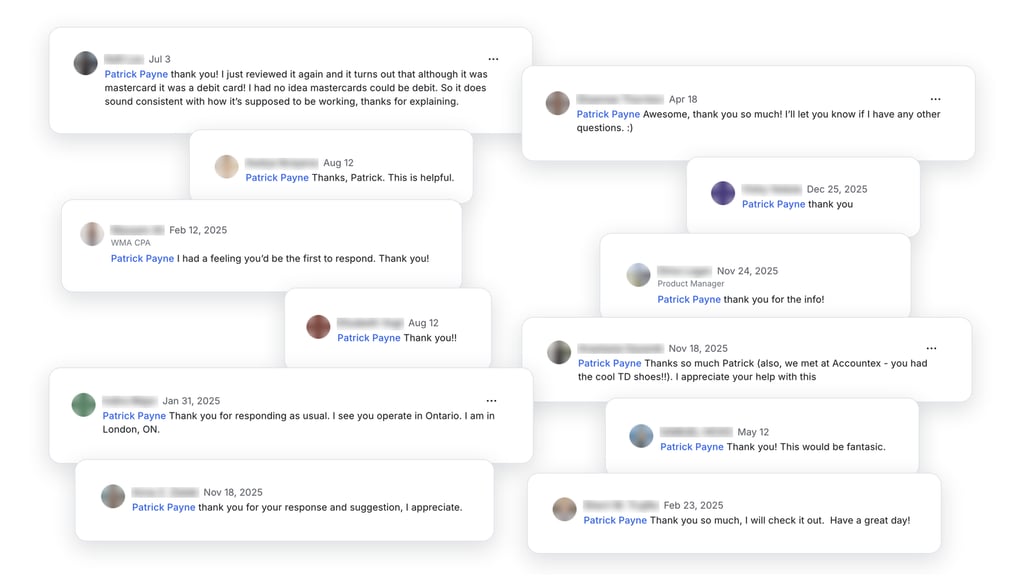
Clients can now pay with Apple Pay and Google Pay when they pay online.
In October, buy now, pay later through Affirm and Klarna opened up to every firm on TaxDome Payments. Clients can spread the cost, and the firm still gets paid in full upfront. For clients who come into the office, US firms now have an in-person card terminal too. It sits alongside TaxDome Kiosk, launched in June, a guided tablet experience that brings in-office clients into the same system as everyone else.
Every release there is for clients, and it’s intentional.
“We’re investing in the client experience just as much as the firm experience,” Patrick says, “because getting paid faster only works if paying is actually easy on the other end too.”
For firms, work can now move forward the moment a client submits payment, without waiting days for ACH to clear.
What Patrick’s proudest of isn’t on the feature list, though. “More than any single feature, I’m proud of the product and development team for shipping so quickly, and the whole company for getting fully behind TaxDome Payments.”
Push him for a favorite and he picks a small one: letting firms choose exactly which payment types they accept. “For small firms especially, that control directly impacts their bottom line, since every percentage point matters more at that scale.”
It’s the kind of change he means when he says:
“Every improvement we ship feels like progress toward the experience I always wanted as a firm owner myself.”
Firms are also taking control of processing costs with the technology fee. TaxDome’s Accounting Industry Index Q3 2026 report shows 81% of firms applying it in April were still applying it in June, and the typical firm applies it to about two clients in three rather than all of them.
His message to firms still deciding is short:
What TaxDome Payments does today
- No monthly fees: 2.9% + $0.30 for cards (plus 1% for Amex and international cards), and 1% for ACH, capped at $10
- Offset card processing costs with an optional 3% technology fee
- Accept credit cards, debit cards, ACH, Apple Pay and Google Pay, with instant bank verification across 10,000+ banks and credit unions
- Lock documents to invoices, so clients get their files once they’ve paid
- Sync payments and fees to QuickBooks Online automatically
- Save client payment methods for future and recurring invoices
- Offer buy now, pay later through Affirm and Klarna
- Take in-person card payments right from TaxDome with a terminal reader
Still on the other side of the invoice
Lower accounts receivable bought Patrick time. It also bought him something harder to put a number on.
Growing the firm is exactly what he’s done. In early 2025, two years into TaxDome, Patrick predicted the next two to five years would be “exponential” for his firm. Since then, it’s taken on around 300 more clients.
For all that, his own firm is still waiting on the product he leads. TaxDome Payments hasn’t reached Canada yet, but Patrick doesn’t mind the wait. When it does arrive, his firm, and every other Canadian firm, will start with all the features US firms asked for, from day one. Whatever comes after that, he’ll make sure firms have a say in it.
His advice to firm owners on the fence about TaxDome comes from his own switch, four years ago.
“Look for good and iterate continuously. For me, it was daily, then it was weekly and monthly, and now it’s quarterly.”
And then he gets to the point:
He’s talking about practice management software, but he’s also talking about the last thirteen years, and a version of himself somewhere in a Toronto coffee shop with a printer in a suitcase, who didn’t have the option of waiting.
“We’ve grown more in the four years since adopting TaxDome than in the entire decade before it.”

Josef creates clear, actionable content at TaxDome, highlighting features, updates, and key accounting topics. His focus is on making complex ideas accessible and engaging, helping users understand and apply insights effectively.
Get your free guide

Thank you!
The guide copy has been sent to your email. Please check your inbox!
Recommended articles

“That’s cute, I’ll just text you”: how one firm won over its most skeptical client

Foundation Group—50+ staff, 3000+ clients, and one of Inc. 5000’s fastest-growing US companies: “TaxDome has been a huge success for us”

Sydney H. Highley CPA Experience: How to Meet Tax Season Challenges with TaxDome